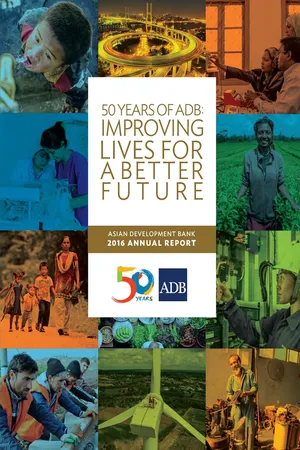
The 2016 Annual Report of the Asian Development Bank (ADB) reviews the significant economic transformation in Asia and the Pacific over the past 50 years, and the role played by ADB to support the region's development to improve people's lives. The report notes that while the region's economic growth and success in reducing poverty have exceeded the most optimistic forecasts, there remain significant challenges to be addressed. The annual report provides a complete picture of ADB's performance in the reporting year through the use of infographics, stunning images, and compelling stories of development from across Asia and the Pacific. The report includes ADB's complete financial statements, and operational data in PDF and Excel formats.
eBook - ePub
About this book
Information
IMPROVING LIVES FOR A BETTER FUTURE

Over the past 50 years, the Asian Development Bank (ADB) has worked to transform Asia and the Pacific from a region that was once engulfed by debilitating poverty and hunger. Today, the countries of the region account for one-third of global gross domestic product and contribute more than half of the world’s economic growth. The emergence of Asia and the Pacific as an economic force has raised living standards in dramatic fashion for many countries.
ADB has been privileged to serve its developing member countries (DMCs). In partnership with its members, ADB has mobilized $267 billion in loans and grants to build infrastructure (for transport, energy, ICT and water and other urban infrastructure and services), support agricultural development, particularly in the early years of ADB operations, provide education, improve health outcomes, stimulate business, combat climate change, attract investment, and strengthen regional cooperation and economic integration in Asia and the Pacific.
The region is, however, still confronted by significant challenges and, even as the organization marks half a century of providing assistance, ADB has a lot of work to do.
Among myriad development issues, the region faces the difficulties brought by rapid urbanization, the threat of climate change, and growing demand for water and energy. Poverty and inequality remain widespread. There are still 330 million people, or around 9% of the population of Asia and the Pacific, surviving on less than $1.90 a day, the threshold of extreme poverty. Another 1.2 billion people live on less than $3.10 a day, a poverty line more typical of low- and middle-income countries. In addition, the commitments made under the Sustainable Development Goals (SDGs) and the global climate agreement, adopted in 2015, set an ambitious international development agenda.

50 YEARS OF THE ASIAN DEVELOPMENT BANK
1966
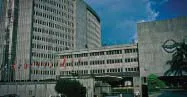
The Asian Development Bank (ADB) opens for business on 19 December 1966. Headquartered in the Philippine capital of Manila, ADB begins operations with 31 members, $1 billion in capital, and 40 staff.
ADB OPERATIONS, 2016
Ordinary Capital Resources and Asian Development Fund Approvals ($17.47 billion)
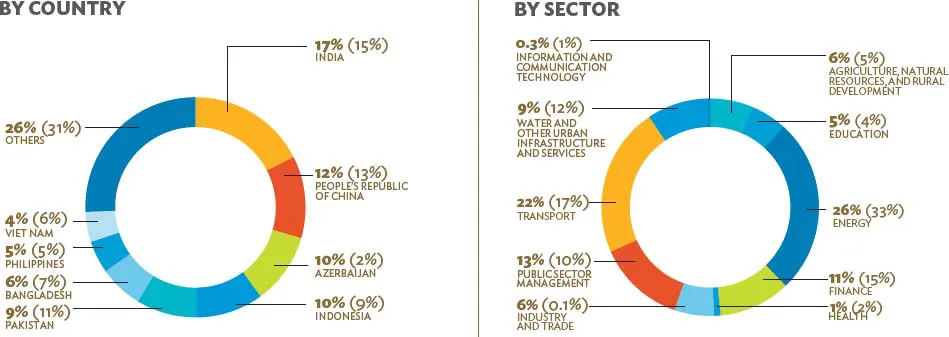
Numbers in paretheses are from 2015.
MEETING FUTURE CHALLENGES TODAY
In 2016, to meet increasing demand from its DMCs, ADB’s total approved operations reached an all-time high of $31.70 billion ($17.47 billion for sovereign and nonsovereign operations from ADB resources, $169 million for technical assistance, and $14.06 billion from various cofinancing partners). Of the $31.70 billion, ADB committed $26.59 billion as financing operations that have been approved and then signed by the counterparty or borrower during 2016. This record lending reflects the scaling up of operations that has occurred since the decision in April 2015 to merge ADB’s Asian Development Fund (ADF) lending operations with its ordinary capital resources (OCR) balance sheet. The merger, effective from January 2017, will increase ADB’s financing capacity to $20 billion by 2020.
In May, ADB welcomed the agreement by donors during the 11th ADF replenishment (ADF 12), to pledge $3.3 billion for 2017–2020. Through the fund, ADB will, over the next 4 years, increase grant support to its poorest DMCs by 70% compared with levels provided in 2013–2016. ADF12 will allow ADB to double the minimum allocation for small countries, provide grant and concessional resources to support further disaster risk reduction, and offer greater assistance in regional health security.
In 2016, ADB continued to develop a new corporate strategy that, when completed, will guide ADB’s engagement with DMCs until 2030. The strategy is expected to define how ADB operations will align with the SDGs approved in September 2015 and the new global climate agreement confirmed in Paris in December 2015. The strategy is expected to propose ways to strengthen ADB’s interaction with middle-income countries as well as deepen support to countries in fragile and conflict-affected situations. Throughout 2016, ADB consulted extensively with various stakeholders—governments, the private sector, development partners, and its own management and staff—on developing the new strategy.
STRATEGIC FOCUS MAINTAINED
Under its current long-term strategic framework, ADB continues to promote three complementary development agendas: inclusive growth, environmental sustainability, and regional cooperation and integration.
Inclusive growth not only generates more diverse economic opportunities and improved social services, but also allows a broader cross-section of society to access, and benefit from, those opportunities and services. In 2016, ADB fostered inclusive economic growth through a variety of country-based and regional initiatives. This included support for infrastructure development (particularly in lagging areas), education, health, and social protection. In the Philippines, ADB approved $400 million of additional financing for a project to support social protection and provide more conditional cash transfers to around 4.4 million of the country’s poorest families. In Myanmar, ADB approved a $98.5 million education loan to help disadvantaged youth participate in new economic opportunities, including targeted skills training for 41,000 young people and education workers. To address population aging, ADB approved technical assistance to support care for elderly people in Indonesia, Mongolia, Sri Lanka, Thailand, Tonga, and Viet Nam. In April, ADB approved an action plan to promote inclusive business in Asia and the Pacific. The plan will support innovative private investment to solve problems particular to poor and low-income countries.
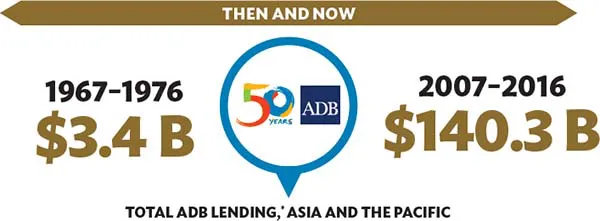
* Loans, grants, and others.
ADB again contributed to environmental sustainability with the approval of 81 projects worth $10.75 billion to support sustainable infrastructure and natural capital, improve environmental governance, and address climate change. ADB remains focused on climate change as one of its strategic priorities, and is on track to meet its target of investing $6 billion annually in climate change projects by 2020. In 2016, ADB approved $4.44 billion (including $700.64 million in external resources) for climate finance, the highest level since tracking of climate finance began 6 years ago. ADB directed $3.25 billion to mitigate climate change and $1.19 billion for adaptation. ADB supports the use of advanced technologies to promote energy efficiency and minimize environmental impacts. In Viet Nam, it supported metro rail projects in Ha Noi and Ho Chi Minh City, providing cleaner, more efficient, and better integrated urban transport. ADB backed bus rapid transit projects for cities in the People’s Republic of China (PRC), the Lao People’s Democratic Republic (Lao PDR), and Mongolia. Through these projects, ADB is helping to deliver quality infrastructure that is environmentally friendly, with clean vehicles, automated fare systems, intelligent transport systems, and energy-efficient street lighting.
In 2016, ADB approved $5.4 billion in projects supporting regional cooperation and integration. ADB finance allowed work to commence on the 500-kilovolt electricity transmission line between Afghanistan’s power import hubs, Pule Khumri and Kabul, with a transmission capacity of 1,000 megawatts. This will enable year-round energy supply from Uzbekistan, Tajikistan, and Turkmenistan to Kabul and other major load centers in southern and eastern Afghanistan. ADB approved $450 million for the PRC to improve infrastructure and trade between the border areas of Guangxi and northern Viet Nam. It also approved $370 million for India to enhance the growth and competitiveness of the industrial corridor from Vishapatnam to Chennai, which will connect India with global production networks. ADB approved a health security project in the Greater Mekong Subregion to improve responses to emerging infectious diseases and other major public threats in selected provinces of Cambodia, the Lao PDR, Myanmar, and Viet Nam. In September, ADB approved its first operational plan on regional cooperation and integration, covering 2016–2020. The plan focuses on strengthening regional connectivity; enhancing competitiveness; and improving regional resources and collective action on issues such as financial and disaster risks, cross-border health, shared natural resources, and climate commitments.
STRONG SUPPORT ACROSS DIVERSE SECTORS
ADB approved $2.54 billion for renewable energy and energy efficiency projects in 2016, the sixth consecutive year its clean energy investment target has been exceeded. This is already approaching the 2020 target of $3 billion annually for clean energy. Through its 2016 investments, ADB helped its DMCs pursue their nationally determined contributions under the Paris Agreement on Climate Change, resulting in additional capacity of 2,056 megawatts from renewable energy sources, 4,692 gigawatt-hours in electricity savings per year, and an annual reduction in carbon dioxide emissions of 13.5 million tons.
LATE 1960s
ADB lending is concentrated on energy, agriculture, transport, and finance.
EARLY 1970s
The first global oil crisis cripples many Asian economies. ADB acts swiftly, increasing energy sector financing to develop indigenous energy sources and improve energy efficiency.
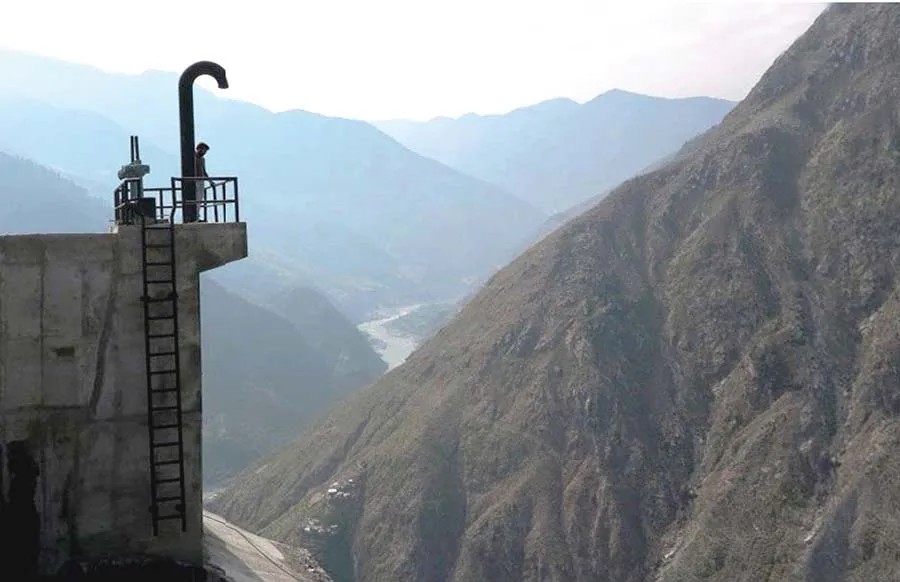

HARNESSING A RIVER’S POWER IN PAKISTAN
Residents of the Pakistani town of Besham, in the country’s Khyber Pakhtunkhwa province, are among almost 5 million people set to see benefits flow from the mighty Indus River.
For years, Pakistan has experienced power shortages, estimated at over 5,000 megawatts during peak demand. These shortages have led to blackouts and load shedding, in turn causing economic and social turmoil.
Part of the solution is the Indus River, which roars down some of the world’s highest mountains and glaciers to sweep across the vast irrigated plains of Khyber Pakhtunkhwa, Punjab, and Sindh provinces.
The Indus River network is estimated to have the potential to generate 60,000 to 70,000 megawatts of electricity, triple the total current demand in Pakistan.
The Ranolia run-of-river hydropower project on the Indus River is part of broader efforts to harness Pakistan’s rich potential for clean energy. Ranolia is one of two hydropower projects being built by the Khyber Pakhtunkhwa provincial government...
Table of contents
- Front Cover
- Title Page
- Copyright Page
- Contents
- Acknowledgments
- President’s Message
- Board of Directors
- Financial Highlights
- Chapter 1
- Chapter 2
- Chapter 3
- Chapter 4
- Special Appendix
- Usb Contents
- Back Cover
Trusted by 375,005 students
Access to over 1.5 million titles for a fair monthly price.
Study more efficiently using our study tools.
Frequently asked questions
Yes, you can cancel anytime from the Subscription tab in your account settings on the Perlego website. Your subscription will stay active until the end of your current billing period. Learn how to cancel your subscription
No, books cannot be downloaded as external files, such as PDFs, for use outside of Perlego. However, you can download books within the Perlego app for offline reading on mobile or tablet. Learn how to download books offline
Perlego offers two plans: Essential and Complete
- Essential is ideal for learners and professionals who enjoy exploring a wide range of subjects. Access the Essential Library with 800,000+ trusted titles and best-sellers across business, personal growth, and the humanities. Includes unlimited reading time and Standard Read Aloud voice.
- Complete: Perfect for advanced learners and researchers needing full, unrestricted access. Unlock 1.5M+ books across hundreds of subjects, including academic and specialized titles. The Complete Plan also includes advanced features like Premium Read Aloud and Research Assistant.
We are an online textbook subscription service, where you can get access to an entire online library for less than the price of a single book per month. With over 1.5 million books across 990+ topics, we’ve got you covered! Learn about our mission
Look out for the read-aloud symbol on your next book to see if you can listen to it. The read-aloud tool reads text aloud for you, highlighting the text as it is being read. You can pause it, speed it up and slow it down. Learn more about Read Aloud
Yes! You can use the Perlego app on both iOS and Android devices to read anytime, anywhere — even offline. Perfect for commutes or when you’re on the go.
Please note we cannot support devices running on iOS 13 and Android 7 or earlier. Learn more about using the app
Please note we cannot support devices running on iOS 13 and Android 7 or earlier. Learn more about using the app
Yes, you can access ADB Annual Report 2016 by in PDF and/or ePUB format, as well as other popular books in Economics & International Economics. We have over 1.5 million books available in our catalogue for you to explore.