The Star Mountain Investment Holding Limited (SMIHL) is a Papua New Guinean (PNG) landowner holding company operating in Western Province, in the shadows of the huge Ok Tedi mine. The initiative drew on a Future Generation Fund and was, for the community, a response to years of frustration with wasted opportunities for economic development which were attributed to a lack of organizational and economic development capacity, capture of benefits by local elites, and the absence of a consensus on how to address the community's long-term interests. Among other things, the case highlights the value of locally-led and facilitated change processes, and the understanding of local cultural dynamics and capacity issues that goes with it.
eBook - ePub
From Dependency to Sustainability
A Case Study on the Economic Capacity Development of the Ok Tedi Mine-area Community
- 39 pages
- English
- ePUB (mobile friendly)
- Available on iOS & Android
eBook - ePub
From Dependency to Sustainability
A Case Study on the Economic Capacity Development of the Ok Tedi Mine-area Community
About this book
Information
MINE-AREA COMMUNITY INVESTMENT PROGRAM
Design and Development
The Mine-area Community Investment Program was designed to develop the economic capacity of the community. Capacity development was needed at different levels using different approaches, and it was recognized that it would require an enabling environment. The key components of the program included development of an investment structure, support for business development, community development initiatives, leadership strengthening (both community and business), and OTML management support.
The community and stakeholder consultations focused on “soft” issues—such as developing trust, understanding, and commitment—while the organizational development aspects addressed “hard” issues, including setting up the landowner companies and sourcing finance.
The objectives of the program components were as follows:
• Organizational Structure Development

• Business Development
• Mine-area Community
• Leadership
• OTML
Investment Structure
A three-tier investment structure (Figure 2) was developed as the core of the program to provide the basis to develop the economic capacity of the mine-area community. It was designed to capture the inflow of cash benefits from individuals, clans, and local businesses and to redirect it to sustainable economic development activities. The three levels are also the entry points for the current benefit streams going to the mine-area community:
Figure 2. Ok Tedi Mine-Area Community Investment Structure
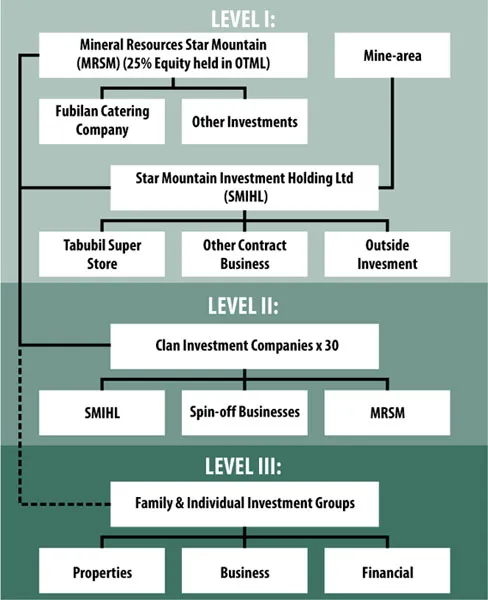
Level 1. Level 1 comprises the community umbrella companies— SMIHL and Mineral Resources Star Mountain (MRSM). SMIHL is locally controlled while MRSM is controlled by Mineral Resources Development Company (MRDC) under the government equity arrangement in OTML. SMIHL, being locally controlled, is seen as the main commercial arm to harness and manage the current economic opportunities for further business and investment growth.
Level 2. The second level comprises the clan-based companies, which are designed purposely to link the investments with the people to filter cash and other benefits directly to individual members of the community. These companies are treated as investment portfolio companies; equity in existing local businesses held by the community is allocated to the respective clan members under their clan companies. Effectively, the clan companies provide a level of investment to maximize future benefits for the community.
Level 3. Level 3 accommodates family initiatives (small and micro businesses). The activities are somewhat detached from those in levels 1 and 2 but are nevertheless recognized and supported, given the investment potential they have in this high cash-flow environment. Appropriate support is provided to encourage families to develop their own economic capacities to prepare for mine closure.
Program Implementation
A three-phased approach to program implementation was taken. First, a thorough community consultation and communication process was conducted with different community groups and OTML to solicit support for the program, but most importantly to effect change in the savings and investment decisions of the people.
The second phase involved the administrative inputs by the business development team. Mobilization of shareholding under the various companies of the investment structure was organized and registrations were formalized with the Government’s Investment Promotion Authority. Also, the equity interests of various clans and groups were streamlined and formalized under the investment portfolio companies.
The third phase involved the technical (business) inputs that were required to launch the start-up of the companies and associated activities. The program was implemented over 2 years, 2002 and 2003, by the business development team.
Community Consultation and Communication
Community consultation and communication were critical components of the program because the implementation of phases 2 and 3 were dependent on the acceptance and support of the community. The consultation and communication approach was carefully planned to capture the interest of the leaders and members of the communities. This was especially crucial when there was no savings and investment culture in the community—combined with a general distrust of local business management. The community needed to have a sense of ownership of the program, but most importantly take proactive steps to change their savings and investment behavior. Questions about who could lead the community consultation effectively, what messages would help to garner community support and cooperation, and which community persons should be drawn in for support, helped to frame the process. The consultation process was designed to have a domino effect on the target groups: initially consult with key community leaders and get their support, and together consult ...
Table of contents
- Front Cover
- Title Page
- Copyright Page
- Contents
- Foreword
- Background
- Mine-Area Community Investment Program
- Analysis, Reflections, and Lessons
- Conclusion
- Back Cover
Trusted by 375,005 students
Access to over 1.5 million titles for a fair monthly price.
Study more efficiently using our study tools.
Frequently asked questions
Yes, you can cancel anytime from the Subscription tab in your account settings on the Perlego website. Your subscription will stay active until the end of your current billing period. Learn how to cancel your subscription
No, books cannot be downloaded as external files, such as PDFs, for use outside of Perlego. However, you can download books within the Perlego app for offline reading on mobile or tablet. Learn how to download books offline
Perlego offers two plans: Essential and Complete
- Essential is ideal for learners and professionals who enjoy exploring a wide range of subjects. Access the Essential Library with 800,000+ trusted titles and best-sellers across business, personal growth, and the humanities. Includes unlimited reading time and Standard Read Aloud voice.
- Complete: Perfect for advanced learners and researchers needing full, unrestricted access. Unlock 1.5M+ books across hundreds of subjects, including academic and specialized titles. The Complete Plan also includes advanced features like Premium Read Aloud and Research Assistant.
We are an online textbook subscription service, where you can get access to an entire online library for less than the price of a single book per month. With over 1.5 million books across 990+ topics, we’ve got you covered! Learn about our mission
Look out for the read-aloud symbol on your next book to see if you can listen to it. The read-aloud tool reads text aloud for you, highlighting the text as it is being read. You can pause it, speed it up and slow it down. Learn more about Read Aloud
Yes! You can use the Perlego app on both iOS and Android devices to read anytime, anywhere — even offline. Perfect for commutes or when you’re on the go.
Please note we cannot support devices running on iOS 13 and Android 7 or earlier. Learn more about using the app
Please note we cannot support devices running on iOS 13 and Android 7 or earlier. Learn more about using the app
Yes, you can access From Dependency to Sustainability by Paulina Siop in PDF and/or ePUB format, as well as other popular books in Economics & Environmental Economics. We have over 1.5 million books available in our catalogue for you to explore.