Conditional cash transfer (CCT), which was initiated in 2007, is becoming a centerpiece of the social protection system in the Philippines. This note reviews economic rationales for transferring a cash grant to the poor contingent on their certain behavior, major challenges in designing a CCT program, targeting methodologies, and impact evaluation designs, to show how the Philippines' CCT program is designed to resolve major difficulties in its design, targeting, and evaluation. The CCT program with a rigorous impact evaluation offers an excellent opportunity for policy makers and development practitioners to learn what works and what does not work in searching for effective poverty interventions.
eBook - ePub
Searching for Effective Poverty Interventions
Conditional Cash Transfers in the Philippines
- 24 pages
- English
- ePUB (mobile friendly)
- Available on iOS & Android
eBook - ePub
Searching for Effective Poverty Interventions
Conditional Cash Transfers in the Philippines
About this book
Information
Impact Evaluation-How Can We Measure True Causal Impacts?
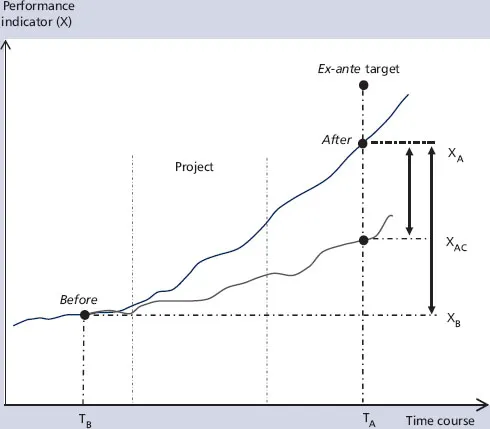
Dilemma of before-and-after comparison. A conventional approach for evaluating impacts of public programs, including social protection projects, is the so-called before-and-after comparison. In processing a project, we usually prepare time-bound and measurable performance indicators that allow the project to be monitored and evaluated subsequently.14 Figure 4 illustrates a hypothetical case. At the designing stage of the project, we set up an ex-ante target for each performance indicator with a specific time frame—how much and when. At a certain stage after project completion (TA), the actual value of the indicator (XA) is measured to know the impact of the project. Although we discuss possible causes for explaining the gap between the ex-ante target and the actual value, project impact is usually measured by comparing the actual indicator value over the baseline value (XB). In this approach, the project impact is estimated as XA–XB.
Figure 4 Dilemma of Before-and-After Comparison—What We Need Is Counterfactual
Source: Author.
A key challenge of the before-and-after comparison lies in its complete lack of attribution or causality. Even if we find an improvement in the performance indicator, it is totally impossible to attribute the observed improvement, i.e., XA–XB, to the project. The improvement may be due partly to the project and partly to all other factors that are not related to the project. At most, what we can say is “our project might contribute, might be partially…might be.” Much worse, at the stage when the project is already completed (TA), we have no way of knowing to what extent the project could contribute to the improvement. If we want to know the real impact of the project, we need to extract the contribution that can be distinctly attributable to the project.
What is a “counterfactual”? The impact attributable to the project can only be obtained by comparing the actual observed indicator (XA) and a hypothetical value of the indicator that would have prevailed in the absence of the project (XAC). This hypothetical value is generally called a counterfactual. The example in Figure 4 shows that, even without the project, the performance indicator could have improved because of other factors outside the project. However, the counterfactual value cannot be observed since the project was already in place. In the context of the Philippines’ CCT program, what we need is unobservable counterfactual outcomes, say school enrollment of recipient households when they hypothetically did not receive cash grants. However, the households cannot be observed simultaneously in two different states, i.e., with and without the CCT program. The central objective of impact evaluation is to construct this unobservable counterfactual value (XAC) for measuring the real impact of the project, i.e., XA–XAC. There are several methodologies in impact evaluation.15
The CCT project of the Philippines adopts two different approaches: (i) a randomized control design (RCT) approach with phase-in design, and (ii) a regression discontinuity design (RD) approach. Three rounds of impact evaluation surveys are expected to be conducted, with the first round in 2011.16
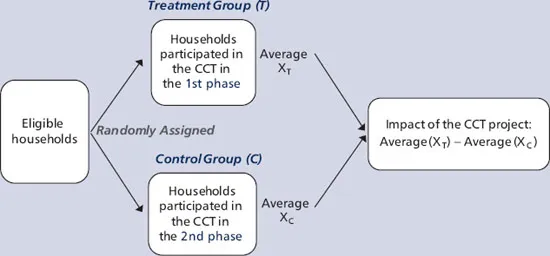
Randomized control design (RCT) approach. In this approach, eligible households for the CCT are randomly assigned to a “treatment group” that will receive cash grants, and a “control group” that will not. By construction, the two groups are identical except for participation in the CCT program.17 It is thus possible to assume that both groups encounter the same external factors. Therefore, any difference in the outcomes between the two groups after project completion can be attributed solely to the CCT project. In the Philippines’ CCT program, the program phase-in is structured to divide eligible households into the treatment and control groups. The CCT covers all eligible households in a phased-in manner, which implies that the eligible households receive the cash transfers at different times. The timing of actual receipt of the cash grants is randomized: households that participate in the CCT program in the second phase can serve as the control group for others that join the program in the first phase (Figure 5).
Figure 5 Randomized Control Design Approach with Phase-In
CCT = conditional cash transfer.
Source: Author.
Sampling. The RCT approach is applied in some municipalities in each representative province. In each municipality, half of the barangays are randomly assigned to the CCT program immediately (treatment group), and the remaining half participate in the project after 1 year (control group).
Regression discontinuity design (RD) approach. This approach can be used when the program’s beneficiaries are determined by an explicit rule, such as the proxy means test (PMT) in the Philippines’ CCT program. Eligible households are determined based on their proxy scores against a cutoff point. This mea...
Table of contents
- Front Cover
- Title Page
- Copyright Page
- Contents
- List of Tables and Figures
- Abbreviations
- Summary
- Introduction
- Conditional Cash Transfer—Why Do We Need It? How Can We Design It?
- Targeting—How Can We Reach the Poor?
- Impact Evaluation—How Can We Measure True Causal Impacts?
- Conclusions
- Back Cover
Trusted by 375,005 students
Access to over 1.5 million titles for a fair monthly price.
Study more efficiently using our study tools.
Frequently asked questions
Yes, you can cancel anytime from the Subscription tab in your account settings on the Perlego website. Your subscription will stay active until the end of your current billing period. Learn how to cancel your subscription
No, books cannot be downloaded as external files, such as PDFs, for use outside of Perlego. However, you can download books within the Perlego app for offline reading on mobile or tablet. Learn how to download books offline
Perlego offers two plans: Essential and Complete
- Essential is ideal for learners and professionals who enjoy exploring a wide range of subjects. Access the Essential Library with 800,000+ trusted titles and best-sellers across business, personal growth, and the humanities. Includes unlimited reading time and Standard Read Aloud voice.
- Complete: Perfect for advanced learners and researchers needing full, unrestricted access. Unlock 1.5M+ books across hundreds of subjects, including academic and specialized titles. The Complete Plan also includes advanced features like Premium Read Aloud and Research Assistant.
We are an online textbook subscription service, where you can get access to an entire online library for less than the price of a single book per month. With over 1.5 million books across 990+ topics, we’ve got you covered! Learn about our mission
Look out for the read-aloud symbol on your next book to see if you can listen to it. The read-aloud tool reads text aloud for you, highlighting the text as it is being read. You can pause it, speed it up and slow it down. Learn more about Read Aloud
Yes! You can use the Perlego app on both iOS and Android devices to read anytime, anywhere — even offline. Perfect for commutes or when you’re on the go.
Please note we cannot support devices running on iOS 13 and Android 7 or earlier. Learn more about using the app
Please note we cannot support devices running on iOS 13 and Android 7 or earlier. Learn more about using the app
Yes, you can access Searching for Effective Poverty Interventions by Norio Usui in PDF and/or ePUB format, as well as other popular books in Social Sciences & Poverty in Sociology. We have over 1.5 million books available in our catalogue for you to explore.