This publication lays out a strategy which identifies and presents a broad framework for integrated water resources planning and management, to increase the level of resilience to climate change in Himachal Pradesh. It is based on an assessment of the status of water resources in the state, including the present and planned water utilization examined within a framework of environment, conservation and sustainability. The strategy also examines the present institutional arrangements for water resources management and assesses the requirements for institutional development, strengthening and necessary reform measures to support the development of robust and sustainable water resources management.
- 77 pages
- English
- ePUB (mobile friendly)
- Available on iOS & Android
eBook - ePub
About this book
Information
1
INTRODUCTION
The development of a climate change adaptation focused water resources strategy has been undertaken at the request of the Government of India, through the Department of Economic Affairs and the Government of Himachal Pradesh (GoHP). This study is designed to review and assess the requirements for efficient and sustainable water resources management in Himachal Pradesh.1
Its broad objective is to develop a climate change adaptation focused sustainable water resources strategy for Himachal Pradesh. The strategy identifies and presents a broad framework for integrated water resources planning and management. It is based on a rapid assessment of the status of water resources in the state, including the present and planned levels of water utilization, as well as issues of environment, conservation, and sustainability. The strategy also examines the present institutional arrangements for water resources management and assesses the requirements for institutional development, strengthening, and necessary reform measures. It presents the outline framework for future water resources planning and management in the face of climate change, and proposes a preliminary road map setting out the broad measures required for adaptation.
It is estimated that climate change will affect people primarily through unpredictable changes in water ecosystems and the water related economies. While projections of future temperatures are becoming better understood, the overall impact on the water resources is still not clearly defined. Irrespective of the scale and viabilities of climate mitigation measures, realistic, and effective adaptation measures are necessary.2 Of major issue for water resources are the nonlinear effects where changes in climate can be amplified in the water environment. For example, small temperature changes of a few degrees might possibly result in both, increases and decreases of water resources, of up to 30 per cent or more. Water sector planners and managers require guidance on directions for future strategies and priorities for investment to meet the challenges of climate change.
The Intergovernmental Panel on Climate Change (IPCC) concludes that so far, water resource issues have not been adequately addressed in climate change analyses and climate policy formulations.3 Likewise, in most cases, climate change problems have not been adequately dealt with in water resources analyses, management, and policy formulation. According to many experts, water and its availability and quality will be the main pressures on, and issues for, societies and the environment under climate change; hence, the necessity to improve the understanding of the problems and inter linkages involved.
India’s position on climate change issues and Government of India (GoI) response:4 India has been and will continue to be severely impacted by climate variability precisely at a time when it is confronted with huge development imperatives. The focus of climate change action cannot just be on emissions but must equally address the important issue of adaptation. India is already subject to a high degree of climate variability that is manifest in droughts, floods, and other extreme weather events. The government’s 11th Five Year Plan (FYP; 2007-2012) clearly articulates the impact and implications of climate change noted in the IPCC Assessment Reports. In an address to the National Conference of Ministers of Environment and Forests in August 2009, the Prime Minister, Dr Manmohan Singh, encouraged state governments to create state level action plans on climate change consistent with the strategies of the National Action Plan on Climate Change (NAPCC) which had been launched on 30 June 2008. Based on the recommendations of the NAPCC, eight National Missions have been established; each of the Missions will be managed by the respective Ministries and line agencies through inter-sectoral groups including related Ministries, Ministry of Finance, Planning Commission, and experts from industry, academia, and civil society.5 Each Mission is preparing detailed implementation plans under the 11th FYP and 12th FYP (2012-2017). In this context, measures for the conservation of mountains have been specifically envisaged. Of the eight National Missions, the National Missions for Himalayan Ecosystems under the Ministry of Science and Technology, the National Water Mission under the Ministry of Water Resources, and the National Mission for Agriculture under the Ministry of Agriculture are of special relevance to the study.
HIMACHAL PRADESH
Himachal Pradesh is a relatively young state, having been granted full statehood in 1971. It is a relatively small state both, in terms of population and size. With a population of 6.6 million, it represents well under 1 per cent of India’s total. About 90 per cent of the population resides in rural areas. Himachal Pradesh is largely mountainous with the exception of small pockets bordering Punjab and Haryana. The state comprises hilly terrain, perennial rivers, and significant forest cover. The state offers many opportunities, given its abundant water resources, hydropower, mineral resources, horticulture, agriculture, and potential for tourism. It is however, facing significant challenges arising from its elevation, topography, and ecological vulnerability. Since the 1990s, Himachal Pradesh has grown faster than the national average and is ahead in terms of most indicators of human development. It is performing better than several more developed states on the plains in terms of social and economic progress. Supportive government policies have invested in infrastructure and given high priority to expenditures in the social sectors; Himachal Pradesh has achieved per capita social expenditures which are approximately double of the all-states average for India. Investments in infrastructure is gradually creating a facilitating environment for growth, but much of the economy remains dependant on public spending financed borrowing and central assistance. Employment opportunities outside the public sector remain scarce and opportunities for the now well educated younger generation in the state remain limited. Himachal Pradesh is one of eleven special category states with eligibility for special central assistance. The state and its rivers are shown in Figure 1.6
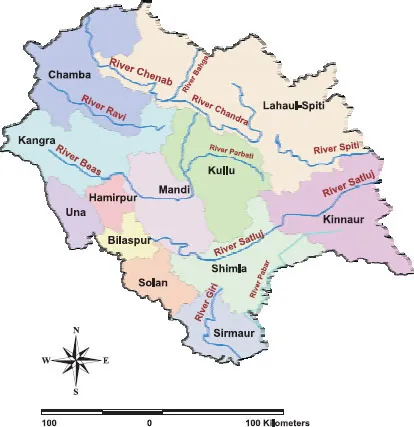
Figure 1 Himachal Pradesh showing rivers
POPULATION
From the 2001 census, the population of the state is esti-mated at 6.1 million; the decadal growth 1991-2001 was 17.5 per cent, a slight downward trend over the previous ten years of growth of 20.6 per cent. Himachal Pradesh has the highest percentage of rural population in the country with 90 per cent of the population recorded as rural. Urban growth is higher than that in the rural areas. The urban population has increased by 1 per cent more than the rural over the last decade. An estimated 26 per cent of the population is below the poverty line; there are however, substantial disparities in wealth in the rural population. Over 29 per cent of Himachal Pradesh’s population are scheduled castes and scheduled tribes; of whom 45 per cent are below the poverty line. The population density in the state is shown in Figure 2.7
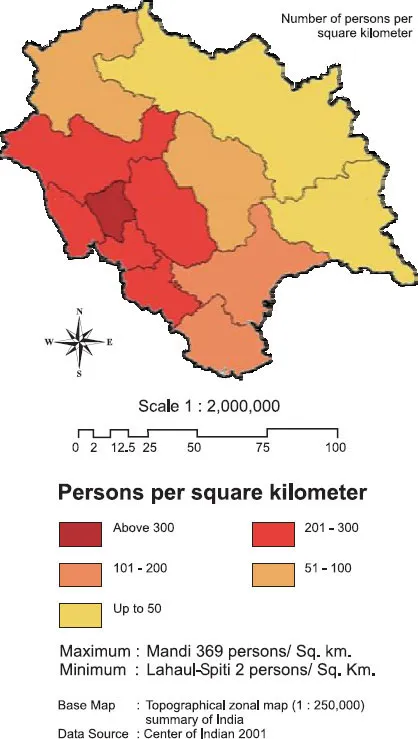
Figure 2 Population Density
LIVELIHOODS
The predominately rural population is primarily dependant on agriculture. Almost every family owns land and is engaged in agriculture or horticulture for their day to day requirements. Over the years, the state has become known for its production of off-season vegetables and flowers. The average land holdings are very small and less than a hectare per family, with many fields being on steep land that do not lend themselves to mechanisation. Most agriculture is of the subsistence type and depends on suitable climate for good yields. The agricultural based economy is therefore, inadequate to fulfil the total livelihood requirement for most of the families. Increasingly, most rural families have access to off-farm incomes to supplement the shortfall from agriculture. Many families have one or more member working in urban centres out of the state, or in the military. Tourism and craft industries provide some supplementary income.
Animal husbandry is another source of income; almost every family raises livestock for its day to day requirements for subsistence as well as for generating cash income. Owing to the very small land holdings, families rely heavily on natural fodder resources including the forest areas to feed their livestock. Livestock kept by tribal communities are subject to transhumance (seasonal movement to new areas) to get the best pastures. Economically vulnerable groups including the scheduled tribes and castes have high dependence on the forest resources including collection of fodder, medicinal plants, and firewood.
DEVELOPMENT PRIORITIES
The 11th FYP seeks to achieve the twin objectives of faster growth and inclusive development including provision of essential social services, especially to disadvantaged groups, increasing farm incomes, developing vital infrastructure, protecting the environment, and improving governance. A vital thrust area identified by the government is the need to tackle unemployment as well as seeking to improve living standards, with priority for disadvantaged sections and remote areas. Himachal Pradesh’s development priorities are a function of its unique socio-economic characteristics where it has natural advantages.
There are sectors with high potential that can contribute to more rapid growth. However, there remain sub-sectors like forestry and hospitality that have grown slower despite the state’s natural advantages. Sub-sectors like manufacturing have been growth drivers in the recent past, helped by historical tax incentives and other benefits which have attracted new industries, especially in the districts bordering Punjab and Haryana. It will be important to sustain this good performance, and retain the new industries after the financial incentives are phased out in 2010.
The state government aims to achieve continued growth during the 11th FYP by capitalizing on its comparative advantage, increasing the productivity and economic value of its natural assets, and specializing in sectors where it can compete effectively in a globalized economy. Agriculture accounts for almost 70 per cent of employment, but generates less than 22 per cent of the gross state domestic product. Not only are productivity and incomes from this sector low, they are also likely to be more volatile, increasing vulnerability to climate impacts. There is a very high dependence on agriculture especially for rural female workers with 95 per cent being employed in this sector. The state is promoting a shift to higher return vegetable crops. There is a need to transition workers out of subsistence agriculture to more productive employment either, in more modern agriculture or by creating suitable opportunities in the non-farm sector. To some extent, the transition is already happening, with increasing deployment of incremental workers in construction, manufacturing, and sectors associated with tourism, while agricultural jobs are on the decline. The slow pace of the process is, however, troubling. In the rural areas in particular, more jobs are being lost in agriculture than are being created elsewhere.
Even though less than 10 per cent of the population is classified as poor, the state faces issues in terms of vulnerability of the population. It is estimated that one fifth of the population could slip into absolute poverty if the state’s good economic performance is not maintained, a situation that might occur if severe climatic problems were to affect the agricultural sector.
2
WATER RESOURCES
THE INDIAN HIMALAYAS
Himachal Pradesh forms a key and central part of the Indian Himalayan region (IHR). The IHR region covers vast areas, with about 17 per cent of the region being under permanent snow cover and glaciers, and about 30-40 per cent under seasonal snow cover, forming a unique water reservoir. This feeds important perennial rivers that provide water for drinking, irrigation, and hydropower. Every year, about 1,200,000 million m3 of water flows from Himalayan Rivers. The IHR is home to nearly 4 per cent of the country’s population, and provides directly or indirectly for their livelihoods. However, the Himalayan ecosystem is highly vulnerable due to geological reasons, stress caused by increased pressure of population, exploitation of natural resources, and other related challenges. These effects are likely to be exacerbated due to the impact of climate change, which may adversely impact the Himalayan ecosystem through increased temperature, altered precipitation patterns, episodes of...
Table of contents
- Front Cover
- Title Page
- Copyright Page
- Acknowledgements
- Preface
- Contents
- Abbreviations
- Executive Summary
- 1 Introduction
- 2 Water Resources
- 3 Climate Change Risks
- 4 Indicative Impacts of Climate Change
- 5 Development Issues and Opportunities
- 6 Water Institutions
- 7 Strategic Framework
- 8 Road Map for Climate Change Adaptation
- 9 Implementation Plan
- Back Cover
Trusted by 375,005 students
Access to over 1.5 million titles for a fair monthly price.
Study more efficiently using our study tools.
Frequently asked questions
Yes, you can cancel anytime from the Subscription tab in your account settings on the Perlego website. Your subscription will stay active until the end of your current billing period. Learn how to cancel your subscription
No, books cannot be downloaded as external files, such as PDFs, for use outside of Perlego. However, you can download books within the Perlego app for offline reading on mobile or tablet. Learn how to download books offline
Perlego offers two plans: Essential and Complete
- Essential is ideal for learners and professionals who enjoy exploring a wide range of subjects. Access the Essential Library with 800,000+ trusted titles and best-sellers across business, personal growth, and the humanities. Includes unlimited reading time and Standard Read Aloud voice.
- Complete: Perfect for advanced learners and researchers needing full, unrestricted access. Unlock 1.5M+ books across hundreds of subjects, including academic and specialized titles. The Complete Plan also includes advanced features like Premium Read Aloud and Research Assistant.
We are an online textbook subscription service, where you can get access to an entire online library for less than the price of a single book per month. With over 1.5 million books across 990+ topics, we’ve got you covered! Learn about our mission
Look out for the read-aloud symbol on your next book to see if you can listen to it. The read-aloud tool reads text aloud for you, highlighting the text as it is being read. You can pause it, speed it up and slow it down. Learn more about Read Aloud
Yes! You can use the Perlego app on both iOS and Android devices to read anytime, anywhere — even offline. Perfect for commutes or when you’re on the go.
Please note we cannot support devices running on iOS 13 and Android 7 or earlier. Learn more about using the app
Please note we cannot support devices running on iOS 13 and Android 7 or earlier. Learn more about using the app
Yes, you can access Climate Change Adaptation in Himachal Pradesh by in PDF and/or ePUB format, as well as other popular books in Biological Sciences & Global Warming & Climate Change. We have over 1.5 million books available in our catalogue for you to explore.