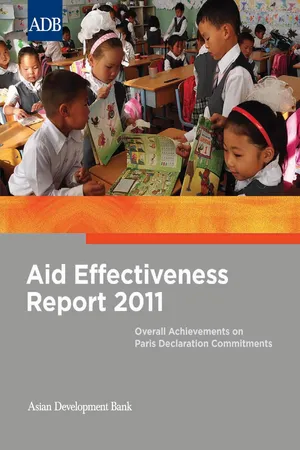
This publication assesses the progress achieved by the Asian Development Bank (ADB) on the 2010 targets of the Paris Declaration and Accra Agenda for Action. It covers ADB's average performance from 2008 to 2010 in 25 developing member countries based on the findings of annual internal monitoring surveys. It also assesses ADB's performance in the Paris Declaration monitoring surveys of the Development Assistance Committee of the Organisation for Economic Co-operation and Development and in several independent evaluations of aid quality conducted by donor countries and external researchers.
- 23 pages
- English
- ePUB (mobile friendly)
- Available on iOS & Android
eBook - ePub
About this book
Information
Appendix
ADB’s Progress on Quantitative Indicators
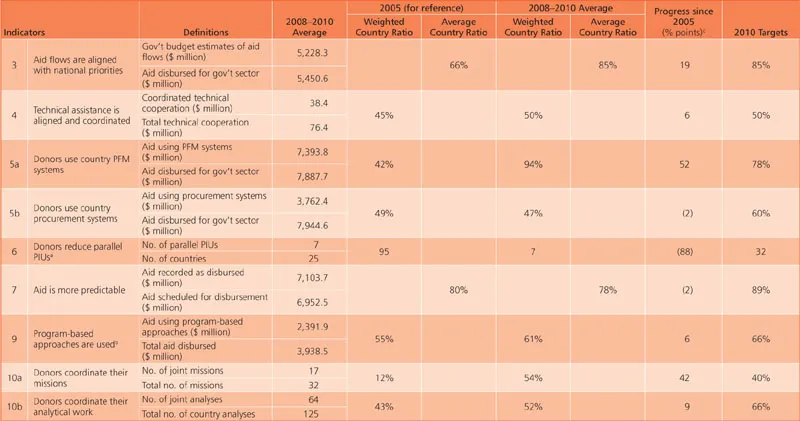
gov’t = government, no. = number, PFM = public financial management, PIU = project implementation unit.
Notes: All data reflect calendar-year amounts. The 2010 targets are for ADB as a whole and are not country specific.
a Figures refer to the number of parallel project implementation units.
b The use of program-based approaches in lending (indicator 9) was not surveyed in 2008; the results reflect average performance in 2009 and 2010 only.
c Figures may not add up due to rounding.
Source: ADB estimates based on data provided by resident missions, regional departments, and ADB’s Central Operations Services Office.
1 Paris Declaration on Aid Effectiveness, Paris, 28 February–2 March 2005. www.oecd.org/dataoecd/11/41/34428351.pdf
2 Accra Agenda for Action, Accra, 2–4 September 2008. www.oecd.org/dataoecd/58/16/41202012.pdf
3 The surveys covered 25 of ADB’s 40 borrowing countries: 11 from Group A (Asian Development Fund–only borrowers—Afghanistan, Bhutan, Cambodia, the Kyrgyz Republic, the Lao People’s Democratic Republic, the Maldives, Mongolia, Nepal, Samoa, Tajikistan, and Tonga); 10 from Group B (blend countries that borrow from both the Asian Development Fund and ADB’s ordinary capital resources—Armenia, Azerbaijan, Bangladesh, Georgia, India, Pakistan, Papua New Guinea, Sri Lanka, Uzbekistan, and Viet Nam); and 4 from Group C (countries borrowing only from ordinary capital resources—the People’s Republic of China, Indonesia, Kazakhstan, and the Philippines). Before January 2009, Indonesia was considered part of Group B.
4 Performance is assessed on the 3-year average. This approach ensured that the results were not unduly influenced by major events that occurred over this period. These included economic and political crises; natural disasters; the introduction of new corporate policies at ADB, such as the revised country partnership strategy guidelines; and the adoption in 2008 of Strategy 2020, ADB’s long-term strategic framework for 2008–2020, which identifies the achievement of the Paris Declaration commitments as a key operational goal.
5 For consistency with international monitoring efforts, ADB uses a similar framework and the same set of indicators and targets as those used by the OECD-DAC in its monitoring. In addition, the data used by ADB for countries that participated in both surveys in 2011 are the same as those submitted for the OECD-DAC survey.
6 The survey covered 9 of 14 Paris Declaration indicators. The five not covered were indicator 8 (aid is untied), which does not apply because all ADB aid is untied, and indicators 1 (operational development strategies), 2 (reliable country systems), 11 (results-oriented frameworks), and 12 (mutual accountability), all of which are tracked only through qualitative assessments. The assessment criteria and baselines for indicators 1 and 11 are based on analysis done by the World Bank for the 2005 Comprehensive Development Framework Progress Report titled Enabling Country Capacity to Achieve Results. Progress was reviewed by the World Bank in a 2007 report titled Results-Based National Development Strategies: Assessment and Challenges Ahead.
7 In some countries, such as Cambodia, the government excludes grant-financed technical cooperation from its budget as it feels it has little control in the allocation, disbursement, or management of these funds. Similarly in Viet Nam, disbursements of technical assistance are not monitored or recorded by the Ministry of Finance.
8 As noted in footnote 6, the survey did not cover indicator 2, part (b) of which measures the reliability of country procurement systems. If a country system is not assessed to be sufficiently reliable for procurement, use of that system without necessary carve-outs exposes the lending institution to increased fiduciary risk.
9 Although ADB’s Procurement Guidelines (2010, as amended from time to time) states that foreign bidders must be allowed to bid under national competitive bidding (NCB) if they wish to, NCB usually attracts only local bidders. Therefore, when international bidder participation is anticipated, international competitive bidding procedures are generally applied instead of NCB.
10 This overall average includes countries in which ADB disbursements exceeded the scheduled amount of aid and countries in which disbursements were below the scheduled amount over the 3-year period.
11 This definition clearly identifies all program loans and grants, sector development programs, and multitranche financing facility subprojects as PBAs. The characteristics of these modalities were seen to broadly match the definition of PBA used by the OECD-DAC in its 2011 monitoring survey. The survey classified a PBA as an approach that meets four criteri...
Table of contents
- Front Cover
- Title Page
- Copyright Page
- Contents
- Table, Figures, and Appendix
- Foreword
- Acknowledgments
- Abbreviations
- Executive Summary
- Introduction
- ADB Meets a Number of Its Aid Effectiveness Targets
- ADB Performs Well Compared with Other Development Partners
- ADB’s Performance Is Ranked High in Several Independent Studies
- Conclusion
- Appendix ADB’s Progress on Quantitative Indicators
- Back Cover
Trusted by 375,005 students
Access to over 1.5 million titles for a fair monthly price.
Study more efficiently using our study tools.
Frequently asked questions
Yes, you can cancel anytime from the Subscription tab in your account settings on the Perlego website. Your subscription will stay active until the end of your current billing period. Learn how to cancel your subscription
No, books cannot be downloaded as external files, such as PDFs, for use outside of Perlego. However, you can download books within the Perlego app for offline reading on mobile or tablet. Learn how to download books offline
Perlego offers two plans: Essential and Complete
- Essential is ideal for learners and professionals who enjoy exploring a wide range of subjects. Access the Essential Library with 800,000+ trusted titles and best-sellers across business, personal growth, and the humanities. Includes unlimited reading time and Standard Read Aloud voice.
- Complete: Perfect for advanced learners and researchers needing full, unrestricted access. Unlock 1.5M+ books across hundreds of subjects, including academic and specialized titles. The Complete Plan also includes advanced features like Premium Read Aloud and Research Assistant.
We are an online textbook subscription service, where you can get access to an entire online library for less than the price of a single book per month. With over 1.5 million books across 990+ topics, we’ve got you covered! Learn about our mission
Look out for the read-aloud symbol on your next book to see if you can listen to it. The read-aloud tool reads text aloud for you, highlighting the text as it is being read. You can pause it, speed it up and slow it down. Learn more about Read Aloud
Yes! You can use the Perlego app on both iOS and Android devices to read anytime, anywhere — even offline. Perfect for commutes or when you’re on the go.
Please note we cannot support devices running on iOS 13 and Android 7 or earlier. Learn more about using the app
Please note we cannot support devices running on iOS 13 and Android 7 or earlier. Learn more about using the app
Yes, you can access Aid Effectiveness Report 2011 by in PDF and/or ePUB format, as well as other popular books in Economía & Economía del desarrollo. We have over 1.5 million books available in our catalogue for you to explore.