The second edition of the Greater Mekong Subregion Atlas of the Environment again champions the environment of this unique part of Asia, an area straddled by rivers great and small, with bountiful watersheds, wetlands, and forests. The Atlas celebrates the peoples of the subregion, and presents the environmental and development challenges they face and their responses. It reminds us that the subregion's peoples and communities are key to maintaining its environment. The Atlas captures in one volume maps, remote-sensing images, and essential information on one of the most culturally, ethnically, and biologically diverse regions in the world. The subregion is made up of Cambodia; Guangxi Zhuang Autonomous Region and Yunnan Province of the People's Republic of China; the Lao People's Democratic Republic; Myanmar; Thailand; and Viet Nam.
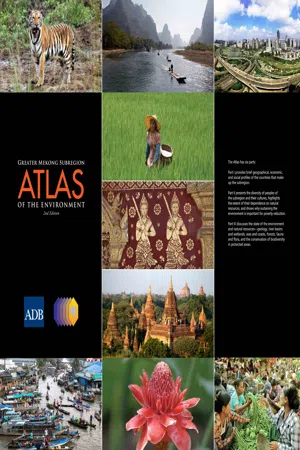
- 308 pages
- English
- ePUB (mobile friendly)
- Available on iOS & Android
eBook - ePub
About this book
Information
Information Resources
Additional information on the contents of the previous chapters of the atlas is contained in this section, in the form of tables and references.
Economic, Social, and Environmental Statistics for the Greater Mekong Subregion
Sets of statistical tables are provided that present environment and development indicators of the subregional countries. The tables follow the sequence of chapters and provide numerical information on the topics in each chapter. The chapters begin with general information on the subregion and member countries, followed by information about the peoples of the subregion, environment and natural resources, development issues, and finally, addressing development and environmental challenges. Whenever possible, data are presented by country, in a time series for each of the indicators.
Literature and Other Sources of Information
A list of references is provided to the main literature and internet sites used in preparation of the text of the atlas chapters. They also complement the sources shown under tables in the text. The references are ordered by chapter. Note that some internet sites and the information they contain change over time; dates on which such sites were accessed are shown after the internet address.
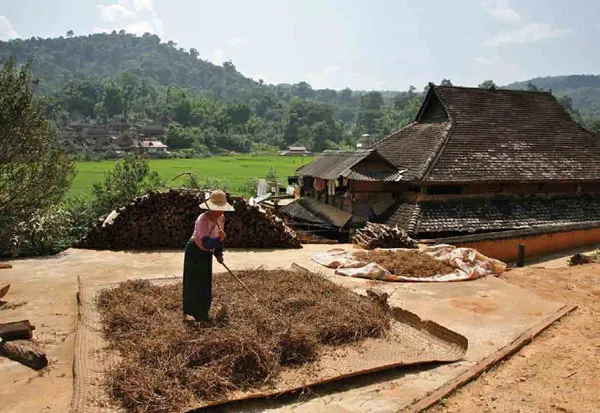
Sun drying crops in a Dai village, Yunnan Province, PRC.

Wat Phra Kaew, or Temple of the Emerald Buddha, in the Grand Palace, Bangkok, Thailand.
List of Tables
Table No. | Title |
Chapter 1 Greater Mekong Subregion | |
1.1 | GDP, 2000–2010 |
1.2 | Growth Rate of GDP, 2000–2010 |
1.3 | Per Capita GDP, 2000–2010 |
1.4 | GDP per Capita Annual Growth, 2000–2010 |
1.5 | Agriculture, 2000–2010 |
1.6 | Industry, 2000–2010 |
1.7 | Service Sector, 2000–2010 |
1.8 | Average Exchange Rate, 2000–2010 |
1.9a | Demographic Data by Country–Cambodia |
1.9b | Demographic Data by Country–Guangxi, PRC |
1.9c | Demographic Data by Country–Yunnan, PRC |
1.9d | Demographic Data by Country–Lao PDR |
1.9e | Demographic Data by Country–Myanmar |
1.9f | Demographic Data by Country–Thailand |
1.9g | Demographic Data by Country–Viet Nam |
Table No. | Title |
Chapter 4 Poverty And Environment | |
4.1 | Human Development Index Value, 2000–2010 |
4.2 | Total Population, 2000–2010 |
4.3 | Total Population Growth Rate, 2000–2010 |
4.4 | Urban Population, 2000–2010 |
4.5 | Urban Population Growth Rate, 2000–2010 |
4.6 | Urban Population, 2000–2010 |
4.7 | Population in Largest City, 2000–2010 |
4.8 | Population Growth Rate in Largest City |
4.9a | MDG Indicators–(Goal 4) Under-Five Mortality Rate, 2000–2010 (per 1,000 live births) |
4.9b | MDG Indicators–Infant Mortality Rate, 2005–2010 (per 1,000 live births) |
4.9c | MDG Indicators–Proportion of 1-Year-Old Children Immunized against Measles, 2000, 2005, 2010 |
4.9d | MDG Indicators–(Goal 5) Proportion of Births Attended by Skilled Health Staff, 2007–2010 |
4.9e | MDG Indicators–(Goal 6) Combat HIV/AIDS, Malaria, and Other Diseases |
4.9f | MDG Indicators–Incidence of Tuberculosis (TB) per 100,000 People, 2000–2010 |
4.9g | MDG Indicators–Proportion of TB Cases Detected under DOTS, 2000–2010 |
4.9h | MDG Indicators–GDP per Unit of Energy Used, 2000–2009 |
4.9i | MDG Indicators–Proportion of Population with Sustainable Access to an Improved Water Source, 2000–2010 |
4.9j | MDG Indicators–Proportion of Population with Access to Improved Sanitation, 2000–2010 |
4.9k | MDG Indicators–(Goal 8) Net Official Development Assistance Received, 2000–2010 |
4.9l | MDG Indicators–Other Indicators |
4.9m | MDG Indicators–Life Expectancy at Birth, 2000–2010 |
4.9n | MDG–Indicators–People Living with HIV, 15–49 Years Old, 2000–2009 |
Table No. | Title |
Chapter 5 Geology | |
5.1 | Mining Sector Share of GDP, 2000–2010 |
5.2 | Mineral Production in GMS Countries, 2010 |
Table No. | Title |
Chapter 6 River Basins And Wetlands | |
6.1 | Contribution of Discharges by Country to Mekong River Basin |
6.2 | Major Rivers of Guangxi, PRC |
6.3 | Area of Wetlands of Guangxi, PRC... |
Table of contents
- Front Cover
- Title Page
- Copyright Page
- Contents
- Foreword
- Greater Mekong Subregional Profile
- Peoples of the Greater Mekong Subregion
- Environment and Natural Resources
- Development in the Greater Mekong Subregion
- Challenges and Responses
- Information Resources
- Abbreviations and Acronyms
- Photo Credits
- Acknowledgments
- Indexes
Trusted by 375,005 students
Access to over 1.5 million titles for a fair monthly price.
Study more efficiently using our study tools.
Frequently asked questions
Yes, you can cancel anytime from the Subscription tab in your account settings on the Perlego website. Your subscription will stay active until the end of your current billing period. Learn how to cancel your subscription
No, books cannot be downloaded as external files, such as PDFs, for use outside of Perlego. However, you can download books within the Perlego app for offline reading on mobile or tablet. Learn how to download books offline
Perlego offers two plans: Essential and Complete
- Essential is ideal for learners and professionals who enjoy exploring a wide range of subjects. Access the Essential Library with 800,000+ trusted titles and best-sellers across business, personal growth, and the humanities. Includes unlimited reading time and Standard Read Aloud voice.
- Complete: Perfect for advanced learners and researchers needing full, unrestricted access. Unlock 1.5M+ books across hundreds of subjects, including academic and specialized titles. The Complete Plan also includes advanced features like Premium Read Aloud and Research Assistant.
We are an online textbook subscription service, where you can get access to an entire online library for less than the price of a single book per month. With over 1.5 million books across 990+ topics, we’ve got you covered! Learn about our mission
Look out for the read-aloud symbol on your next book to see if you can listen to it. The read-aloud tool reads text aloud for you, highlighting the text as it is being read. You can pause it, speed it up and slow it down. Learn more about Read Aloud
Yes! You can use the Perlego app on both iOS and Android devices to read anytime, anywhere — even offline. Perfect for commutes or when you’re on the go.
Please note we cannot support devices running on iOS 13 and Android 7 or earlier. Learn more about using the app
Please note we cannot support devices running on iOS 13 and Android 7 or earlier. Learn more about using the app
Yes, you can access Greater Mekong Subregion Atlas of the Environment by in PDF and/or ePUB format, as well as other popular books in Economics & Environmental Economics. We have over 1.5 million books available in our catalogue for you to explore.