The Development Effectiveness Review is the annual corporate performance report of the Asian Development Bank (ADB). It assesses progress in implementing Strategy 2020, ADB's long-term strategic framework, using the performance indicators, baselines, and targets in the ADB results framework. It analyzes performance trends, identifies strengths and weaknesses, and defines corrective actions.
A worker checks machinery at the Lahendong 2 geothermal power plant in Sulawesi, a subproject of the ADB-financed Renewable Energy Development Project in Indonesia.
Level 1 Development Progress in the Region
ADB monitors development outcomes in Asia and the Pacific to track progress and help shape ADB’s operational strategy.3 This section examines the region’s performance in achieving the objectives of poverty reduction and human development, and other regional outcomes (growth, regional cooperation and integration, basic infrastructure, finance, governance, and the environment). The 2011 DEfR draws on the most recent data available on the indicators, which range from 2008 to 2011.
Poverty and Human Development
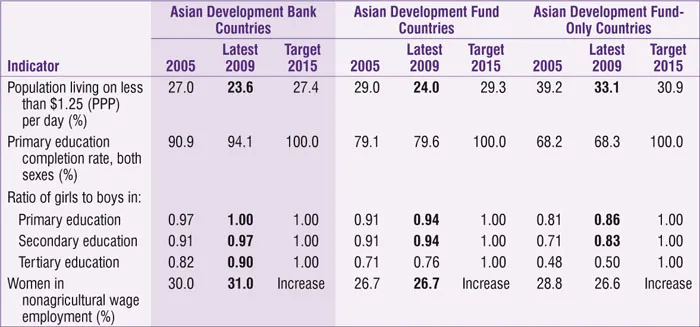
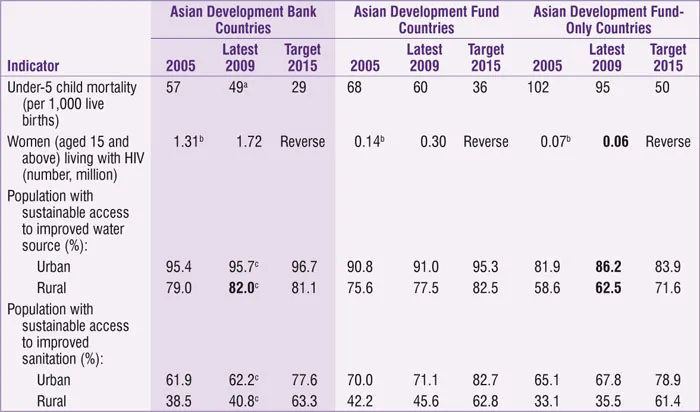
The region’s rapid economic expansion continued to reduce poverty and improve some social outcomes, often dramatically. However, wide gaps in country attainment remain (Table 1 and Appendix 1, Tables A1.1 and A1.2, and Appendix 4, Tables A4.1–A4.3). Overall, regional trends in poverty and human development remain unchanged since the last DEfR, underlining the urgency of accelerating efforts to achieve the Millennium Development Goals (MDGs) human development targets by 2015.
Table 1: Poverty and Human Development in Asia and the Pacific (Level 1)
PPP = purchasing power parity.
Note: For latest values, bold font signifies that the indicator is on track to achieve the internationally agreed target for 2015. Targets are calculated by ADB for its country groups based on 1990 official figures or earliest available data thereafter. ADB countries include all of its developing member countries. Asian Development Fund (ADF) countries are a subset of ADB countries that have access to the ADF (including blend countries with access to both ordinary capital resources and the ADF). ADF-only countries are a subset of ADB countries that have access only to the ADF. ADB, ADF, and ADF-only country lists are based on country classification during its eighth replenishment period (Appendix 2). Data have been revised to include new country data on poverty and development made available in 2010–2011 (Appendix 3, Table A3.1).
a 2010 data.
b 2001 data used for baseline.
c 2008 data.
Sources: Regional aggregates are prepared by the ADB Strategy and Policy Department using country data from the United Nations Economic and Social Commission for Asia and the Pacific (UNESCAP) Statistics Division as part of the partnership between ADB, the United Nations Development Programme, and UNESCAP on the Millennium Development Goals. Estimates are weighted averages of actual country values or imputed country values wherever data are missing for the year required; population data used as weights are from the United Nations Population Division, World Population Prospects: The 2010 Revision. New York for population data (accessed 4 October 2011); HIV data are from the Joint United Nations Programme on HIV/AIDS (UNAIDS). 2010. Report on the Global AIDS Epidemic 2010. Geneva.
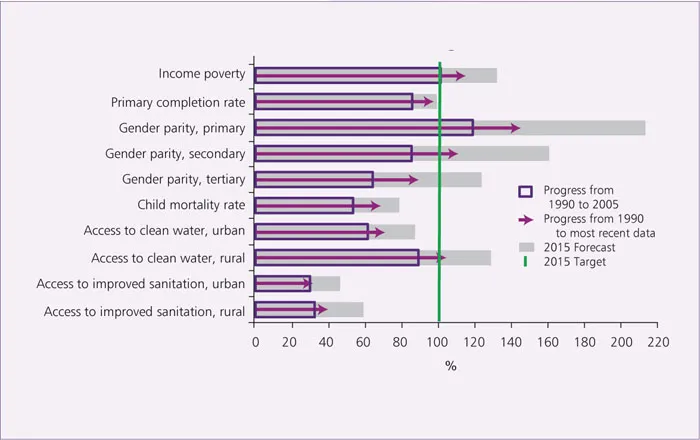
Figure 2 shows that the region has made considerable progress toward the MDGs since 1990—their baseline year—and illustrates the progress required to reach the 2015 targets for the selected indicators.4 While the targets for income poverty, gender parity in primary and secondary education, and access to clean water in rural areas have been met, targets for primary education completion, child mortality, access to clean water in urban areas, and access to improved sanitation in rural and urban areas are proving more difficult to achieve.
Figure 2: Progress since 1990 of Selected Millennium Development Goal Indicators toward 2015 Targets
Note: Figure shows the percentage progress achieved by selected indicators since the 1990 baseline relative to progress required to meet 2015 targets for the Millennium Development Goals.
Source: Asian Development Bank Strategy and Policy Department.
Only half of key performance indicators for poverty and human development outcomes are on track or above target, therefore the region’s score is mixed.5 ADF countries are also making insufficient progress in rural water supply and gender parity in tertiary education. With only one-third of indicators on track or above the MDG targets, progress for ADF countries as a group is rated poor. The performance of ADF-only countries is similar to ADB countries as a whole, with half of key performance indicators on track.6
Income Poverty
ADB and ADF countries achieved the 2015 income poverty target as early as 2005. ADF-only countries are on course to reach the target well before 2015. When the MDG target year is reached, the proportion of the population in ADB countries living on less than $1.25 a day is projected to be 18.6%, far surpassing the regional target of 27.4%. Despite this success, some countries have been left behind. In a quarter of countries in the region, at least 30% of the population was living in poverty in 2009.7 Growing income inequality continues to be a challenge for Asia and the Pacific. During 1990–2005, income inequality increased in 18 of the 28 countries for which data are available.
In seven Asian countries for which data has become available for 2008 and 2009, the global economic crisis had not—at least by 2009—slowed the pace of poverty reduction seen in the pre-crisis years.8 Most countries in the sample showed declines in the percentage of people living on less than $1.25 a day that were either similar to or larger than past trends would indicate. In Indonesia, for example, past trends would indicate 20.6% living on $1.25 a day, but 2009 data showed the figure was 18.7%.
Quality of Primary Education—Primary
In 2009, about 94% of primary-age children in ADB countries were attending school—a higher percentage than the developing regions of the world combined (89%). The net enrollment ratio increased by only 0.15 percentage points per year in 2005–2009 compared with 0.32 percentage points per year in 1999–2005. Despite the slowing progress, ADB countries as a group remain on track to meet the target of near-universal enrollment in primary education. One indicator used to gauge the quality of primary education is the percentage of children that complete the last grade of primary school. This increased steadily for ADB countries as a group; and in 2009, 94% of children in the region completed primary education. The completion rate for ADF countries was lower at 80% and for ADF-only countries at 68%. The biggest improvements in primary completion were in Bhutan (whose completion rate was among the lowest in 2005), Georgia, and India. However, the improvement was insufficient to enable the region as a whole, or the ADF and ADF-only countries, to achieve the target.
Gender Equality—Ratio of Girls to Boys in
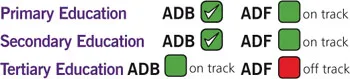
The region has already achieved gender parity based on enrollment in primary and secondary education, and is on track to achieve it in tertiary education by 2015. ADF and ADF-only countries are likely to match this performance only in primary and secondary education as gender disparity in tertiary education remains pronounced in these countries, partly because fewer girls tha...
Table of contents
Front Cover
Title Page
Copyright Page
Contents
Abbreviations
Executive Summary
Introduction
Level 1: Development Progress in the Region
Level 2: ADb’s Core Outputs and Outcomes
Level 3: ADb’s Operational Effectiveness
Level 4: ADb’s Organizational Effectiveness
Actions
Conclusion
Appendixes
Backcover
Trusted by 375,005 students
Access to over 1.5 million titles for a fair monthly price.
Study more efficiently using our study tools.
Frequently asked questions
Yes, you can cancel anytime from the Subscription tab in your account settings on the Perlego website. Your subscription will stay active until the end of your current billing period. Learn how to cancel your subscription
No, books cannot be downloaded as external files, such as PDFs, for use outside of Perlego. However, you can download books within the Perlego app for offline reading on mobile or tablet. Learn how to download books offline
Perlego offers two plans: Essential and Complete
Essential is ideal for learners and professionals who enjoy exploring a wide range of subjects. Access the Essential Library with 800,000+ trusted titles and best-sellers across business, personal growth, and the humanities. Includes unlimited reading time and Standard Read Aloud voice.
Complete: Perfect for advanced learners and researchers needing full, unrestricted access. Unlock 1.5M+ books across hundreds of subjects, including academic and specialized titles. The Complete Plan also includes advanced features like Premium Read Aloud and Research Assistant.
Both plans are available with monthly, semester, or annual billing cycles.
We are an online textbook subscription service, where you can get access to an entire online library for less than the price of a single book per month. With over 1.5 million books across 990+ topics, we’ve got you covered! Learn about our mission
Look out for the read-aloud symbol on your next book to see if you can listen to it. The read-aloud tool reads text aloud for you, highlighting the text as it is being read. You can pause it, speed it up and slow it down. Learn more about Read Aloud
Yes! You can use the Perlego app on both iOS and Android devices to read anytime, anywhere — even offline. Perfect for commutes or when you’re on the go. Please note we cannot support devices running on iOS 13 and Android 7 or earlier. Learn more about using the app
Yes, you can access Development Effectiveness Review 2011 Report by in PDF and/or ePUB format, as well as other popular books in Economics & Development Economics. We have over 1.5 million books available in our catalogue for you to explore.