Through the 3R initiative (Reduce, Reuse, Recycle), recycling will become part of local governments' solid waste management. To some extent, it will formalize parts of waste processing, largely handled by informal sector waste pickers and recyclers. With this publication, the Asian Development Bank aims to support the 3R initiative and encourage developing member countries to initiate investments in materials recovery facilities, which are essential tools for waste recycling under the initiative. This tool kit will be useful in deciding the size and design of such facilities as it also provides an indication of the cost of such investments.
- 48 pages
- English
- ePUB (mobile friendly)
- Available on iOS & Android
eBook - ePub
About this book
Information
Parameters Considered in Planning, Design, and Operation of Materials Recovery Facilities
Nature of Waste Generators
The nature of waste generators should be considered when planning MRFs. Residential areas discard newspaper, mixed paper, plastics, clothing, food packaging, cans and bottles, food scraps, and yard trimmings. Commercial and institutional establishments dispose of cardboard, office paper and mixed paper, newspaper, packaging materials, and food waste. Schools and offices produce predominantly paper waste. Industrial facilities produce more packaging materials than most waste generators. Hotel and restaurants generate a large amount of plastic bottles and tin cans.
Urban areas tend to generate more paper and plastic materials than rural areas. Low- to medium-income residential areas segregate more recyclable materials than high-income residences.
Waste Composition
Local government units submit results of waste characterization studies (WACS) to the National Solid Waste Management Commission. The data are usually presented as tables and pie diagrams similar to Figure 2, which show relative percentages of different waste components. Recyclable materials determined from WACS conducted at source range from 40% to 50% of the generated waste. It is, however, misleading to think that this is similar to the amount of salable recyclables gained in MRFs, considering that materials segregated may be contaminated or not segregable (i.e., too small for hand sorting and/or not identifiable by the mechanical sorting equipment). Therefore, an end-of-pipe WACS must be conducted prior to acquiring equipment to process the recyclables. Where possible, the WACS should determine the amount or proportion of recyclables that is segregated at the collection trucks. A mass balance of the waste must be prepared to determine the amount of each material the facility must process and store, as well as the quantity of residuals that must be disposed of or subjected to further processing at the expected year or period of the start of MRF operations.
Figure 2 Metro Manila Waste Composition, 2013 (%)
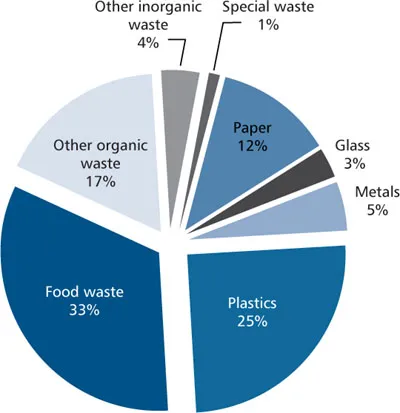
Source: ADB. 2002. Technical Assistance to the Philippines for Metro Manila Solid Waste Management. Manila (TA 3848-PHI) and Department of Environment and Natural Resources.
Waste Generation
Waste generation rates indicate how much waste can be generated by a given city or municipality, which can potentially serve as the source of recyclables for MRFs. In the Philippines, the estimated per capita waste generation rates observed in rural and urban areas are 0.3 kilograms per day (kg/day) and 0.7 kg/day, respectively. Table 2 shows the waste generation rates of key Asian cities, which could serve as a guide for the potential waste that can be generated by the city which intends to build and operate an MRF. The MRF proponent should take note that generation rates increase with economic activity and should be updated by conducting WACS for a more updated and realistic estimate of potential recyclable waste.
Table 2 Waste Generation Rates of Key Asian Cities (kilograms/day)
City | Per Capita Waste Generation | Year |
Phnom Penh, Cambodia | 0.740 | 2005a |
Vientiane, Lao PDR | 0.686 | 2011b |
Dhaka, Bangladesh | 0.340 | 2004c |
Ho Chi Minh City, Viet Nam | 0.81 | 2009d |
Kolkata, India | 0.605 | 2011e |
Jakarta, Indonesia | 0.713 | 2008f |
Beijing, People’s Republic of China | 0.85 | 2006g |
Kuala Lumpur | 1.72 | 2011h |
Bangkok, Thailand | 0.98 | 2008i |
Singapore | 3.65 | 2011j |
a Japan International Cooperation Agency. 2005. The Study on Solid Waste Management in the Municipality of Phnom Penh in the Kingdom of Cambodia. Final Report. Phnom Penh, Cambodia: JICA.
b LPPE Newsletter. 2012. Baseline Survey on Urban Environment in the 3 Cities. February 2012. Volume 2. http://www.jica.go.jp/project/laos/008/news/environment/pdf/newsletter_02.pdf.
c Japan International Cooperation Agency. 2005. The Study on the Solid Waste Management in Dhaka City. Final Report. Clean Dhaka Master Plan. Volume 2.
d Ho Chi Minh City People’s Committee. 2011. Solid Waste Management in Ho Chi Minh City, Viet Nam. Kitakyushu, Japan. 14–16 March. http://www.iges.or.jp/en/kuc/pdf/activity20110314/8_WS-S1B-2-Viet-HoChiMinh-E.pdf
e R. K. Annepu. 2012. Sustainable Waste Management in India. New York: Columbia University. Available at http://www.seas.columbia.edu/earth/wtert/sofos/Sustainable%20Solid%20Waste%20Management%20in%20India_Final.pdf
f Jakarta Capital City Government. 2010. Waste Management in Jakarta. Tokyo: Asian Network of Major Cities.
g Z. S. Li, et al. 2009. Municipal Solid Waste Management in Beijing City. Waste Management. 29 (2009). pp. 2596–2599.
h N. A. Kabbashi, et al. 2011. Integrated Scheduled Waste Management System in Kuala Lumpur Using Expert System. African Journal of Biotechnology. 10 (81). pp. 18781–18787.
i S. Jungrungruen. 2011. Solid Waste Management in Bangkok. http://www.iges.or.jp/en/kuc/pdf/activity20110314/9_WSS1B-3-Bangkok_E.pdf
j National Environmental Agency. Singapore Waste Statistics 2010. http://www.zerowastesg.com/ (accessed 8 September 2012).
Waste Collection
Collection is usually presented as a percentage of total waste generation. It immediately gives an indication of the amount of waste that can be processed in an MRF. Waste ...
Table of contents
- Front Cover
- Title Page
- Copyright Page
- Contents
- List of Tables and Figures
- Preface
- Abbreviations
- Currency Equivalents
- Definition of Key Terms
- Introduction
- Materials Recovery Facilities and Solid Waste Management Systems
- Types of Materials Recovery Facilities
- Materials Recovery Facility Siting Criteria
- Parameters Considered in Planning, Design, and Operation of Materials Recovery Facilities
- Design of a Materials Recovery Facility
- Materials Recovery Facility Operations
- Recommendations and Considerations for Feasible Facilities
- Appendixes
- References
- Back Cover
Trusted by 375,005 students
Access to over 1.5 million titles for a fair monthly price.
Study more efficiently using our study tools.
Frequently asked questions
Yes, you can cancel anytime from the Subscription tab in your account settings on the Perlego website. Your subscription will stay active until the end of your current billing period. Learn how to cancel your subscription
No, books cannot be downloaded as external files, such as PDFs, for use outside of Perlego. However, you can download books within the Perlego app for offline reading on mobile or tablet. Learn how to download books offline
Perlego offers two plans: Essential and Complete
- Essential is ideal for learners and professionals who enjoy exploring a wide range of subjects. Access the Essential Library with 800,000+ trusted titles and best-sellers across business, personal growth, and the humanities. Includes unlimited reading time and Standard Read Aloud voice.
- Complete: Perfect for advanced learners and researchers needing full, unrestricted access. Unlock 1.5M+ books across hundreds of subjects, including academic and specialized titles. The Complete Plan also includes advanced features like Premium Read Aloud and Research Assistant.
We are an online textbook subscription service, where you can get access to an entire online library for less than the price of a single book per month. With over 1.5 million books across 990+ topics, we’ve got you covered! Learn about our mission
Look out for the read-aloud symbol on your next book to see if you can listen to it. The read-aloud tool reads text aloud for you, highlighting the text as it is being read. You can pause it, speed it up and slow it down. Learn more about Read Aloud
Yes! You can use the Perlego app on both iOS and Android devices to read anytime, anywhere — even offline. Perfect for commutes or when you’re on the go.
Please note we cannot support devices running on iOS 13 and Android 7 or earlier. Learn more about using the app
Please note we cannot support devices running on iOS 13 and Android 7 or earlier. Learn more about using the app
Yes, you can access Materials Recovery Facility Tool Kit by in PDF and/or ePUB format, as well as other popular books in Technology & Engineering & Environmental Management. We have over 1.5 million books available in our catalogue for you to explore.