An integrated, prosperous, and equitable Mekong subregion is the vision of the Greater Mekong Subregion (GMS) Economic Cooperation Program. Developing the energy sector is critical to realizing this vision. The results of the formal energy modeling exercise make a strong case for pursuing an integrated regional energy strategy. Targeted and sustained policy actions, including reforms, are necessary for a viable GMS energy strategy. Private sector participation is also key in accomplishing this goal. This book synthesizes the output of the consultative process undertaken by the Asian Development Bank's technical assistance to develop a GMS energy strategy, and proposes concrete actions for a cleaner, brighter energy future for the subregion.
- 224 pages
- English
- ePUB (mobile friendly)
- Available on iOS & Android
eBook - ePub
About this book
Information
1
Coming Together—The Greater Mekong Subregion
The Greater Mekong Subregion (GMS) Economic Cooperation Program (the Program) is the driving force in bringing together the six countries that share the Mekong River—Cambodia, People’s Republic of China (PRC), Lao People’s Democratic Republic (Lao PDR), Myanmar, Thailand, and Viet Nam. Within the subregion, the PRC is represented by the Guangxi Zhuang Autonomous Region (Guangxi) and Yunnan Province (Yunnan). The GMS covers 2.6 million square kilometers, which is roughly an area the size of the Eurozone, and is home to a total population of about 320 million (Table 1). The subregion has significant potential for rapid and sustained economic growth, given its abundance of human and natural resources and its strategic location that acts as a “land bridge” between South and East Asia.
Table 1. GMS Physical Indicators, 2005
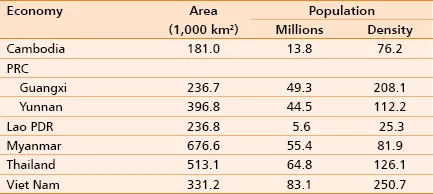
km2 = square kilometer, GMS = Greater Mekong Subregion, Lao PDR = Lao People’s Democratic Republic, PRC = People’s Republic of China.
Note: Density is defined as the number of persons per km2.
Sources: ADB. 2007c. Key Indicators. Manila. and China Data Online 2008.
Despite the subregion’s geographic advantage, rapid rate of economic growth, and abundance of natural resources, about 15 million GMS inhabitants are still poor, surviving on less than the equivalent of $1 a day, with nearly 60% of the population earning less than $2 a day. The GMS Program thus envisions a more integrated, prosperous, and equitable Mekong subregion, and its goal is to achieve this by complementing national efforts in promoting economic growth and reducing poverty. As a result, the Program focuses on expanding trade and investment among member economies, facilitating cross-border movement of people and goods, and addressing common resource and policy requirements. The Program underscores the importance of the “three Cs”: greater Connectivity to enhance Competitiveness to help build a prosperous, cohesive Community.
The GMS Program is a results-oriented and pragmatic initiative guided by a set of general principles and institutional arrangements. Within this context, all member economies jointly plan and implement projects for their mutual benefit. Activities under the program focus on several strategic areas, and can be grouped into three major categories: (i) physical infrastructure (transport, power, and telecommunication facilities) to promote overall economic growth and greater trade, investment, and tourism flows; (ii) policy and institutional initiatives to maximize the benefits of physical infrastructure; and (iii) initiatives to address common concerns relating to social development and environmental sustainability.
In sum, the GMS Program helps realize the subregion’s potential for economic growth and social development. It does this by (i) creating policies that promote growth, (ii) strengthening infrastructure linkages that facilitate economic cooperation, (iii) developing the subregion’s human resources, and (iv) respecting the environment and the social interests of its member economies. The Program aims to ensure sustainable and equitable economic development.
At their first summit held at Phnom Penh, Cambodia in November 2002, the six GMS member economies formulated and endorsed a 10-year strategic framework that envisions an integrated and prosperous Mekong subregion free of poverty and committed to environmental protection. Its overall aim is to ensure that the economic benefits of regional cooperation and rapid growth are delivered within a context of rising income and continual improvement in the quality of life, and that both of these are shared as widely as possible.
Growth, Poverty, and Human Development
Energy is of crucial importance in fulfilling the Program’s vision of economic development and continuous improvement in the quality of life. While access to modern energy is not by itself a goal, it is a critical element in attaining virtually all of the Millennium Development Goals (MDGs). A common recommendation of the 10 Task Forces of the United Nations (UN) Millennium Project was to improve access to energy services as a means of meeting each MDG. Appendix 1 describes GMS’s progress in achieving these goals.
Some of the linkages between access to modern energy and achieving the MDGs are direct. For example, energy is a key input into industrial development, transport, and communications, all three of which are directly linked to economic development and poverty reduction. Effective health care service delivery requires access to modern energy sources. Media campaigns for spreading awareness of health threats from HIV/AIDS, malaria, and other communicable diseases are unlikely to succeed if the target population lacks access to electricity.
Indirect linkages between access to modern energy forms and success in achieving development-related goals also exist. Teachers and doctors are unlikely to serve in rural areas or isolated communities that lack access to modern energy sources. Electricity extends the working day for students, and access to modern cooking fuels saves time otherwise spent in collecting fuelwood. Similarly, unchecked use of traditional fuels leads to deforestation, soil erosion, and reduced soil fertility, and causes indoor pollution that leads to major health risks.
Access to energy is positively linked to fulfilling goals related to health and education. Several studies have established a link between the human development index (HDI) ranking of a country or province and access to modern energy sources. Figure 1 shows that most countries with high HDI rankings also have high levels of electricity consumption. In this regard, there is an important threshold level of annual per capita electricity consumption of 4,000 kilowatt-hours (kWh) that corresponds to an HDI value of 0.9.1
Figure 1. Human Development Index and Global Per Capita Electricity Consumption, 2005
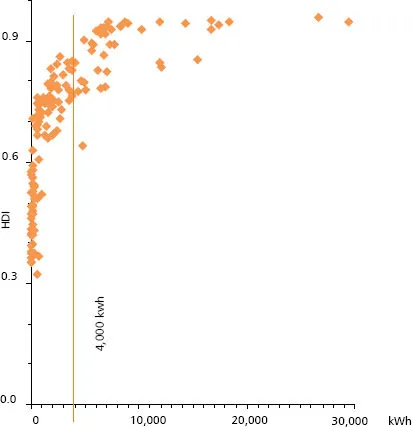
kWh = kilowatt-h...
Table of contents
- Front Cover
- Title Page
- Copyright Page
- Contents
- Abbreviations
- Foreword
- Acknowledgments
- Executive Summary
- 1. Coming Together – The GMS
- 2. Emerging Challenges in the GMS
- 3. Why Integrate the Energy Sector?
- 4. The Economics of Energy Integration
- 5. Energy Trade under the GMS Integrated Scenario
- 6. A Shared Energy Future: What Will It Take?
- 7. A Shared Energy Future: Acting Now
- Endnotes
- Appendixes
- References
- Back Cover
Trusted by 375,005 students
Access to over 1.5 million titles for a fair monthly price.
Study more efficiently using our study tools.
Frequently asked questions
Yes, you can cancel anytime from the Subscription tab in your account settings on the Perlego website. Your subscription will stay active until the end of your current billing period. Learn how to cancel your subscription
No, books cannot be downloaded as external files, such as PDFs, for use outside of Perlego. However, you can download books within the Perlego app for offline reading on mobile or tablet. Learn how to download books offline
Perlego offers two plans: Essential and Complete
- Essential is ideal for learners and professionals who enjoy exploring a wide range of subjects. Access the Essential Library with 800,000+ trusted titles and best-sellers across business, personal growth, and the humanities. Includes unlimited reading time and Standard Read Aloud voice.
- Complete: Perfect for advanced learners and researchers needing full, unrestricted access. Unlock 1.5M+ books across hundreds of subjects, including academic and specialized titles. The Complete Plan also includes advanced features like Premium Read Aloud and Research Assistant.
We are an online textbook subscription service, where you can get access to an entire online library for less than the price of a single book per month. With over 1.5 million books across 990+ topics, we’ve got you covered! Learn about our mission
Look out for the read-aloud symbol on your next book to see if you can listen to it. The read-aloud tool reads text aloud for you, highlighting the text as it is being read. You can pause it, speed it up and slow it down. Learn more about Read Aloud
Yes! You can use the Perlego app on both iOS and Android devices to read anytime, anywhere — even offline. Perfect for commutes or when you’re on the go.
Please note we cannot support devices running on iOS 13 and Android 7 or earlier. Learn more about using the app
Please note we cannot support devices running on iOS 13 and Android 7 or earlier. Learn more about using the app
Yes, you can access Building a Sustainable Energy Future by in PDF and/or ePUB format, as well as other popular books in Business & Energy Industry. We have over 1.5 million books available in our catalogue for you to explore.