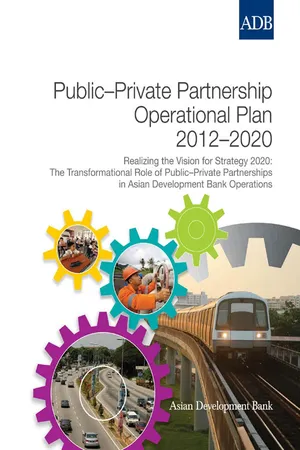
The Public-Private Partnership Operational Plan 2012-2020 provides a consistent analytical and operational framework for scaling up public-private partnerships (PPPs) in support of Strategy 2020. The PPP operations of the Asian Development Bank (ADB) are based on four pillars: (i) advocacy and capacity development, (ii) enabling environment, (iii) project development, and (iv) project financing. Applying PPP principles holistically to ADB operations holds the potential to vastly improve the quality of design and outputs of PPP projects in support of Strategy 2020 targets. It also provides ADB with an opportunity to significantly leverage its limited resources in attracting private sector investments and commercial financing to meet the Asia and Pacific region's huge and growing infrastructure investment needs.
- 79 pages
- English
- ePUB (mobile friendly)
- Available on iOS & Android
eBook - ePub
About this book
Information
Appendix 1
Characteristics of Public–Private Partnerships
1. Public–private partnerships. Public–private partnerships (PPPs) are generally characterized by five key elements: (i) duration; (ii) asset financing, life-cycle responsibility, and ownership; (iii) performance-based returns; (iv) output and quality of service specification; and (v) risk allocation to the private sector.
2. Duration. The relationship between the public partner and private partner for a planned project, which is usually medium to long term, requires a contract addressing different aspects. Continuous monitoring during the entire life of the contract would ensure efficiencies from long-term private sector–led asset management.
3. Asset financing, life-cycle responsibility, and ownership. The asset financing or the method of project funding, in part or full from the public or private sector, sometimes involves complex arrangements between the various participants, with the ownership of the assets often reverting to the public sector at the end of the arrangement. Since the private sector is responsible for maintaining the asset through its useful life, this is an incentive to build an asset that optimizes periodic life-cycle maintenance costs.
4. Performance-based returns. Emphasis is on the specification and delivery of services associated with the procured asset rather than the asset itself, so well-functioning PPP arrangements often specify that payment is contingent on the operator meeting a set of performance standards in service delivery. Among the most important benefits of PPP are the achievable efficiency gains and substantial risk allocation to the private sector rather than just access to private finance.
5. Output and quality of service specification. The roles and responsibilities of the private and public sectors differ. The private sector partner has the potential to participate in different project stages (design, construction and/or rehabilitation, operation, maintenance, and funding) depending on the need defined by the public sector. The public sector partner concentrates primarily on defining the outcomes to be attained in terms of public interest, quality of services provided, and pricing policy. The public sector may need to provide, on a case-by-case basis, required financial support (e.g., availability payments, minimum revenue guarantees, loan guarantees, and viability gap funding). When such public funding is available, whether to complement user fees, the contracts will directly link the release of such public funding to the actual delivery and availability of services. Performance must be monitored over the whole life of the contract to ensure efficiencies from long-term private asset management. Thus, the public sector partner also takes responsibility for monitoring compliance with outcomes and managing contingent liabilities.
6. Risk allocation to the private sector. Risks generally borne by the public sector in traditional construction or turnkey contracts are distributed between the public and private partners. However, a PPP does not necessarily mean that the private partner assumes all the risks, or even the major share of risks linked to the project.
7. The precise distribution of risks is determined case by case according to the respective ability of the public and private sector partners concerned to assess, control, and cope with the risk. The most important principle of risk allocation arrangements in PPPs is that risks are disaggregated, quantified, and allocated to the party best able to manage each risk. Sectors in which PPPs have been completed worldwide include
(i) energy and power generation, transmission, distribution, and street lighting;
(ii) telecommunications;
(iii) transport, that is, ports, roads and highways, bridges, railways, airports, urban transport facilities like mass transit facilities, bus stations, and parking;
(iv) water and wastewater management, and desalinization plants;
(v) solid waste management and effluent treatment plants;
(vi) hospitals and health services;
(vii) school buildings, teaching facilities, and higher education institutes;
(viii) tourism infrastructure and facilities including those for meetings, conferences, and exhibitions;
(ix) other infrastructure and/or public sector services such as government buildings, low-income housing, stadiums, prisons, billing, and other information and communication technology systems; and
(x) prison and correction services.
Appendix 2
Project Development Process for Public–Private Partnerships
1. A good project development process is a critical factor in the successful implementation of a public–private partnership (PPP) project. The process involves several critical steps and requires multidisciplinary skills to make the process robust and the project bankable. It thus forms a critical part of activities of the Asian Development Bank (ADB) Public–Private Partnership Operational Plan, 2012–2020 under Pillar 3: Increased ADB support for creating project pipelines and undertaking project development (Appendix 6).
A. Project Development Phase
2. The primary objective of the project development phase is to ensure that the proposed project is properly positioned for commercial implementation. The project must be sufficiently defined to provide the government a basis for awarding clearances, to provide commercial investors a basis for assessing the viability and hence the attractiveness of investing in the project, and to provide a sufficiently rigorous and transparent basis to select a partner.
3. The government perspective. The key requirement for the government is the ability to demonstrate that the project is constructed, operated, and maintained in a demonstrably cost-effective manner and offers value for money. The government should also ensure that the project conforms to public standards, especially with respect to user charges, environmental and social standards, regulatory aspects, and applicable design and performance standards. Furthermore, where government support is required, the project must explicitly demonstrate the need and form of such support.
4. The commercial perspective. The key commercial concerns and requirements include
(i) definitiveness of the project concept and scope;
(ii) certainty of revenue streams;
(iii) project structure, especially with a view to ensuring greater investor interest in the project;
(iv) perceived risks of the project;
(v) extent of government support; and
(vi) rigor and comprehensiveness of the contractual framework.
5. Successful commercialization of infrastructure projects requires the resolution and balancing of the requirements of both the government and the private sector. To fully satisfy these requirements, documentation to be generated during project development must explicitly reflect these concerns and provide a sufficiently rigorous basis for its recommendations. The documentation and specific steps include a detailed feasibility and bankability assessment, environmental and social assessment, contractual framework, procurement process, and risk management plan.
1. Detailed Feasibility and Bankability Assessment
6. The detailed feasibility and bankability assessment (i.e., the business case) conducted during project development includes the following activities.
(i) Feasibility assessment. To raise commercial resources for infrastructure projects, the project must exhibit the requisite capacity to service investments. The feasibility study must establish the viability of the project to the extent that it is capable of sustaining commercial scrutiny.
(ii) Project cost estimates. Project cost estimates include
(a) inflation indexation up to the year of commissioning;
(b) interest during construction;
(c) initial working capital deficits; and
(d) other financing costs, including provisioning for reserve accounts or meeting other covenants as required by lenders.
(iii) Revenue potential. On the cash-flow side, the willingness of users to pay for the services needs to be demonstrated. The intent of the feasibility study should be to establish unambiguously the viability of the project on a pure cash-flow basis. The financial feasibility of the project should be analyzed using the discounted cash-flow analysis technique. Legal structures need to be developed to provide a framework for resource mobilization to access alternate sources of finance in a cost-effective manner. The framework design should take into account issues relating to fiscal constraints, project cash-flow profiles, and access to capital markets.
(iv) Financing strategy. An appropriate financing mix needs to be developed based on the determination of the proposed project’s operating cash flow. This would address issues relating to debt–equity structures, maturity profile, and type of investment best suited for the project; sustainable cost of funds; construction financing; and the need to reinvest surplus-operating cash flows. In this exercise, project expenditure needs to be phased to match resource-raising ability and servicing requirements.
(v) Credit structure. The credit structure provides a framework for risk management, taking into account risks during construction and operation. Construction risks broadly include execution-related risks and financial risks. The execution risks are technical and logistical in nature. Financial risks need to be evaluated in the context of the construction estimates and the acquisition of land for the particular project. Financial risks primarily relate to the tasks of dovetailing the liquidity requirements of the project with the fund mobilization program. Operator risks relate to demand generation, operator ability, and debt-servicing ability over the operating life of the project.
(vi) The need for asset quality. As the recovery of the investment is predicted on the levy of user charges or availability of payments from the government, the asset created must be of quality as specified in the contract and that
(a) users are amenable to levies if there is direct correlation between the money they spend and the quality delivered; and
(b) no user charge will be collected if the physical condition of the asset deteriorates, service provision is erratic, or the service is not available as stipulated in the contract.
(vii) Risk management. The risk relating to asset quality can be mitigated only through the choice of a reputable contractor with a track record of timely delivery, who demonstrates pride in the asset created. The procurement process should thus remain independent of local requirements and lead to the transparent selection of the most competitive offer. Transparent procurement processes are preconditions for international investment and multilateral participation in the financing of a project.
(viii) Timely execution. The essence of commercialization entails ...
Table of contents
- Front Cover
- Title Page
- Copyright Page
- Contents
- Abbreviations
- Executive Summary
- I. Introduction
- II. Conceptual Framework
- III. Challenges in Infrastructure Financing
- IV. Public–Private Partnership Operational and Guiding Principles
- V. Implementation of the Operational Plan
- Appendixes
- Back Cover
Trusted by 375,005 students
Access to over 1.5 million titles for a fair monthly price.
Study more efficiently using our study tools.
Frequently asked questions
Yes, you can cancel anytime from the Subscription tab in your account settings on the Perlego website. Your subscription will stay active until the end of your current billing period. Learn how to cancel your subscription
No, books cannot be downloaded as external files, such as PDFs, for use outside of Perlego. However, you can download books within the Perlego app for offline reading on mobile or tablet. Learn how to download books offline
Perlego offers two plans: Essential and Complete
- Essential is ideal for learners and professionals who enjoy exploring a wide range of subjects. Access the Essential Library with 800,000+ trusted titles and best-sellers across business, personal growth, and the humanities. Includes unlimited reading time and Standard Read Aloud voice.
- Complete: Perfect for advanced learners and researchers needing full, unrestricted access. Unlock 1.5M+ books across hundreds of subjects, including academic and specialized titles. The Complete Plan also includes advanced features like Premium Read Aloud and Research Assistant.
We are an online textbook subscription service, where you can get access to an entire online library for less than the price of a single book per month. With over 1.5 million books across 990+ topics, we’ve got you covered! Learn about our mission
Look out for the read-aloud symbol on your next book to see if you can listen to it. The read-aloud tool reads text aloud for you, highlighting the text as it is being read. You can pause it, speed it up and slow it down. Learn more about Read Aloud
Yes! You can use the Perlego app on both iOS and Android devices to read anytime, anywhere — even offline. Perfect for commutes or when you’re on the go.
Please note we cannot support devices running on iOS 13 and Android 7 or earlier. Learn more about using the app
Please note we cannot support devices running on iOS 13 and Android 7 or earlier. Learn more about using the app
Yes, you can access Public-Private Partnership Operational Plan 2012-2020 by in PDF and/or ePUB format, as well as other popular books in Business & Business Development. We have over 1.5 million books available in our catalogue for you to explore.