The economic success of the People's Republic of China (PRC) over the last three decades has brought with it new challenges. With a per capita gross national income of $4,930 in 2011, the PRC has just passed the threshold of upper-middle-income status and it still has a long way to go before becoming a high-income country. But with rising wages and population aging, growth will have to be increasingly driven by productivity improvement through innovation and industrial upgrading---the PRC needs to move from a lowcost to a high-value economy. Moreover, rapid growth has exposed several structural problems, in particular, economic imbalances, rising inequality, resource constraints, and environmental degradation. If not addressed, these problems could hinder PRC's efforts in moving toward a high-value economy and increase the risk of getting caught in what is increasingly known as the "middle-income trap."
eBook - ePub
Growing Beyond the Low-Cost Advantage
How the People's Republic of China can Avoid the Middle-Income Trap
- 92 pages
- English
- ePUB (mobile friendly)
- Available on iOS & Android
eBook - ePub
Growing Beyond the Low-Cost Advantage
How the People's Republic of China can Avoid the Middle-Income Trap
About this book
Information
1. Introduction
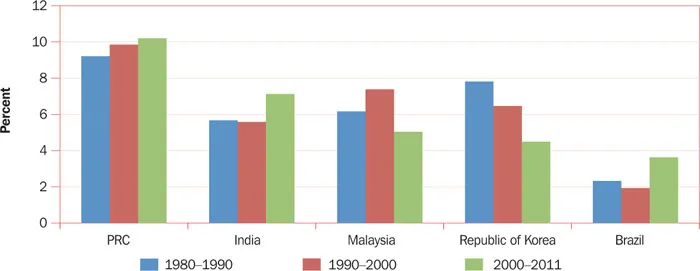
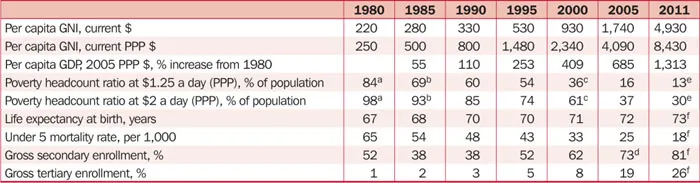
Economic growth in the People’s Republic of China (PRC) has been spectacular since reforms began in the late 1970s. During 1980–2011, gross domestic product (GDP) expanded at an average rate of about 10% per year (Figure 1.1). Per capita income increased by a factor of 13 in constant 2005 purchasing power parity (PPP) dollars (Table 1.1). From a very poor and agriculture-based economy 30 years ago, the PRC has reached upper middle-income status with a large industrial base, and is now often called the “workshop of the world.”
Figure 1.1 Average annual GDP growth, selected economies, 1980–2011
GDP = gross domestic product, PRC = People’s Republic of China.
Source: World Bank, World Development Indicators Online (accessed 19 July 2012).
Table 1.1 PRC: Per capita income and human development indicators, 1980–2011
a 1981 data. b 1984 data. c 1999 data. d 2006 data. e 2008 data. f 2010 data.
GDP = gross domestic product, GNI = gross national income, PPP = purchasing power parity, PRC = People’s Republic of China.
Note: Gross enrollment ratio is the ratio of total enrollment, regardless of age, to the population of the age group that officially corresponds to the level of education shown.
Source: World Bank, World Development Indicators Online (accessed July 2012).
Rapid growth and structural transformation have significantly reduced poverty, improved human wellbeing, and created a decent standard of living. When the reforms began, 84% of the population lived below the internationally accepted poverty line of $1.25 per person per day (Table 1.1). By 2008, that proportion had fallen to 13%—an incredible achievement. Longevity increased from 67 years in 1980 to 73 years in 2010, and child mortality under the age of 5 years declined from 65 to 18 deaths per 1,000 during the same period. These impressive achievements have been emulated by very few developing economies, and, in recent years, have become the envy of both emerging and advanced countries.
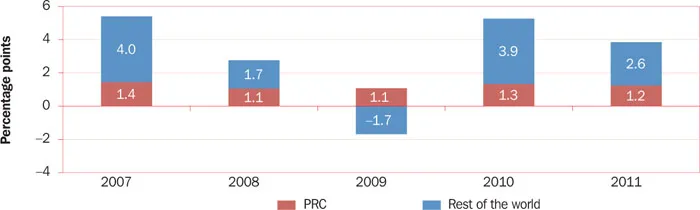
Rapid economic expansion has also led to a sharp rise in the country’s importance globally. The PRC is now the world’s largest exporter, the largest holder of foreign reserves, and the second largest economy after the United States (US). What happens in the PRC matters greatly to the rest of the world. The Millennium Development Goal (MDG) of reducing global poverty by half will be achieved by 2015 largely because of the PRC. The world economy recovered quickly from the 2008 global financial crisis because the PRC, India, and other emerging economies managed to sustain demand and growth (Figure 1.2). The current century can indeed become an “Asian century” only if the PRC—along with India—continues to make rapid economic progress (ADB 2011a). The PRC’s influence on global economic policy and governance is also growing rapidly and will continue to do so.
Figure 1.2 Contribution of the PRC to global growth, 2007–2011
PRC = People’s Republic of China.
Sources: ADB staff estimates using data from IMF, World Economic Outlook April 2012; and ADB, Asian Development Outlook 2012.
The PRC’s impressive achievement, however, should not make one lose sight of the major challenges it faces.
• First, despite significant gains, PRC’s technological and productivity gaps with advanced economies remain large. With a per capita gross national income (GNI) of $4,930 in 2011, it still has a long way to go before becoming a high-income country.
• Second, the country’s rapid growth in recent decades has benefited greatly from its low-cost advantage, especially in labor. However, with declining rural surplus labor and rising wages, growth will have to be increasingly driven by productivity improvement through innovation and industrial upgrading—the PRC needs to move from a low-cost to a high-value economy which is much more challenging.
• Third, rapid growth has exposed several structural problems in the economy, in particular, imbalances in the sources of growth and rising income inequality. While to some extent these are often associated with rapid structural transformation, incomplete reform is a major contributing factor. If not addressed, these problems could hinder the PRC’s efforts in moving toward a high-value economy.
• Fourth, rapid growth has also created enormous pressures on resources, such as energy and water, and the environment.
Because of these challenges, a question observers and commentators often ask is: How long can the country’s strong growth continue? With the current weak global economy and slowdown in the PRC growth, this question has only gained in relevance.
International experiences show that, in many countries, growth slowed significantly after they attained middle-income status. They find they were caught in what is increasingly known as the “middle-income trap.” On one hand, they could no longer compete with low-income countries because of rising wages. On the other, they were unable to compete with high-income countries because they have not shifted into higher-value production through innovation and industrial upgrading. Many Latin American countries and several Southeast Asian economies are often considered caught in the middle-income trap—they became middle-income countries some 40–50 years ago and are likely to languish there for many years to come. While the PRC graduated from low- to middle-income status only in 1998, policy makers are increasingly concerned with the danger of getting caught in the trap.
This report argues that, to avoid the middle-income trap, the PRC needs to tackle its emerging challenges effectively. Doing so requires a development strategy containing the following key agenda:
• Stepping up innovation and industrial upgrading;
• Deepening structural reforms, in particular reforms of enterprises, factor markets, and the fiscal system;
• Expanding services and scaling up urbanization;
• Maintaining macroeconomic and financial stability;
• Reducing income inequality to make growth more inclusive;
• Promoting green growth to conserve resources and protect the environment; and
• Strengthening international and regional economic cooperation.
Effective implementation of this strategy would enable the PRC to continue to grow at a robust pace and grow beyond its low-cost advantage. It would make the PRC technologically more advanced, structurally more balanced, socially more inclusive, and environmentally more sustainable—thereby greatly increasing the likelihood of advancing into high-income status before 2030. The report notes that, encouragingly, the PRC’s 12th Five-Year Plan has introduced many policy measures that support these agenda.
The rest of the report is organized as follows. Section 2 discusses the key drivers of the PRC’s rapid growth over the past 30 years; Section 3 explains how a country enters the middle-income trap and discusses policy lessons learned from both countries caught in the trap and those that successfully avoided it; Section 4 examines the emerging challenges the PRC faces, which, if not addressed effectively, pose significant risks to its long-term growth; Section 5 discusses policy options to consider in sustaining growth and avoiding the middle-income trap; and finally, Section 6 examines the outlook of the PRC economy up to 2030.
2. Key drivers of the PRC’s economic performance in recent decades
The PRC’s remarkable achievement in economic transformation and social development was built on three key drivers: (i) market-oriented reform, (ii) low-cost advantage, and (iii) the role of the government. These have been supported by a range of other factors that helped create a virtuous cycle of growth and development.
2.1. Market-oriented reform
The first and most fundamental success factor was market-oriented reform since the late 1970s. The shift away from central planning allowed market forces to determine prices, enterprises to make production decisions based on demand and supply, and private businesses to compete in the marketplace. These changes unleashed powerful economic incentives and significantly improved the efficiency of resource allocation and utilization. At the same time, the government managed the reform process in a gradual and pragmatic manner. As in the words of former PRC leader Deng Xiaoping, the government sought to “cross the river by feeling the stones.” By doing so, the economy reformed while ensuring stability. For example, the PRC avoided the destabilization brought on by the rapid and wholesale privatization that sparked economic crises in other transitional economies.
A key aspect of this reform was the liberalization of foreign trade and investment (Figure 2.1). Increased trade openness—culminating in accession to the World Trade Organization in 2001—exposed the PRC firms to international competition and allowed them to explore this comparative advantage. It also opened doors to vast global markets, while offering economies of scale and access to needed capital goods and other resources. In addition, foreign direct investment (FDI) played an important role in supporting industrial expansion. It helped improve export competitiveness by providing access to advanced technologies, management skills, and external capital. FDI, in turn, was attracted by a low-cost production base and the country’s vast and expanding domestic market.
Figure 2.1 Share of global exports and FDI, selected economies, 1980–2010
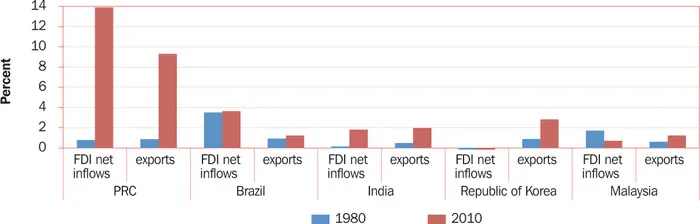
FDI = foreign direct investment, PRC = People’s Republic of China.
Note: 1980 FDI for PRC refer to 1982. Exports consist of goods and services.
Source: World Bank, World Development Indicators Online (accessed January 2012).
2.2. Low-cost advantage
The second key driver of economic success was the PRC’s low-cost advantage—largely the result of a vast army of rural surplus labor, typical of a dual economy (Lewis 1954). This ensured a steady supply of low-cost labor for the modern, formal sectors in urban and industrial areas. Labor-intensive manufacturing and services grew rapidly, allowing firms to re-invest retained earnings in a classic pattern of development and structural transformation. For any low-income country, its comparative advantage lies in producing goods that require low technology at low labor costs. As recently as 2010, hourly compensation rates in the PRC remained slightly below the Philippines, and considerably ...
Table of contents
- Front Cover
- Title Page
- Copyright Page
- Contents
- Boxes, Figures, and Tables
- Foreword
- Preface
- Acknowledgments
- Abbreviations and Acronyms
- Executive Summary
- 1. Introduction
- 2. Key drivers of the PRC’s economic performance in recent decades
- 3. The middle-income trap and policy lessons
- 4. Sustaining the PRC’s long-term growth: Challenges and risks
- 5. How the PRC can avoid the middle-income trap: Policy options
- 6. The long-term outlook of the PRC economy
- Background Papers
- References
- Footnote
- Back Cover
Trusted by 375,005 students
Access to over 1.5 million titles for a fair monthly price.
Study more efficiently using our study tools.
Frequently asked questions
Yes, you can cancel anytime from the Subscription tab in your account settings on the Perlego website. Your subscription will stay active until the end of your current billing period. Learn how to cancel your subscription
No, books cannot be downloaded as external files, such as PDFs, for use outside of Perlego. However, you can download books within the Perlego app for offline reading on mobile or tablet. Learn how to download books offline
Perlego offers two plans: Essential and Complete
- Essential is ideal for learners and professionals who enjoy exploring a wide range of subjects. Access the Essential Library with 800,000+ trusted titles and best-sellers across business, personal growth, and the humanities. Includes unlimited reading time and Standard Read Aloud voice.
- Complete: Perfect for advanced learners and researchers needing full, unrestricted access. Unlock 1.5M+ books across hundreds of subjects, including academic and specialized titles. The Complete Plan also includes advanced features like Premium Read Aloud and Research Assistant.
We are an online textbook subscription service, where you can get access to an entire online library for less than the price of a single book per month. With over 1.5 million books across 990+ topics, we’ve got you covered! Learn about our mission
Look out for the read-aloud symbol on your next book to see if you can listen to it. The read-aloud tool reads text aloud for you, highlighting the text as it is being read. You can pause it, speed it up and slow it down. Learn more about Read Aloud
Yes! You can use the Perlego app on both iOS and Android devices to read anytime, anywhere — even offline. Perfect for commutes or when you’re on the go.
Please note we cannot support devices running on iOS 13 and Android 7 or earlier. Learn more about using the app
Please note we cannot support devices running on iOS 13 and Android 7 or earlier. Learn more about using the app
Yes, you can access Growing Beyond the Low-Cost Advantage by Juzhong Zhuang, Paul Vandenberg, Yiping Huang in PDF and/or ePUB format, as well as other popular books in Economics & Development Economics. We have over 1.5 million books available in our catalogue for you to explore.