This report synthesizes the results of country and sector studies on the economic costs and benefits of unilateral and regional actions on climate change in the Asian Development Bank's six South Asia developing members, namely Bangladesh, Bhutan, India, the Maldives, Nepal, and Sri Lanka. The study takes into account the different scenarios and impacts projected across vulnerable sectors and estimates the total economic loss throughout the 21st century and amount of funding required for adaptation measures to avert such potential losses. It is envisioned to strengthen decision-making capacities and improve understanding of the economics of climate change for the countries in South Asia.
- 161 pages
- English
- ePUB (mobile friendly)
- Available on iOS & Android
eBook - ePub
About this book
Information
PART I
Situation Analysis and Methodology
1 Introduction
South Asia stretches from the northern Himalayan peaks of Bhutan and Nepal to the Hindu Kush in the west and the vast delta of Bangladesh in the east, the Indian peninsula, and the islands of Sri Lanka and the Maldives in the Indian Ocean. The region faces the Bay of Bengal, the Indian Ocean, and the Arabian Sea.
South Asia’s economy has been accelerating since the early 1990s. Powered by the dynamic growth of the Indian economy, it is one of the fastest-growing areas in the world today. Economic growth has contributed to significant reduction in poverty in the region, and the potential for sustained growth is high.
In recent years, the economic performance of South Asian countries has been impressive. After the 2007 global financial crisis, these economies recovered quickly, reaching an average growth rate of 7.8% in 2010. Country-specific growth rates, however, varied greatly, with India growing at 8.6% and Nepal at 4.0%. The region is projected to achieve average growth rates of 7.5% in 2011 and 8.1% in 2012 (ADB 2011).
Notwithstanding the high rates of economic growth and the steady progress in poverty reduction, nearly half of the world’s poor are in the region. Climate change impacts are emerging as significant risks to sustained growth.
South Asia is home to varied and extensive geographical features, such as glaciers, rainforests, valleys and deltas, deserts, and grasslands. The climate varies considerably from tropical monsoon in the south to temperate and alpine in the north, according to a combination of altitude, proximity to the coast, and the seasonal impact of the monsoons.
Climate Change
Climate change projections made by the Intergovernmental Panel on Climate Change (IPCC) Fourth Assessment Report (AR4) (IPCC 2007) for South Asia as a whole show that warming is likely to be above the global mean. Rainfall in the summer season is likely to increase and it is very likely that there will be an increase in the frequency of intense precipitation events in parts of South Asia. Extreme rainfall and winds associated with tropical cyclones are also likely to increase, according to the assessment.
Climate change is projected to affect the main systems that shape the region’s climate, including the strength and timing of the Asian monsoon. The retreating Himalayan glaciers are believed to be speeding up climate warming in the region due to the alteration of the overall albedo and surface energy balance.
Due to rising temperatures in the Himalayas, a greater proportion of the precipitation now falls as rain. Snowmelt starts earlier and the winter season is shorter. Such changes will have significant effects on river flows, water-related natural hazards, local water supplies, infrastructure (especially hydropower), agriculture, and natural ecosystems. The most serious impacts are related to increased frequency and magnitude of extreme weather events—on the one hand, intense rainfall leading to flash floods, landslides and debris flow; and on the other, severe droughts.
The South Asian economies are becoming increasingly vulnerable to the many climate risks. Coastal areas and megacities are exposed to rising sea level and intensifying storm surges, while many inland regions will have to cope with heightening climate variability that results in too much or too little water. The rising temperature, coupled with increased variation of extreme temperature, increases economic burdens, ranging from health risks to electricity bills. In parallel, local air and water quality continue to deteriorate. Extreme weather events only exacerbate the situation.
Water-related hazards in the region are bound to increase with climate change. Between 1990 and 2008, more than 750 million people in South Asia were affected by at least one type of natural disaster, resulting in almost 230,000 deaths. Half of the disaster events have been due to floods and landslides, in turn associated with extreme weather events. Climate change is predicted to make such extreme weather events more destructive, in particular through the intensified Asian monsoon system. The Himalayan region of the Indian subcontinent has become even more vulnerable to natural disasters spawned by melting glaciers, which form high-altitude lakes that can suddenly breach and cause catastrophic flooding downstream. The frequency of such events, called glacial lake outburst floods (GLOF), has increased in recent decades. At the other end of extreme weather events is a predicted increase in duration and intensity of droughts, particularly in the arid and semi-arid areas of Bangladesh and India.
Increased incidence of flooding, storm surges, and intense rainfall could worsen erosion and landslide problems in the region. For instance, 26% of India’s coastline is prone to erosion; a similar problem is apparent in Sri Lanka. In the mountain areas of Bhutan, India, and Nepal, landslides are bound to increase, causing debris flow in the rivers and threat to lives and infrastructure. Increased coastal erosion and landslide occurrence will accompany increased rainfall and intensified cyclones predicted with climate change.
Increasing temperatures and water stress could lead to reduction in crop yields. Given that glacial melt water is estimated to supply a large fraction of the flow in the Indus River, for instance, the implications of dry season water stress on the region’s agriculture would be massive. Not only would water supplies diminish, crop water demand would simultaneously rise due to rising temperatures. The 2007 IPCC AR4 indicated that cereal crop production in South Asian countries could decline by 4%–10% by 2100.
The mountain ecosystems of South Asia, which are highly vulnerable to fragmentation, are particularly sensitive to changes in climate due to the short distances in which climatically different climate zones and microhabitats occur. A significant threat is increased incidence of forest fires and pests as temperatures rise and drought incidence increases.
Climate change may shift the boundary of the farming-pastoral regions in northern high-altitude parts of the Indian subcontinent. A shift to more dryland ecosystems due to global warming may increase the area for farming and livestock production (due to reduced frost and cold damage), but could also increase the risk of desertification. There is still much uncertainty about climate impacts on the vegetation and animal productivity in high-altitude dryland ecosystems. Increased evaporation, reduced snow cover, and precipitation fluctuation tend to degrade high-altitude dryland ecosystems.
Abnormal monsoon patterns and more frequent and intense storms have aggravated natural disasters and climate change impacts in recent years. Bearing the brunt of these are the more than 600 million absolute poor—more than half of the world’s total poor—living in the region, who depend on climate-sensitive sectors including agriculture, forestry, and traditional fishing for much of their day-to-day needs. With changes in the global climate system likely to continue into the next century, geography, high population density, and immense poverty will continue to make South Asia especially vulnerable.
About This Study
Economic information concerning climate change is critical in supporting development and climate actions in South Asia. In order to improve living standards and achieve sustainable development, steps taken now and in the future must take into account climate change and its potential consequences.
This study examines the adaptation side of climate change management: vulnerability and adaptation options covering Bangladesh, Bhutan, India, the Maldives, Nepal, and Sri Lanka. The study aims to (i) assess the biophysical impacts of climate change in the region, including individual country impacts; (ii) estimate the total economic loss to the countries in the region toward the year 2100, taking into account the different scenarios and impacts projected across vulnerable sectors; and then (iii) estimate the magnitude of funding for adaptation measures required to avert such potential losses. Results of the study will aid development of future policies and programs for climate change adaptation in the region, including initiatives for regional cooperation and capacity building in climate change management.
2 Methodology
Approach and Framework
The study approach involves (i) scoping and review of existing relevant knowledge and initiatives in South Asia; (ii) consultation with stakeholders; and (iii) quantitative modeling of climate change, its impact and adaptation, and economic implications. The approach framework is shown in Figure 1.
Figure 1: Impact Modeling and Assessment Framework
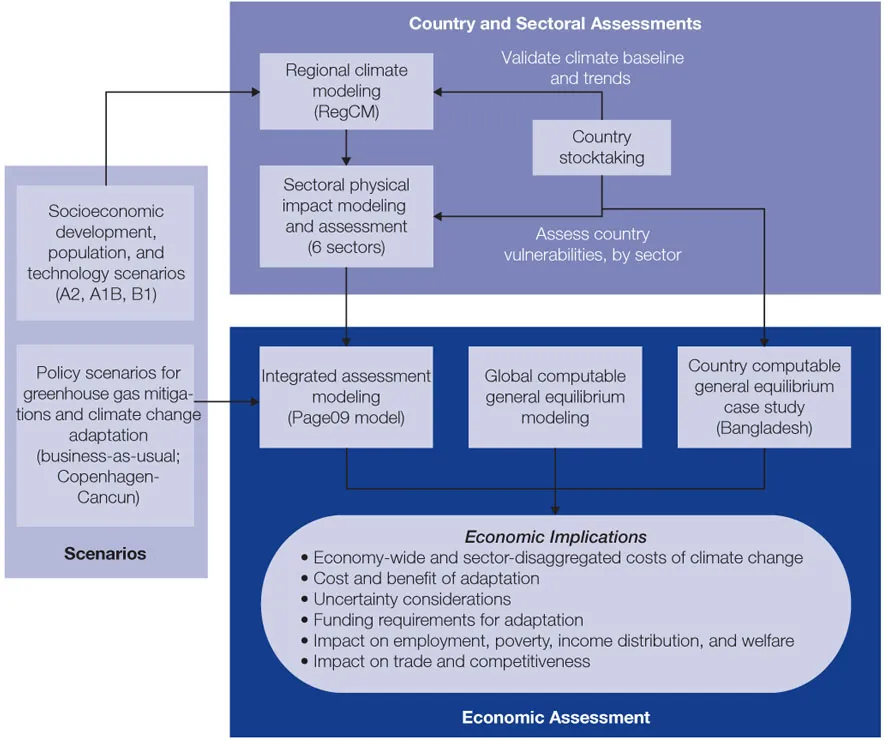
The modeling was conducted under emission scenarios consistent with those developed by the IPCC Fourth Assessment Report (AR4) as well as policy scenarios consistent with recent development of climate change negotiations under the United Nations Framework Convention on Climate Change process. Climate projections are undertaken for 2030, 2050, and 2080, and analyzed with respect to the baselines. The IPCC AR4 A1B scenario is used as a reference case in sector analyses, while other scenarios are also analyzed and discussed in comparison throughout the report.
The analyses are based on a three-step modeling approach: (i) climate downscaling, (ii) physical impact assessment, and (iii) economic assessment.
For each study country, stocktaking was done to review the literature on climate change vulnerability concerns and responses, including observations on current climate patterns and perceived changes that were used to validate climate change projections derived from the modeling. Key sectors affected by extreme weather occurrences, as well as slow-onset climate changes (e.g., higher temperatures) were examined. Responses being taken by governments were also reviewed, with reference to each National Adaptation Program of Action and IPCC communications, as well as initiatives by the nongovernment sector. Ongoing coping and adaptation measures, including constraints to building adaptive capacity, were also reviewed. The stocktaking provided information to assess baseline conditions for the sector impact modeling.
Sector-based physical impact modeling, supported by a comprehensive literature review, was carried out to generate information for use in the study’s subsequent step of evaluating economy-wide impacts of climate change, and in formulating policy recommendations. The indicators used for impact assessment are shown in Table 1.
Table 1: Sectors Analyzed and Physical Impact Modeling Parameters
Sector | Physical Impact Modeling Parameters |
Agriculture | Changes in crop yield; optimal crop growing temperature; shifts in cropping calendar |
Coastal and marine | Loss of dryland and wetland areas due to sea level rise; extent of coastal areas temporarily inundated by high tides and storm surges |
Energy | Impact on hydropower generation capacity; changes in energy demand (cooling and heating requirements) |
Forests and other land ecosystems | Change in total carbon storage; change in net primary productivity; change in vegetation types |
Human health | Mortality and morbidity due to water-borne and vector-borne diseases; mortality and morbidity due to extreme cold and heat |
Water resources | Dependable water resource; length of projected water deficits; average annual water deficit volumes |
Models and Scenario Assumptions
Models Used in the Study
Regional Climate Modeling
Climate change scenarios for this study were generated using dynamical downscaling from a general circulation model (GCM) used in the IPCC AR4’s scenario projections. The dynamical downscaling was accomplished using a one-way nested regional climate model (Box 1).
Box 1: Regional Climate Model (RegCM4)
The modeling...
Table of contents
- Front Cover
- Title Page
- Copyright Page
- Contents
- Tables, Figures, and Boxes
- Foreword
- Acknowledgments
- Abbreviations
- Executive Summary
- PART I: Situation Analysis and Methodology
- PART II: Climate Change—Impact and Adaptation
- PART III: Responses
- Appendixes
- References
- Back Cover
Trusted by 375,005 students
Access to over 1.5 million titles for a fair monthly price.
Study more efficiently using our study tools.
Frequently asked questions
Yes, you can cancel anytime from the Subscription tab in your account settings on the Perlego website. Your subscription will stay active until the end of your current billing period. Learn how to cancel your subscription
No, books cannot be downloaded as external files, such as PDFs, for use outside of Perlego. However, you can download books within the Perlego app for offline reading on mobile or tablet. Learn how to download books offline
Perlego offers two plans: Essential and Complete
- Essential is ideal for learners and professionals who enjoy exploring a wide range of subjects. Access the Essential Library with 800,000+ trusted titles and best-sellers across business, personal growth, and the humanities. Includes unlimited reading time and Standard Read Aloud voice.
- Complete: Perfect for advanced learners and researchers needing full, unrestricted access. Unlock 1.5M+ books across hundreds of subjects, including academic and specialized titles. The Complete Plan also includes advanced features like Premium Read Aloud and Research Assistant.
We are an online textbook subscription service, where you can get access to an entire online library for less than the price of a single book per month. With over 1.5 million books across 990+ topics, we’ve got you covered! Learn about our mission
Look out for the read-aloud symbol on your next book to see if you can listen to it. The read-aloud tool reads text aloud for you, highlighting the text as it is being read. You can pause it, speed it up and slow it down. Learn more about Read Aloud
Yes! You can use the Perlego app on both iOS and Android devices to read anytime, anywhere — even offline. Perfect for commutes or when you’re on the go.
Please note we cannot support devices running on iOS 13 and Android 7 or earlier. Learn more about using the app
Please note we cannot support devices running on iOS 13 and Android 7 or earlier. Learn more about using the app
Yes, you can access Assessing the Costs of Climate Change and Adaptation in South Asia by in PDF and/or ePUB format, as well as other popular books in Economics & Development Economics. We have over 1.5 million books available in our catalogue for you to explore.