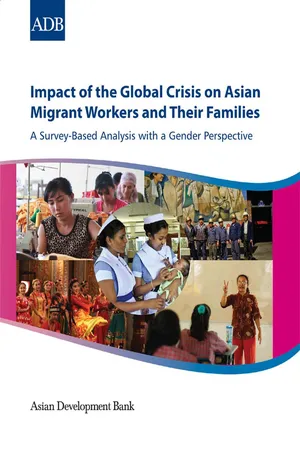
This publication examines the impact of the crisis among migrant workers and their families---with gender perspective---to provide useful information for better evidence-based policy making. Based on household surveys in Indonesia and the Philippines, the results show that women are in worse condition and are more vulnerable than men. Women migrants still have lower education and skills, reflected in their inferior jobs. They face greater difficulties in reintegration when they return, forcing them to return abroad. Women also bear a heavier burden due to their gendered role in the family, and those who stay are more often unemployed or in vulnerable employment. Moreover, despite strong views that the man should be the breadwinner and the one going abroad, the increasing feminization of current migration indicates that necessity is a strong push factor forcing more women to go abroad. These findings further strengthen the call for considering gender in migration policies.
- 172 pages
- English
- ePUB (mobile friendly)
- Available on iOS & Android
eBook - ePub
About this book
Information
1. Introduction
1.1. Background
As the global financial crisis that began in 2008 unraveled, the fear that labor migration and associated remittances would be among the first casualties was especially strong in Asia. This is because the region is the main source of migrant workers and therefore receives the bulk1 of remittances from its host countries. The fears of a slump in remittances and a large-scale return of migrants proved largely unfounded (World Bank 2011a; Ratha 2011, slide 14; Oxfam International 2010, p. 16), but this did not mean that the crisis did not have implications for migrant workers and their families, especially as the crisis apparently hide variations of impacts at sector or migrant family levels. This concern is increasingly relevant as recession continues in major industrial economies, and the economic environment and outlook for global job creation continue to remain bleak (International Labour Organization 2012a, p. 9). For migrant households, the important transmission channels for the impacts are not only through overseas employment and remittances but also through local employment and income-earning opportunities, particularly for household members working in export-oriented sectors that were badly hit by the crisis.
To examine the impact of the global financial crisis on migration and remittances in developing countries in Asia, the Asian Development Bank (ADB) conducted a series of studies financed under the ADB regional technical assistance project Global Crisis, Remittance, and Poverty in Asia (RETA 7436). The project basically examines the possible impacts of the crisis at different levels (global, country, sector, and migrant household levels). The global-level analysis was conducted using an econometric method based on global migration and remittances data. The country-level analysis was done for Bangladesh, Indonesia, Pakistan, the Philippines, and Viet Nam using computable general equilibrium modeling and/or econometric techniques based on country-level data. Finally, examination at the migrant household level was carried out based on a series of migrant household surveys,2 which were conducted in Bangladesh, Indonesia, and the Philippines. These countries were selected because they are among the largest labor-exporting countries in Asia and hence receive significant amounts of remittances. Results of the study have been published in many different publications (in an ADB-International Organization for Migration joint publication entitled The Impact of the Global Financial Crisis on Migrants and their Families in Asia: A Survey-based Analysis (ADB and IOM 2011); in two chapters of the World Bank publication Migration and Remittances during the Global Financial Crisis and Beyond (World Bank 2012a); and in an ADB publication, Global Crisis, Remittances, and Poverty in Asia (ADB 2012b).
The study found that the effects of the crisis differ across countries and sectors among other factors, and that the impacts could adversely affect the economic growth and poverty reduction in the sending countries. To some extent, the effects are also influenced by migrants’ characteristics, such as countries of origin and destination, levels of education, and occupation and length of stay abroad, as well as by migrant household attributes such as educational attainment of household heads and household size and composition (ADB 2012a).
Further examination of the results reveals the need to see the gender dimension of the impact—the extent to which men and women migrant workers and their families were affected differently by the crisis will have valuable policy implications. Therefore, ADB conducted a follow-up study in 2012 in order to

The follow-up study was financed by a regional technical assistance project, Impact of the Global Crisis on Asian Migrant Workers and their Families: A Survey-Based Analysis with a Gender Perspective as a subcomponent of the project Promoting Gender Equality and Women Empowerment (RETA 6143). As part of the follow-up study, revisit surveys were conducted in Indonesia and the Philippines.3 Bangladesh was excluded, for its labor migration is not as highly feminized as in Indonesia and the Philippines. Women compose an estimated 75% of Indonesian migrant workers and more than 50% of those in the Philippines, while in Bangladesh the share is only about 10%.
Therefore, the analysis presented here was based the two interconnected surveys. The first survey was conducted in 2010, covering about 600 migrant households with the period of observation from October 2008 to September 2009 (hereinafter referred as 2010 survey) and no special gender perspective. The second, or revisit, survey was done in 2012, covering around 200 migrant households drawn primarily from the original sample of the first survey covering the period October 2008 to April 2012 (hereinafter referred as the 2012 survey). Parallel with both surveys, a series of focus groups and roundtable discussions were carried out with migrant household heads and family members, return migrants, and key informants to validate the survey results and to shed further light on the issues. Details of the survey design,4 together with the household questionnaire used in the second survey and the guides for the focus group and roundtable discussions, are provided in Appendixes 4a to 4c.
In this context, it is important to note that various other studies have also emphasized the following points:
1.2. Objectives and Structure of the Report
The results of the first study brought out the need to systematically analyze the impacts of the crisis from a gender perspective. To this end, the second study examined how men and women migrant workers and their household members were affected differently by the crisis. The main objectives of this study are to examine the impacts of the crisis on migrant workers and their families by using all available information, including from the 2010 and 2012 surveys, and by considering the gender dimension explicitly. In particular, the study seeks to achieve the following:
The ADB-IOM first survey covered the period between October 2008 and September 2009 as “after the crisis.” By 2010, the “palpable sense of crisis” had receded in Asian countries, but the world economy has far from recovered5—the global outlook is increasingly uncertain and the crisis conditions in the global labor markets continue.6 While Asia’s economic performance remains positive, ...
Table of contents
- Front Cover
- Title Page
- Copyright Page
- Contents
- Boxes, Figures, and Tables
- Foreword
- Acronyms and Abbreviations
- Executive Summary
- 1. Introduction
- 2. Impact of the Crisis on Migrant Workers and Their Families: A Macro Picture
- 3. Impact of the Crisis on Migrant Workers and Their Families: A Survey-Based Analysis
- 4. Conclusion and Policy Implications
- 5. Reflections on Gender-Responsive Policies for Migrant Workers and Their Families
- References
- Appendix 1: Methodology of the 2010 Survey
- Appendix 2: Methodology of the 2012 (Revisit) Survey and Focus Group and Roundtable Discussions
- Appendix 3: Questionnaire for the Impact of Global Financial Crisis among Women and Men Migrants and Their Families: A Gender Perspective, 2012 Survey
- Appendix 4a: Focus Group Discussion Guide: Heads of Migrant Households
- Appendix 4b: Focus Group Discussion Guide: Return Migrants
- Appendix 4c: Focus Group Discussion Notes for the Facilitation Team
- Appendix 5: Migrants Covered under ILO Domestic Workers Convention, 2011 (No.189)
- Appendix 6: Statistical Tables from the Results of the 2010 and 2012 Surveys
- Back Cover
Trusted by 375,005 students
Access to over 1.5 million titles for a fair monthly price.
Study more efficiently using our study tools.
Frequently asked questions
Yes, you can cancel anytime from the Subscription tab in your account settings on the Perlego website. Your subscription will stay active until the end of your current billing period. Learn how to cancel your subscription
No, books cannot be downloaded as external files, such as PDFs, for use outside of Perlego. However, you can download books within the Perlego app for offline reading on mobile or tablet. Learn how to download books offline
Perlego offers two plans: Essential and Complete
- Essential is ideal for learners and professionals who enjoy exploring a wide range of subjects. Access the Essential Library with 800,000+ trusted titles and best-sellers across business, personal growth, and the humanities. Includes unlimited reading time and Standard Read Aloud voice.
- Complete: Perfect for advanced learners and researchers needing full, unrestricted access. Unlock 1.5M+ books across hundreds of subjects, including academic and specialized titles. The Complete Plan also includes advanced features like Premium Read Aloud and Research Assistant.
We are an online textbook subscription service, where you can get access to an entire online library for less than the price of a single book per month. With over 1.5 million books across 990+ topics, we’ve got you covered! Learn about our mission
Look out for the read-aloud symbol on your next book to see if you can listen to it. The read-aloud tool reads text aloud for you, highlighting the text as it is being read. You can pause it, speed it up and slow it down. Learn more about Read Aloud
Yes! You can use the Perlego app on both iOS and Android devices to read anytime, anywhere — even offline. Perfect for commutes or when you’re on the go.
Please note we cannot support devices running on iOS 13 and Android 7 or earlier. Learn more about using the app
Please note we cannot support devices running on iOS 13 and Android 7 or earlier. Learn more about using the app
Yes, you can access Impact of Global Crisis on Migrant Workers and Families by in PDF and/or ePUB format, as well as other popular books in Business & Women in Business. We have over 1.5 million books available in our catalogue for you to explore.