An effective system for complaint handling is a key element of a good development project. This reader presents the experiences and lessons learned in handling complaints under the Asian Development Bank-assisted Earthquake and Tsunami Emergency Support Project in Indonesia, and similar initiatives supported by other organizations, in the rehabilitation of Aceh and Nias following the disasters there in December 2004 and March 2005. The book will contribute to capacity building for complaint handling within local governments in Aceh and Nias as well as provide a wider sharing of experiences within governments and nongovernment organizations in Indonesia and beyond. A summary of lessons and recommendations draws together common strands from the 18 papers presented.
- 172 pages
- English
- ePUB (mobile friendly)
- Available on iOS & Android
eBook - ePub
About this book
Information
1. Complaint Handling at the Agency for the Rehabilitation and Reconstruction of NAD and Nias1
by Zahrul Fuady,2 Fajri Jakfar,3 and Jose T. Nicolas4
Background
The Agency for the Rehabilitation and Reconstruction of Nanggroe Aceh Darussalam (NAD) and Nias (BRR) was established by the Government of Indonesia on 17 April 2005 to rebuild the regions hit by the tsunami and earthquake on 26 December 2004 and 28 March 2005 in NAD and Nias. Based on Government Regulation No. 2/2005, which was then endorsed as Law No. 10/2005, BRR is tasked with carrying out rehabilitation and reconstruction programs, and organizing and coordinating the implementation of rehabilitation and reconstruction activities implemented by the central government, local governments, nongovernment organizations (NGOs), and other parties.
BRR is expected to ensure that the rehabilitation and reconstruction of Aceh and Nias are in accordance with and supportive of the vision and mission of the regions affected by the disaster. BRR has formulated the following vision statement:
“Building reliable, dignified, prosperous, and democratic Aceh and Nias”
BRR consists of three important boards—an advisory board (Dewan Pengarah or Wanrah), a supervisory board (Dewan Pengawas or Wanwas), and an executive board (Bapel or steering committee). These boards play complementary roles and share responsibilities. The executive board plans and implements rehabilitation and reconstruction activities in NAD and Nias. The steering committee ensures that the aspirations of various groups are represented in the rehabilitation and reconstruction activities. The supervisory board supervises the process of rehabilitation and reconstruction implemented by the executive board.
The BRR structure has been set up following the four principles of good governance: transparency, participation, accountability and enforcement. These principles are imbedded in all planning, procurement, hiring, supervision, and implementation activities under BRR.
Part of the accountability mechanism within BRR is the establishment of a system for receiving and acting on feedback and complaints from the public. BRR requires agencies implementing projects related to the rehabilitation of NAD and Nias to receive all grievances and inputs from all levels of the community with regard to the implementation and performance of the program by the implementing agency or other parties under its coordination, i.e., government offices, ministries, local governments, NGOs, the private sector, and others.
Under the BRR executive board, the Anti-Corruption Unit (Satuan Anti Korupsi or SAK) was established to receive and facilitate complaints, whether corruption related or not. Complaints can be submitted through the “Public Voices” section of BRR’s website, the grievances post office box, or the toll-free telephone line managed by SAK. Although supervision of SAK was transferred to the BRR Supervisory Board on 27 June 2007, SAK has remained autonomous in most of its operations.
The BRR supervisory board has two main functions: (i) supervise the rehabilitation and reconstruction process; and (ii) receive, review, and follow up complaints submitted by members of the community. It also has the authority to
• appoint and utilize the services of independent professional auditors or other specialists,
• request explanations from the BRR executive board and other parties in relation to the implementation of rehabilitation and reconstruction, and
• prepare recommendations to the president based on the findings of supervisory activities concerning the implementation of rehabilitation and reconstruction.
Figure 1 shows the relationship among the three BRR boards and their interaction with other audit and integrity organizations and the public.
Figure 1: Coordination among BRR, Audit and Integrity Agencies, and the Community
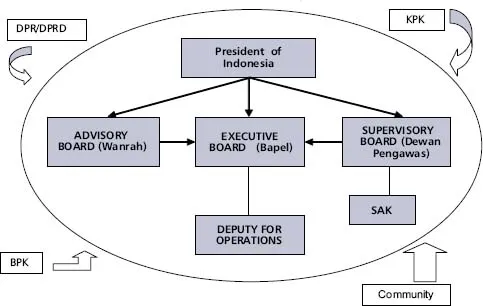
BPK = Supreme Audit Agency, BRR = Badan Rehabilitasi dan Rekonstruksi, DPR = House of Representatives of Parliament
DPRD = Regional People’s Representative Assembly, KPK = Anticorruption Commission, SAK = Anticorruption Unit (Satuan Anti Korupsi).
Anticorruption Unit
SAK started operations in September 2005 under the head of BRR Bapel with the following general objectives:
• to maintain the trust of countries and agencies that have contributed to the rehabilitation and reconstruction program of Aceh and Nias,
• to ensure that the victims of the tsunami receive their entitlements in accordance with the blueprint, and
• to monitor development sectors that were targeted for rehabilitation and reconstruction.
SAK’s scope of work includes (i) supervising budget expenditures totaling Rp67 trillion, (ii) maintaining accountability of 124 project implementation units (satkers) and their subunits, and (iii) monitoring the implementation of some 24,000 contracts and/or projects. Its activities are divided into three integrated components:
• prevention, which involves reviewing systems to identify potential areas of weakness that may give rise to corrupt practices, and recommending improvements to strengthen the integrity of these systems; this covers issues as diverse as procurement and gratuities;
• investigation, which includes review of specific activities to ensure that they comply with BRR procedures and, to the maximum extent possible, to prevent the loss of resources caused by corruption; and
• education, which operates at two levels: the first is to provide specific advice to staff and the wider community on how to comply with ethical standards; the second and wider task is to strengthen citizen rejection of corrupt and unethical practices within the public domain.
Although SAK’s mandate centers primarily on preventing and investigating corruption in rehabilitation activities, its work actually covers issues beyond corruption concerns. SAK has adopted the following policies in receiving complaints:
• no case or complaint is too small or too large,
• acceptance of cases and/or complaints that are anonymous, and
• protection of complainants through nondisclosure of identity.
These policies have encouraged the public to report a wide variety of complaints to the unit, even those that are not directly related to corruption.
SAK classifies complaints received according to their gravity and to the time needed to resolve them. Complaints related to legal matters are classified as high, issues concerning behavior or ethics are categorized as medium, while general complaints are categorized as low.
The Supreme Audit Agency (BPK) assigned some of its provincial staff to assist in SAK’s prevention, investigation, and education activities, as well as in the maintenance of data and management information reporting. SAK also works with the Indonesian Transparency Society, Transparency International Indonesia, Indonesian Corruption Watch, People’s Movement for Anti-Corruption, university groups, and international institutions in carrying out its tasks.
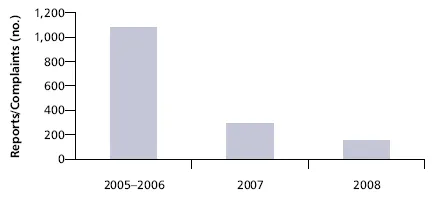
From its establishment until the end of 2008, SAK received a total of 1,530 reports and/or complaints. Most of these (70.3%) were received in 2005–2006, when the rehabilitation projects were in their initial implementation stages and there was much confusion about implementation arrangements, budgeting, and eligibility for assistance. Figure 2 shows the reports and/or complaints received by SAK from September 2005 until December 2008.
Figure 2: Reports and/or Complaints Received by SAK from September 2005 to December 2008
While SAK accepts anonymous complaints and information, 9 of every 10 complainants or reporters chose to identify themselves. Reports and/or complaints come from internal BRR staff, private individuals, contractors, other government agencies, project staff, and NGOs and civil society groups. The most common complaints received are about tendering activities, possible cheating or corruption, concerns about project implementation, and complaints about staff. Other complaints relate to various issues such as general inquiries about regulations, complaints about rules and procedures, issues of ethical guidance, and advice and concerns from victims that their needs are not being met.
SAK’s Information Processing Unit collects all reports received by SAK from various stakeholders (individuals, vendors, government offices, media, and journalists, BRR, NGOs, etc.). It studies each report and prepares a first information report. In some cases, follow-up calls are made to the complainant to seek clarification or additional information. Simple queries are clarified by staff from the Information Processing Unit or are referred to the BRR unit concerned. Reports without sufficient substance or information are archived. There have also been instances when SAK facilitated meetings to mediate between contending parties.
In case there are indications of loss or misappropriation, the SAK Monitoring Unit issues a work order for monitoring. This can be either routine monitoring, special monitoring, or an operational audit, depending on the nature of the case. The outcome of the monitoring is prepared in the form of an audit finding. If the audit finding does not indicate monetary loss by the state through corruption, collusion, or nepotism, the report is submitted to the provincial office of BPK. Complaints involving possible state loss are submitted to government law enforcement agencies (police, attorney’s office, and also the provincial BPK).
Upon delivery of the audit finding from SAK to BPK and investigators, SAK’s mission is deemed completed (it has no authority to interfere with the work of government agencies). However, at times, if the BPK and investigators’ audit finding results in a formal court proceeding, SAK may be called as a witness.
Actions taken by SAK on complaints involving funds misappropriation or corruption have resulted in
• cancellation of tender result and termination of contract (90 cases with potential loss of Rp715,139,356,755);
• blacklisting of 129 business entities and/or legal entities and banning them from participating in BRR projects;
• 11 cases submitted to BPK involving funds totaling Rp39,904,441,218;
• 15 cases submitted to the Anticorruption Commission involving funds amounting to Rp62,938,565,164; and
• 22 cases submitted to the Public Attorney’s Office involving funds amounting to Rp2,941,373,824.
BRR Supervisory Board (Dewan Pengawas)
To perform its mandate of supervising the rehabilitation and reconstruction process and of receiving and/or reviewing complaints from the public, the BRR supervisory board formed two secretariats—one in Banda Aceh and one in Jakarta. It engaged a number of experts and outsourced personnel to help in field monitoring, evaluation, and obtaining feedback from beneficiaries and the public. See Figure 3.
Figure 3: Organizational Structure of BRR Supervisory Board
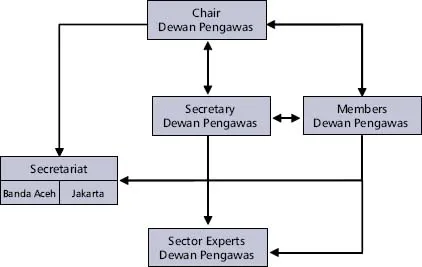
Dewan Pengawas is headed by a 7-member board. Although the board is supported by the two secretariats, the bulk of its work is done by the Banda Aceh-based one including receiving and recording complaints, feedback, and queries from the public. Dewan Pengawas has seven sector experts, who undertake field visits to monitor the progress of the rehabilitation projects and to get feedback from beneficiaries and communities. Each expert is assisted by outsourced staff hired for specific monitoring tasks and field activities. Areas covered by the sector experts are divided as follows:
• communication and public participation;
• infrastructure, housing, and land administration;
• agriculture and natural resources;
• religious, social, and cultural affairs;
• legal and legal institutional affairs;
• education,...
Table of contents
- Front Cover
- Title Page
- Copyright Page
- Contents
- Abbreviations and Acronyms
- Local Terms
- Foreword
- Preface
- Summary of Lessons and Recommendations by Robert C. May
- 1 Complaint Handling at the Agency for the Rehabilitation and Reconstruction of NAD and Nias by Zahrul Fuady, Fajri Jakfar, and Jose T. Nicolas
- 2 Capacity Building for Complaint Handling: The OSPF Experience in Aceh by Karin Oswald
- 3 Grievance Mechanisms under the Earthquake and Tsunami Emergency Support Project by Pieter Smidt
- 4 The ETESP Grievance Facilitation Unit: Benefits, Challenges, and Lessons Learned by Jose T. Nicolas and Sofyan
- 5 Complaint Handling in the ETESP Housing Sector: Experience of the Housing Oversight Consultant’s Complaint and Grievance Unit by Herman Soesangobeng
- 6 Involving Beneficiaries in Complaint Handling: The German Agro Action Experience in Pante Raja and Simeulue by Hotman Ronal Purba and Jumi Sanoprika
- 7 Complaint Management, a Key Element in House Construction and Rehabilitation: The Muslim Aid Experience in Pidie by Muchtar Razali and Yulia Medina
- 8 Complaint-Handling Challenges in a Community-Led Project: The UN-HABITAT Experience by Diella Dachlan
- 9 Community Negotiations and Adat Values: Experience of HELP in Nias Selatan by Herman Soesangobeng and Yarisman Teluambanua
- 10 A Complaint- and Grievance-Handling Mechanism in Conflict-Affected and Isolated Villages: The Cordaid Seunuddon Experience by Saputra Liadi
- 11 Complaint Handling in Community Facilitation: The Bina Swadaya Experience by Jose T. Nicolas, Ira Hermantyo, and Agung Prasetio
- 12 Complaint Handling Involving Project-Affected Persons: Experience in the ETESP Roads and Bridges Sector by Jose T. Nicolas and Izziah Hasan
- 13 Role of the Extended Mission in Sumatra in Complaint Handling for the ETESP by Jose T. Nicolas and Izziah Hasan
- 14 Complaint Handling under the Multidonor Trust Fund for Aceh and Nias by Dusty Geumala Yatim and Nia Sarinastiti
- 15 The Community-Based Settlement Rehabilitation and Reconstruction Project: Complaint-Handling Experience by Lisa Anggraini
- 16 Complaint Handling and Anticorruption Activities in the National Community Empowerment Program for Self-Reliant Rural Villages by Anthony Torrens
- 17 Handling Complaints Efficiently: Developing a Kecamatan-Based Complaint-Handling Mechanism and Independent Monitoring of Post-Tsunami Rehabilitation and Reconstruction Projects in Aceh by Rony Iskandar and Ikhwan Nursujoko
- 18 Adat Conflict Resolution: Experience from Rehabilitation and Reconstruction in Aceh and Nias by Herman Soesangobeng, Zahrul Fuady, and Jose T. Nicolas
Trusted by 375,005 students
Access to over 1.5 million titles for a fair monthly price.
Study more efficiently using our study tools.
Frequently asked questions
Yes, you can cancel anytime from the Subscription tab in your account settings on the Perlego website. Your subscription will stay active until the end of your current billing period. Learn how to cancel your subscription
No, books cannot be downloaded as external files, such as PDFs, for use outside of Perlego. However, you can download books within the Perlego app for offline reading on mobile or tablet. Learn how to download books offline
Perlego offers two plans: Essential and Complete
- Essential is ideal for learners and professionals who enjoy exploring a wide range of subjects. Access the Essential Library with 800,000+ trusted titles and best-sellers across business, personal growth, and the humanities. Includes unlimited reading time and Standard Read Aloud voice.
- Complete: Perfect for advanced learners and researchers needing full, unrestricted access. Unlock 1.5M+ books across hundreds of subjects, including academic and specialized titles. The Complete Plan also includes advanced features like Premium Read Aloud and Research Assistant.
We are an online textbook subscription service, where you can get access to an entire online library for less than the price of a single book per month. With over 1.5 million books across 990+ topics, we’ve got you covered! Learn about our mission
Look out for the read-aloud symbol on your next book to see if you can listen to it. The read-aloud tool reads text aloud for you, highlighting the text as it is being read. You can pause it, speed it up and slow it down. Learn more about Read Aloud
Yes! You can use the Perlego app on both iOS and Android devices to read anytime, anywhere — even offline. Perfect for commutes or when you’re on the go.
Please note we cannot support devices running on iOS 13 and Android 7 or earlier. Learn more about using the app
Please note we cannot support devices running on iOS 13 and Android 7 or earlier. Learn more about using the app
Yes, you can access Complaint Handling in the Rehabilitation of Aceh and Nias by in PDF and/or ePUB format, as well as other popular books in Economics & Development Economics. We have over 1.5 million books available in our catalogue for you to explore.