Actively engaging women in climate mitigation activities can yield multiple benefits, including improved jobs, better livelihoods, and more equitable revenue flows. Efforts are moving forward to design climate funding mechanisms to help capture these benefits, but policy makers and other stakeholders need more guidance on designing gender-responsive climate policies and funding proposals. The guidelines in this publication fill this void. It is hoped that these guidelines would equip policy makers with pragmatic advice on how to mainstream gender into climate change mitigation actions and funding proposals. This publication reflects on applications for the guidelines as well as relationships between climate planning and funding proposal.
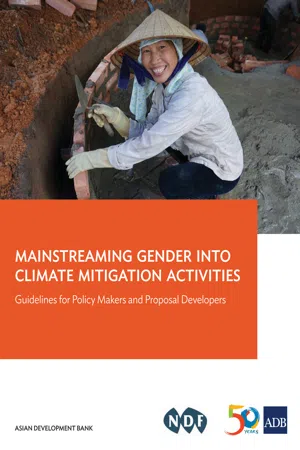
eBook - ePub
Mainstreaming Gender into Climate Mitigation Activities
Guidelines for Policy Makers and Proposal Developers
- 32 pages
- English
- ePUB (mobile friendly)
- Available on iOS & Android
eBook - ePub
Mainstreaming Gender into Climate Mitigation Activities
Guidelines for Policy Makers and Proposal Developers
About this book
Information
Topic
BiowissenschaftenSubtopic
Globale Erwärmung & Klimawandel1 |
Introduction: Toward Gender-Responsive Mitigation |
Climate change frequently affects women and men differently (IPCC 2007). The primary reason for these differences is the varying levels of access to resources– knowledge, skills, and finance–that shape how women and men adapt to climate impacts. By the same token, women and men often contribute to activities that mitigate climate change and may share the benefits of climate finance differently. The primary reasons are varying life experiences, consumption patterns, and spending habits. For much of the early history of international climate negotiations, these differences were not readily appreciated. However, the climate policy landscape has undergone important changes in recent years. The impetus for those changes is the realization that actively engaging women as “agents of change” in climate solutions not only helps stabilize the climate but also yields multiple other benefits, including gender equality and women’s empowerment.
Since the 14th Conference of the Parties (COP 14) to the United Nations Framework Convention on Climate Change (UNFCCC), a broad coalition of stakeholders have advocated for more gender-responsive international climate funding mechanisms to help deliver these benefits. In consequence, the recently opened Green Climate Fund (GCF) has committed to a gender-sensitive approach that may influence allocations of future climate financing (UNFCCC 2011). The GCF’s Gender Policy and Action Plan 2014–2017 has provided further evidence of efforts to institutionalize gender’s expanding role in climate financing decisions (GCF 2014). The broader support for cross-sectoral integration in the recently agreed Sustainable Development Goals (SDGs) also suggests that the international development community will look favorably on actions that empower women (SDG 5) while responding to climate change (SDG 13). In short, the above trends reveal an emerging consensus around the promise of gender-responsive climate finance at the international level.
These trends have also not escaped the notice of some policy makers at the national level. For example, several countries have highlighted gender in their pledges of nationally appropriate mitigation actions (NAMAs) to reduce greenhouse gases (GHGs) through 2020 under the UNFCCC (Bock et al. 2015). More recently, an even greater number of countries have included gender in their intended nationally determined contributions (INDCs) that outline their planned response to climate change from 2020 to 2030 (IUCN 2012). The growing signs of national and international support for gender-responsive climate actions are indeed welcome; failures to account for the gender-specific contributions to climate mitigation and adaption have arguably widened equality gaps and narrowed financing bottlenecks (Huyer 2016). At the same time, fully realizing the potential of these international and national reforms will require more guidance on the steps policy makers and other relevant gender stakeholders should follow to develop gender-responsive climate policies and funding proposals. At present, this guidance remains in short supply.
The primary purpose of these guidelines is to fill this need. More concretely, the guidelines aim to equip policy makers, proposal developers, and other interested parties with pragmatic advice on how to mainstream gender into mitigation actions and funding proposals. The guidelines draw heavily on experiences from the Asian Development Bank (ADB) regional technical assistance project entitled Harnessing Climate Change Mitigation Initiatives to Benefit Women. Funded by the Nordic Development Fund, this ADB project aims to assist policy makers in Cambodia, the Lao People’s Democratic Republic, and Viet Nam with integrating gender into national and/or subnational climate strategies, climate action plans, and climate finance screening processes (ADB 2011). The ADB project, like these guidelines, is unique in that it concentrates on the interlinkages between gender and climate mitigation; there has been relatively less attention to the gender–mitigation relationship than that between gender and climate adaptation. Further, while the ADB project focuses on three Southeast Asian countries, this publication is intended for a wide range of countries and stakeholders. The guidelines are, moreover, not meant as a “one size fits all” blueprint; rather, they are intended to serve as flexible “fit for purpose” steps that can be tailored to particular national and local circumstances. They are also intended to outline ways to not only recognize gender co-benefits but also give gender stakeholders an elevated platform and an audible voice at critical junctures of the decision-making process (Huyer et al. 2015).
The guidelines are organized into three complementary sections. The first section outlines the rationale for seeking gender into climate actions and then details a nine-step process for integrating gender into NAMAs and INDCs. The second section outlines how gender can be incorporated into four essential elements of climate finance proposals that may draw support from the GCF (in view of the reforms outlined in the aforementioned Gender Policy and Action Plan 2014–2017) as well as other relevant funding mechanisms (including the Climate Investment Funds [CIFs] and Global Environment Facility [GEF]). A concluding section reflects briefly on applications for the guidelines as well as relationships between the climate planning and funding proposal sections. Please note that the guidelines do not offer a more general review of climate and gender; such a review can be found in many sources, including a previous publication from this project entitled Training Manual to Support Country Driven-Gender and Climate Change (ADB and NDF 2015).
2 | Bringing Together Gender and Climate Change |
Both governments and international organizations have recognized that gender equality and women’s empowerment are fundamental to socioeconomic development. The commitment to gender equality and women’s empowerment is captured in milestone agreements such as the Convention on the Elimination of All Forms of Discrimination against Women and the Beijing Platform for Action. It is also a central feature of the 2030 development agenda–as evidenced by SDG 5 on gender equality and assertions that gender is interrelated to achieving many other SDGs. At the core of these international agreements lies the shared global understanding that women should enjoy the same social, political, and economic rights as men, including the right to education, access to health services, employment, and participation in decision-making processes.
Translating these international commitments into national actions requires projects and policies that directly value women’s approach to managing natural resources. It further necessitates more explicit recognition of women’s contributions to the economy at large– for instance, in terms of the jobs they perform and investments they make. While many of these contributions influence climate change, there were previously few efforts to ac...
Table of contents
- Front Cover
- Title Page
- Copyright Page
- Contents
- Tables, Figures, and Boxes
- Acknowledgments
- Abbreviations
- 1 Introduction: Toward Gender-Responsive Mitigation
- 2 Bringing Together Gender and Climate Change
- 3 Mainstreaming gender into Mitigation actions in nine steps
- 4 developing gender-responsive Mitigation Funding Proposals
- 5 Conclusion
- Bibliography
- Appendix: Project Proposal template with gender guidance Questions
- Back Cover
Trusted by 375,005 students
Access to over 1.5 million titles for a fair monthly price.
Study more efficiently using our study tools.
Frequently asked questions
Yes, you can cancel anytime from the Subscription tab in your account settings on the Perlego website. Your subscription will stay active until the end of your current billing period. Learn how to cancel your subscription
No, books cannot be downloaded as external files, such as PDFs, for use outside of Perlego. However, you can download books within the Perlego app for offline reading on mobile or tablet. Learn how to download books offline
Perlego offers two plans: Essential and Complete
- Essential is ideal for learners and professionals who enjoy exploring a wide range of subjects. Access the Essential Library with 800,000+ trusted titles and best-sellers across business, personal growth, and the humanities. Includes unlimited reading time and Standard Read Aloud voice.
- Complete: Perfect for advanced learners and researchers needing full, unrestricted access. Unlock 1.5M+ books across hundreds of subjects, including academic and specialized titles. The Complete Plan also includes advanced features like Premium Read Aloud and Research Assistant.
We are an online textbook subscription service, where you can get access to an entire online library for less than the price of a single book per month. With over 1.5 million books across 990+ topics, we’ve got you covered! Learn about our mission
Look out for the read-aloud symbol on your next book to see if you can listen to it. The read-aloud tool reads text aloud for you, highlighting the text as it is being read. You can pause it, speed it up and slow it down. Learn more about Read Aloud
Yes! You can use the Perlego app on both iOS and Android devices to read anytime, anywhere — even offline. Perfect for commutes or when you’re on the go.
Please note we cannot support devices running on iOS 13 and Android 7 or earlier. Learn more about using the app
Please note we cannot support devices running on iOS 13 and Android 7 or earlier. Learn more about using the app
Yes, you can access Mainstreaming Gender into Climate Mitigation Activities by Eric Zusman, So-Young Lee, Ana Rojas, Linda Adams in PDF and/or ePUB format, as well as other popular books in Biowissenschaften & Globale Erwärmung & Klimawandel. We have over 1.5 million books available in our catalogue for you to explore.