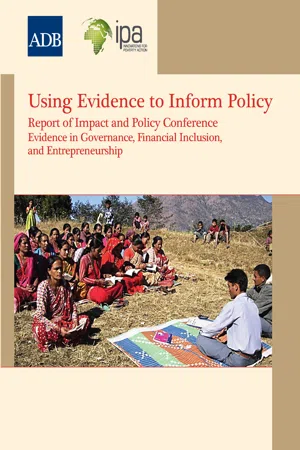
Report of Impact and Policy Conference: Evidence in Governance, Financial Inclusion, and Entrepreneurship
,
28 pages
English
ePUB (mobile friendly)
Available on iOS & Android
eBook - ePub
Using Evidence to Inform Policy
Report of Impact and Policy Conference: Evidence in Governance, Financial Inclusion, and Entrepreneurship
,
About this book
To promote evidence-based policy making, the Asian Development Bank partnered with Innovations for Poverty Action and the Abdul Latif Jameel Poverty Action Lab in 2012 to deliver a 3-day conference on impact evaluation and public policy in Bangkok. Over 200 scholars, practitioners and policy makers from 34 countries attended the conference. Each day of the conference focused on one of three areas that have high relevance to the region and have received the most proactive development efforts: governance, financial inclusion, and small and medium enterprise development. This report summarizes innovative evaluation studies presented at the conference and researchers' insights into the topics.
Strengthening governance is an issue of critical importance in development policy. Increasing citizen participation in elections and the responsiveness of elected officials to citizen preferences, reducing leakages in service delivery, and improving management of conflict and reconstruction are critical in improving development outcomes.
During the Governance and Postconflict Resolution sessions, researchers discussed how access to information can help inform constituents’ voting and increase the responsiveness of politicians to the electorate; the ways in which targeting of social programs can be improved by involving the community in the process; and how an evidence-based approach to policy making can contribute to conflict management and reconstruction.
Elections
The presumption of democratic governance is that citizen participation in decision-making processes—as voters, politicians, and members of local communities—makes the electorate and polity more representative of the society, better aligns policies with citizens’ preferences, and ultimately results in better outcomes for the citizenry. While participation is widely considered a primary means of empowerment, there is still little empirical evidence on how participation actually influences policy, and how any such policy affects the lives of citizens.
The elections panel discussed how people can exercise greater influence over politicians and policy through elections and participatory institutions. Researchers presented evidence on the impact of two programs implemented during elections: publicly disseminating information about corruption in Brazil, and a preelection awareness campaign in Pakistan.
Both Claudio Ferraz of Pontifícia Universidade Católica do Rio de Janeiro and Xavier Giné of the World Bank looked at the impact of disseminating information during election time. Ferraz, with coauthor Frederico Finan, conducted a study in Brazil where lotteries were held to select 50 to 60 municipalities to be audited every 2 months. The audits reviewed the use of public resources and described all irregularities that were found. These findings were then summarized and posted on the internet and disclosed to the mass media. The results showed that releasing audit findings of local governments’ use and misuse of public resources before an election decreased the share of votes and the probability of reelection for corrupt incumbents. Further, municipalities that used local radio to disseminate results of the audits saw reduced reelection rates for corrupt mayors.
Researcher Insight: Xavier Giné, World Bank
Despite improvements in legal rights to female political participation in emerging democracies, women are less likely than men to stand for public office and to participate as voters. Even when they do vote, women are less likely to exercise independence in candidate choice. Instead, women report voting in accordance with the preferences of the caste, clan, or household head in contrast to men of all ages who exercise independence in candidate choice.
The Marvi Rural Development Organization, with the help of the Pakistan Poverty Alleviation Fund, conducted a field experiment to test these ideas. The setting for the study was rural Pakistan, where women still face significant barriers to effective political participation. An awareness campaign was conducted just before the 2008 national elections, after the voter registration period had ended. The villages were divided into geographical clusters that were randomly assigned to receive the information or not. Within the group that received the information, a subset of households was also randomly assigned to receive a door-to-door awareness campaign.
The campaign was developed as a set of simple visual aids with two different messages: the importance of voting, which focused on the relationship between the electoral process and policy; and the significance of secret balloting, which explained the actual balloting process. Women received either the first message or both messages, allowing a test of whether knowledge about the voting process, including the fact that ballots are cast in an environment of secrecy, enhances female participation and independence in candidate choice.
The experiment found that election turnout increases by about 12% for women who received the messages compared with women who did not, with somewhat larger effects for women exposed to both messages. More importantly, comparable turnout rates were found for the uninvolved close neighbors of women who received the information, indicating large geographical spillovers.
For every 10 women who received the messaging (roughly 4 households), female turnout increases by about 9 additional votes. Once this externality is taken into account, the cost of the intervention drops from $16.7 to about $2.3 per additional vote. In addition, treated women are significantly more likely to vote for the second-most-voted-for political party. Further, women in those same clusters who did not receive the information behave as if they had, confirming once more the importance of social interactions. Polling station data show that an increase of 10% in the share of treated women led to a decrease in the share of female votes for the winning party of 6%. These results suggest that the campaign could have influenced the share of votes at the constituency level and thus the policy agenda, had it been implemented at a larger scale.
The results show that the campaign was least effective among women who had not voted in the past. As a result, more intensive interventions may be required for such women, including assistance with voter registration. In general, while attitudes and social mores change slowly, the results suggest that information provision can empower women and provide a relatively cost-effective mechanism for enhancing the participation of rural women in the democratic process.
Ferraz’s study highlights the importance of accessible information on influencing voter behavior. Similarly, Xavier Giné and Ghazala Mansuri’s study investigated the effect of information about the voting process on voter turnout and candidate choice among rural women in Pakistan, and whether voting behavior is influenced by the behavior of others. To test these hypotheses, Giné and Mansuri conducted a door-to-door voter information campaign, varying the intensity of visits, with two treatments: the first treatment group was told about the importance of voting, and the second group was told about the importance of voting plus the significance of secret balloting (the ability to vote in accordance with one’s own preferences without external pressure). The information campaign was developed as a set of simple visual messages (an example of one of the visual messages can be seen in the Researcher Insight from Xavier Giné). The researchers found that there are indeed significant peer effects; and using administrative data from all polling stations that served the study villages, they found that for every 10 treated women, (roughly 4 households), female turnout increases by 9 additional votes.
Leakages in Service Delivery
Access to information can lead to greater accountability in governance and better service delivery. This is essential as billions of dollars are spent each year to provide basic services and development programs aimed at improving the lives of those living in poverty, but very often a large percentage of this money does not reach the intended beneficiaries. The effectiveness of such public spending is often compromised by leakages and poor oversight.
During this session researchers explored the ways in which service delivery can be improved and leakages reduced. Specifically, researchers presented findings from a cash transfer program in Indonesia and the provision of health products in Uganda.
In her presentation titled Targeting and Leakages in Transfer Programs, Rema Hanna of the Harvard Kennedy School discussed a study, undertaken with coauthors Vivi Alatas, Abhijit Banerjee, Benjamin Olken, and Julia Tobias, that evaluated three different types of targeting methods used for social programs in Indonesia: a proxy means test, which generates a ...
Table of contents
Front Cover
Title Page
Copyright Page
Contents
Foreword
Acknowledgments
Abbreviations
Introduction
Small and Medium-Sized Enterprises
Governance and Postconflict Resolution
Financial Inclusion
Conclusion and Summary
Appendix: List of Research Presented
Back Cover
Trusted by 375,005 students
Access to over 1.5 million titles for a fair monthly price.
Study more efficiently using our study tools.
Frequently asked questions
Yes, you can cancel anytime from the Subscription tab in your account settings on the Perlego website. Your subscription will stay active until the end of your current billing period. Learn how to cancel your subscription
No, books cannot be downloaded as external files, such as PDFs, for use outside of Perlego. However, you can download books within the Perlego app for offline reading on mobile or tablet. Learn how to download books offline
Perlego offers two plans: Essential and Complete
Essential is ideal for learners and professionals who enjoy exploring a wide range of subjects. Access the Essential Library with 800,000+ trusted titles and best-sellers across business, personal growth, and the humanities. Includes unlimited reading time and Standard Read Aloud voice.
Complete: Perfect for advanced learners and researchers needing full, unrestricted access. Unlock 1.5M+ books across hundreds of subjects, including academic and specialized titles. The Complete Plan also includes advanced features like Premium Read Aloud and Research Assistant.
Both plans are available with monthly, semester, or annual billing cycles.
We are an online textbook subscription service, where you can get access to an entire online library for less than the price of a single book per month. With over 1.5 million books across 990+ topics, we’ve got you covered! Learn about our mission
Look out for the read-aloud symbol on your next book to see if you can listen to it. The read-aloud tool reads text aloud for you, highlighting the text as it is being read. You can pause it, speed it up and slow it down. Learn more about Read Aloud
Yes! You can use the Perlego app on both iOS and Android devices to read anytime, anywhere — even offline. Perfect for commutes or when you’re on the go. Please note we cannot support devices running on iOS 13 and Android 7 or earlier. Learn more about using the app
Yes, you can access Using Evidence to Inform Policy by in PDF and/or ePUB format, as well as other popular books in Business & Government & Business. We have over 1.5 million books available in our catalogue for you to explore.