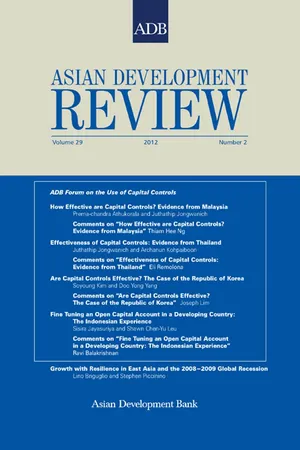
The Asian Development Review is a professional journal for disseminating the results of economic and development research carried out by staff and resource persons of the Asian Development Bank (ADB). The Review seeks high-quality papers with relevance to policy issues and operational matters done in an empirically-rigorous way. Articles are intended for readership among economists and social scientists in government, private sector, academia, and international organizations. This is the second issue to cover the proceedings of ADB's Forum on Capital Controls held on 14 July 2011, and assesses the experiences of selected Asian countries in using de jure capital controls.
eBook - ePub
Asian Development Review
Volume 29, Number 2, 2012
- 221 pages
- English
- ePUB (mobile friendly)
- Available on iOS & Android
eBook - ePub
Asian Development Review
Volume 29, Number 2, 2012
About this book
Information
How Effective are Capital Controls? Evidence from Malaysia
I. INTRODUCTION
The orthodox thinking on capital account convertibility during the Bretton Woods era was that capital account opening should be done cautiously and only after substantial progress had been made in restoring macroeconomic stability, liberalizing the trade account, and establishing a strong regulatory framework to foster a robust domestic financial system. Abrupt dismantling of capital controls at an early stage of reforms without achieving these preconditions was thought to be a recipe for exchange rate overvaluation, financial fragility, and eventual economic collapse (Edwards 1984, Corbo and de Melo 1987, McKinnon 1993, Michaely, Papageorgou, and Choksi 1991).
There was, however, a clear shift in policy emphasis in favor of greater capital account opening from about the late 1980s, with the IMF and the United States (US) Treasury adopting this view as a basic tenet of their policy advocacy for developing countries (Bhagwati 1998, Rodrik 2011). This new policy emphasis was reflected in a major decision by the International Monetary Fund (IMF) to pursue capital account opening as one of its operational objectives. In September 1997, at its annual meeting in Hong Kong, China, the Interim Committee of the IMF proposed an amendment to the IMF Articles of Agreement with a view to extending the definition of currency convertibility, which was then limited to current account transactions, to encompass capital account transactions.
The push towards capital account opening came under serious reconsideration, however, following the onset of the Asian financial crisis (1997–1998) and the global reverberation that impacted a number of other emerging economies. The observation that the countries succumbing to the crisis had for some years received substantial foreign capital flows raised questions about the role of capital inflows in creating the conditions that generated the crisis or favored its dissemination. Informed opinion swung towards the thinking that those countries still maintaining closed capital account regimes should undertake the liberalization of short-term capital movements only gradually and with extreme caution (Cooper 1999, Bhagwati 1998, Eichengreen 2003, Furman and Stiglitz 1998, Stigliz 2002, Radelet and Sachs 1998, Williamson 1993).
Even the IMF, despite its continuous flirting with mandatory capital account convertibility, became more sympathetic to this cautious approach to the opening of the capital account (Fischer 2004). Krugman (1999) added variety to the debate in the context of the East Asian crisis by arguing in favor of the Keynesian advocacy of using controls on capital outflows as a means of regaining macroeconomic policy autonomy in countries where the currency crisis had rapidly translated into painful economic collapse. In recent years, the case for not only retaining exit controls but also imposing new controls to tame short-term capital inflows gained added emphasis because of the increase in capital inflows to emerging market economies as part of the rapid globalization of capital, a process that intensified following the onset of the global financial crisis (2008–2009).
Critics of capital controls, however, argue that these controls are unlikely to cushion economies against the volatility and unpredictability of capital movement given difficulties involved in the actual implementation. A major doubt about the effectiveness of capital controls as a crisis management tool relates to presumably ample scope for avoidance and evasion, which can simply negate the expected monetary policy autonomy (Hale 1998, Edwards 1999a and 1999b). The general argument here is that the more extensive trade and investment links are, the more difficult and costly it would be to control capital account transactions because of the multiplication in the number of arbitrage possibilities that arise in the course of normal business. The problem with this argument is that it is based on a misleading mixing of “placing funds abroad retail” (retail transfer of funds abroad) by manipulating current account transactions and “exporting capital wholesale” (Williamson 1993, p. 36). There is ample evidence from both developed and developing countries that capital controls are in fact effective in substantially reducing, if not preventing, capital flows of the latter type (Eichengreen 2003, Larrain and Laban 2000, Radelet and Sachs 1998).
This paper aims to inform the policy debate on the effectiveness of capital controls in developing countries through a case study of Malaysia. The Malaysian experience provides an excellent laboratory to investigate these issues given the nature of policy shifts relating to capital account opening over the past four decades. During this period, Malaysia implemented selective capital controls on a temporary basis on two occasions as part of macroeconomic policy, against the back drop of a long-term commitment to maintaining an open capital account policy regime. In the first half of 1994, capital inflow controls were introduced when the booming economy triggered massive short-term capital inflows jeopardizing macroeconomic stability. Capital outflow controls were the centerpiece of Malaysia’s unorthodox policy response to the Asian financial crisis (1998–1999). This was the first case in postwar economic history of an emerging market economy imposing controls on capital outflows in a crisis context to set the stage for fixing the exchange rate and monetary and fiscal expansion.
The paper is written in three parts. Section II provides an overview of capital account policies in Malaysia. Section III examines the effectiveness of these policies by first constructing indexes based on a carefully compiled chronology of policy changes then using them as the key explanatory variables within a standard vector autoregressive modeling framework to examine the impact of capital account policy on capital flows and other related macroeconomic variables. Section IV supplements the econometric analysis with case studies of capital inflow controls in 1994 and capital outflow controls during 1998–1999. The main findings are summarized in the concluding section. A comprehensive chronology of Malaysia’s capital account policy is provided in the Appendix.
II. CAPITAL ACCOUNT POLICY
Malaysia is unique among developing countries in its long-standing commitment to an open foreign trade regime. 1 As an essential element of openness to trade, the Malaysian dollar (renamed ringgit in 1975) remained fully convertible on the current account throughout the post-independence period. Although exporters were required to convert foreign currency sales proceeds into local currency within 6 months, this was not a binding constraint on production for export because the import trade regime remained highly liberal. Despite mandatory approval procedures, the exchange rules relating to all current account transactions remained liberal. With this policy orientation, Malaysia achieved Article VIII status (for current account convertibility) under the IMF Articles of Agreement on 11 November 1968, becoming the fourth Asian economy to enter this country league after Hong Kong, China (15 February 1961); Japan (1 April 1964); and Singapore (9 November 1968).
A natural companion to outward-oriented trade policy was a firm commitment to the promotion of foreign direct investment (FDI). FDI approval procedures and restrictions on foreign equity ownership were very liberal by developing country standards even in the 1950s and 1960s at a time when hostility towards multinationals was the order of the day in the developing world. Emphasis on FDI promotion received added impetus with a notable shift in development policy towards export-oriented industrialization in the early 1970s.
The Malaysian policy regime relating to non-FDI capital flows (that is, international flows of purely financial capital) in general, too, was much more liberal throughout the postwar period compared to most other developing countries (Williamson and Mahar 1998). However, liberalization in this sphere was much more cautious and gradual by Malaysia’s own historical record of trade and FDI liberalization. Most restrictions on short-term overseas investment by residents were removed in the 1970s. By the turn of the decade, residents were free to place deposits abroad, lend to nonresidents, purchase immobile properties, or invest in foreign equity, provided such investments were not financed from borrowing in Malaysia. However, there were binding restrictions on short-term capital inflows, foreign share holdings in local brokerage firms, and bank lending to nonresidents.
As part of the reform package implemented in response to the economic crisis during 1985–1986, there was a new emphasis on promoting FDI in the economy. The Investment Coordination Act, promulgated in 1975 to achieve the objective of increased Bumiputera involvement at the enterprise level, was amended in October 1986 to apply only to investments of roughly $1 million or more (the previous threshold was $400,000) or to plants employing more than 75 workers. The amendment also eased limitations on the number of expatriates employed in foreign affiliates. Foreign investors could own 100% of new projects that exported most of their products or sold its products to firms in free trade zones that employ at least 350 full-time Malay workers. The Promotion of Investment Act (1986) strengthened incentives to foreign investors.
In response to the significant deterioration in bank balance sheets during 1985–1986, stringent limits on private foreign borrowing were introduced under the Banking and Financial Regulation Act enacted in 1989. This important legislation required Bank Negara Malaysia (BNM), the central bank, to monitor foreign currency borrowings by residents and...
Table of contents
- Front Cover
- Title Page
- Copyright Page
- Contents
- How Effective are Capital Controls? Evidence from Malaysia
- Effectiveness of Capital Controls: Evidence from Thailand
- Are Capital Controls Effective? The Case of the Republic of Korea
- Fine Tuning an Open Capital Account in a Developing Country: The Indonesian Experience
- Growth with Resilience in East Asia and the 2008-2009 Global Recession
- List of Referees
- Call for Papers
- Backcover
Trusted by 375,005 students
Access to over 1.5 million titles for a fair monthly price.
Study more efficiently using our study tools.
Frequently asked questions
Yes, you can cancel anytime from the Subscription tab in your account settings on the Perlego website. Your subscription will stay active until the end of your current billing period. Learn how to cancel your subscription
No, books cannot be downloaded as external files, such as PDFs, for use outside of Perlego. However, you can download books within the Perlego app for offline reading on mobile or tablet. Learn how to download books offline
Perlego offers two plans: Essential and Complete
- Essential is ideal for learners and professionals who enjoy exploring a wide range of subjects. Access the Essential Library with 800,000+ trusted titles and best-sellers across business, personal growth, and the humanities. Includes unlimited reading time and Standard Read Aloud voice.
- Complete: Perfect for advanced learners and researchers needing full, unrestricted access. Unlock 1.5M+ books across hundreds of subjects, including academic and specialized titles. The Complete Plan also includes advanced features like Premium Read Aloud and Research Assistant.
We are an online textbook subscription service, where you can get access to an entire online library for less than the price of a single book per month. With over 1.5 million books across 990+ topics, we’ve got you covered! Learn about our mission
Look out for the read-aloud symbol on your next book to see if you can listen to it. The read-aloud tool reads text aloud for you, highlighting the text as it is being read. You can pause it, speed it up and slow it down. Learn more about Read Aloud
Yes! You can use the Perlego app on both iOS and Android devices to read anytime, anywhere — even offline. Perfect for commutes or when you’re on the go.
Please note we cannot support devices running on iOS 13 and Android 7 or earlier. Learn more about using the app
Please note we cannot support devices running on iOS 13 and Android 7 or earlier. Learn more about using the app
Yes, you can access Asian Development Review by Prema-chandra Athukorala, Juthathip Jongwanich, Thiam Hee Ng, Archanun Kohpaiboon, Eli Remolona, Soyoung Kim, Doo Yong Yang, Joseph Lim, Sisira Jayasuriya, Shawn Chen-Yu Leu, Ravi Balakrishnan, Lino Briguglio, Stephen Piccinino in PDF and/or ePUB format, as well as other popular books in Economia & Economia dello sviluppo. We have over 1.5 million books available in our catalogue for you to explore.