The Maldives has propelled itself to middle-income status despite its geographic constraints and the risks it faces as a small island economy. The economy has been growing in the last 5 years, but development challenges remain formidable. How can the Maldives sustain and improve the pace of its economic growth and reduce poverty and inequality? This report identifies the critical constraints to inclusive growth and discusses policy options to overcome such constraints.
- 128 pages
- English
- ePUB (mobile friendly)
- Available on iOS & Android
eBook - ePub
About this book
Information
Topic
EconomiaSubtopic
Economia internazionale1.1. Introduction
The Maldives is one of the smallest countries in Asia and the Pacific by population and land area, and its people are scattered across 194 islands. Located in the Indian Ocean to the southwest of the Indian subcontinent, the Maldives comprises an archipelago of about 1,190 low-lying coral reef islands in an ocean area more than 800 kilometers (km) long and 130 km wide. The land area, which includes about 26 natural atolls, is grouped into 20 administrative atolls.
The population, estimated at 341,256 (NBS 2014), is widely dispersed across 188 inhabited islands of which about 125 islands have fewer than 1,000 inhabitants. Some islands are reported to have fewer than 500 inhabitants. One-third of the population lives in the capital city, Malé, which is an island of less than 2 square km. The dispersal of the population over such a wide expanse of atolls with limited transport infrastructure and service hampers connectivity and presents a formidable challenge to sustaining growth and providing the Maldivians with public goods and services.
Like other small island developing countries, the Maldives experiences specific problems that arise from the interplay of its small size and external factors. Its small size means that the country is undiversified across economic sectors and lacks arable land and natural resources other than fisheries. The dispersion of its islands has resulted in diseconomies of scale, high transport costs, a limited internal market, heavy dependence on imports, and vulnerability to exogenous economic and financial shocks. The Maldives’ economy is very open, with its trade as a share of gross domestic product (GDP) equivalent to 223% in 2012.1 The Maldives is also vulnerable to natural disasters, as the extremely low elevation of its islands (averaging about 1.5 meters above mean sea level) increases its susceptibility to tsunamis and effects of climate change.
Tourism from other Asian countries has been the engine of growth during the last 4 decades, propelling the Maldives to middle-income status. Since 1972, the government has been able to turn the dispersion of its islands into an opportunity to develop its tourism industry by converting some of the islands into high-end resorts. Thus, despite the daunting challenges of geography and a widely dispersed population, the Maldives has recorded significantly high growth in the last decades: real GDP growth averaged about 7.4% per year during 1986–2014 (Figure 1.1). The Maldives was able to graduate from a least-developed country in the 1970s to middle-income country status in 2011.2 The Maldives has reported the highest GDP per capita among the South Asian countries since 1995. Its per capita GDP at constant 2005 $ in 2014 was $6,154—almost three times the South Asia subregion’s average, 3 times that of Bhutan, at $2,068, and 14 times that of Nepal at $426.3 (Measured at 2011 purchasing power parity international dollars, the Maldives’ per capita GDP in 2014 was $14,095, more than twice the average level of the South Asia subregion.)
Figure 1.1: Per Capita GDP and GDP Growth
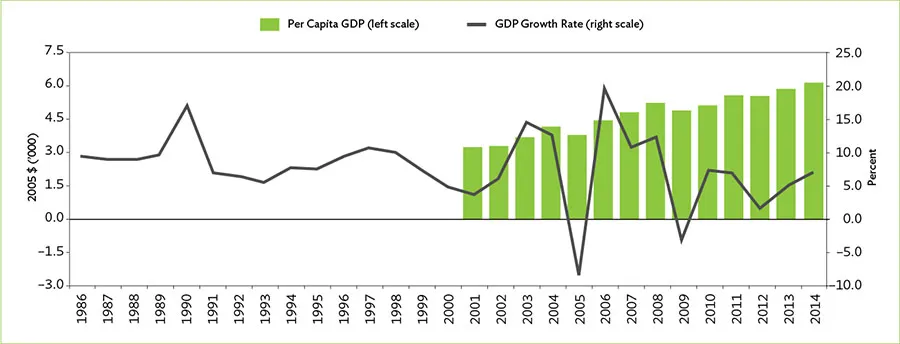
GDP = gross domestic product.
Notes:
(1) GDP growth is at constant 2003 basic prices; while per capita GDP is at constant 2005 $.
(2) Data on per capita GDP is available from 2001 only.
Source: For GDP growth, DNP (various years); for per capital GDP, World Bank, World Development Indicators (accessed July 2015).
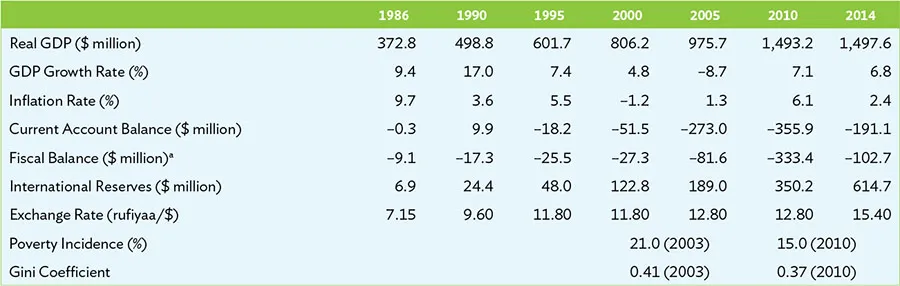
This growth has enabled the government to support poverty reduction initiatives and implement social development programs. Investments in social development programs led to visible progress in achieving the Millennium Development Goals. Table 1.1 presents a brief summary of the Maldives’ socioeconomic development during the last 2.5 decades.
Table 1.1: Broad Socioeconomic Indicators
GDP = gross domestic product.
a Average annual exchange rate was used to estimate fiscal balance in dollars.
Note: Real GDP is at basic prices.
Sources: For current account balance and international reserves: IMF, International Financial Statistics (accessed March 2015) for 1986–2006 data; MMA (2015b) for 2010 and 2014. For exchange rates: IMF, International Financial Statistics (accessed March 2015) for 1986–2010 data; MMA (2015b) for 2014. For fiscal balance: ADB, Statistical Database System (accessed March 2015) for 1986–2009 data; MMA (2015b) for 2010–2014. For poverty incidence and Gini coefficient: DNP (2012b). For others: DNP (various years).
At the same time, the country’s small size and dispersion creates enormous challenges in terms of public service delivery, so the government has been tackling these through consolidation. The government has recognized that to create scale in economic activities and efficiency in delivering various services, consolidating the population into fewer islands is a prime option. Population and development consolidation continues to be envisaged as one means to bring down the cost of service delivery, address connectivity, and deal with the threat of rising sea levels and natural calamities. The 7th National Development Plan states that the government is bent on pursuing “the Population and Development Consolidation program.”4 Under this program, the government plans to offer incentives for people to migrate from islands that are environmentally vulnerable and/or from islands with populations less than 1,000 (MPND 2007). The policy also encourages people to move voluntarily to less vulnerable islands. However, the government has first to address its mounting public debt, as the resettlement program will require a huge amount of resources.
Following interruptions induced by political uncertainty, the main development agenda of the government going forward includes expanding social welfare and economic diversification. In November 2009, the government crafted a strategic action plan (SAP) outlining the national framework for development for 2009–2013.5 The SAP was intended to be the government’s principal planning document for delivering its pledges and programs outlined in the Maldivian Democratic Party Alliance Manifesto. However, the political and social unrest and the ensuing uncertainty from 2011 to 2013 delayed implementation of the SAP. The government that was elected in November 2013 formulated a development plan following the President elect’s campaign promises. The plan’s main pillars included creating desirable jobs especially for the youth, addressing law-and-order problems, and tackling social welfare issues such as state-provided health care and housing. The plan also aims to pursue greater economic diversity and expand agriculture so as to reduce dependency on food imports. The return of political stability following the 2013 presidential elections and the 2014 parliamentary elections enhanced the environment for business investment.
1.2. Small Economy
Due to its small size, the economy is vulnerable to shocks. The Maldives’ growth performance has been highly successful considering a number of adverse factors, both internal and external, that have transpired in the last 28 years. Tourism has been the main driver of growth, but its importance has also exposed the economy to greater volatility. External developments such as the Asian Financial Crisis of 1997–1998, the Indian Ocean tsunami of 2004, and the 2007–2008 global financial crisis demonstrated how the Maldives’ heavy dependence on one sector—tourism—creates underlying vulnerabilities.
The impact of the 2004 tsunami was particularly devastating. Financial damage due to the tsunami was estimated at $470 million (44% of the country’s 2004 GDP), excluding the environmental costs, i.e. the value of the topsoil and reclaimed land that was washed out to sea (World Bank 2005). The tourism industry was severely affected the following year, as it contracted by 34% and the economy as a whole contracted by 8.7%. The economy was able to recover from the tsunami to register double digit growth rates between 2006 and 2008. However, the substantial increase in public spending following the tsunami had a major impact on the fiscal position.
The country suffered another shock in the late 2000s as the world economy faltered in the aftermath of the global financial crisis of 2007–2008. The economy contracted by 3.6% in 2009 due to a fall in tourism receipts, capital inflows, and exports. Along with acute dollar shortages and falling reserves, the fiscal condition deteriorated sharply while the increased monetization of the fiscal deficit fueled inflation.
Vulnerabilities are still palpable. The economic rebound in 2010–2011, driven by the recovery of tourism, has been relatively weak as the uncertainty about global economic recovery continues. Real GDP is projected to grow at 6.3% in 2015, about 0.5 percentage points lower than 6.8% growth in 2014. The country continues to face severe fiscal and external imbalances, with a high risk of debt distress.
1.3. Growth by Sources of Production
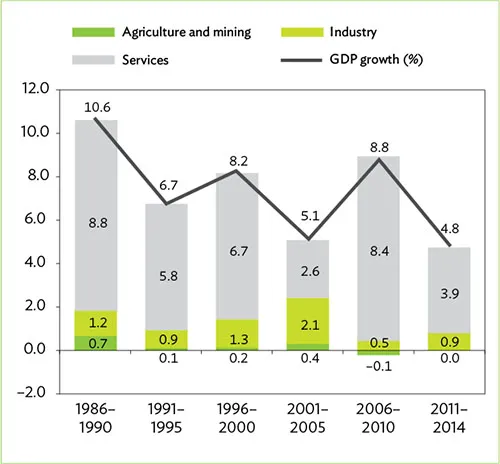
The Maldives’ archipelagic structure constrains the country’s range of economic activities. As is typical of countries composed of dispersed islands, the Maldives’ services sector, of which tourism is the biggest component, has been the main driver of growth for almost 3 decades. Agriculture, which has been constrained by a dearth of arable land, and industry, with limited manufacturing activities, have played a minor role in the economy (Figure 1.2).
Figure 1.2: Average Contributions of Major Sectors to GDP Growth, 1986–2014 (percentage points)
GDP = gross domestic product.
Source: Calculations based on DNP (various years).
The services sector averaged 82.8% of GDP during 1986–2014, and has been by far the largest contributor to GDP during the last 3 decades. The exception was in 2004–2005, when the 2004 tsunami led to a dramatic fall in GDP, with the services sector contributing only 2.6%. The growth of services has been even more important in relative terms since the 2007 recession, given the lackluster growth and weak recovery of the other sectors following the global financial crisis. The sudden increase in output of the public sector in 2008—due to a sizable increase in recurrent expenditures—counteracted to some extent the sharp drop in tourism activity. The real gross value added of the services sector has been on an increasing trend since tourism has flourished as one of the main growth drivers.
Tourism continues to be the mainstay of the economy, averaging 35% of services’ share in GDP during 2001–2014. Since the first tourist resorts opened in 1972, tourism reached a 26,891 bed-night capacity on 104 resort islands at the end of 2014. Tourism...
Table of contents
- Front Cover
- Title Page
- Copyright Page
- Contents
- Foreword
- Preface
- Acknowledgments
- Abbreviations and Acronyms
- Maldives Fast Facts
- Executive Summary
- 1. Development Performance
- 2. Critical Constraints to Growth
- 3. Critical Constraints to Inclusiveness
- 4. Challenges the Maldives and Other Small Island Developing States Face
- 5. Policy Recommendations
- References
- Footnote
- Boxes
- Back Cover
Trusted by 375,005 students
Access to over 1.5 million titles for a fair monthly price.
Study more efficiently using our study tools.
Frequently asked questions
Yes, you can cancel anytime from the Subscription tab in your account settings on the Perlego website. Your subscription will stay active until the end of your current billing period. Learn how to cancel your subscription
No, books cannot be downloaded as external files, such as PDFs, for use outside of Perlego. However, you can download books within the Perlego app for offline reading on mobile or tablet. Learn how to download books offline
Perlego offers two plans: Essential and Complete
- Essential is ideal for learners and professionals who enjoy exploring a wide range of subjects. Access the Essential Library with 800,000+ trusted titles and best-sellers across business, personal growth, and the humanities. Includes unlimited reading time and Standard Read Aloud voice.
- Complete: Perfect for advanced learners and researchers needing full, unrestricted access. Unlock 1.5M+ books across hundreds of subjects, including academic and specialized titles. The Complete Plan also includes advanced features like Premium Read Aloud and Research Assistant.
We are an online textbook subscription service, where you can get access to an entire online library for less than the price of a single book per month. With over 1.5 million books across 990+ topics, we’ve got you covered! Learn about our mission
Look out for the read-aloud symbol on your next book to see if you can listen to it. The read-aloud tool reads text aloud for you, highlighting the text as it is being read. You can pause it, speed it up and slow it down. Learn more about Read Aloud
Yes! You can use the Perlego app on both iOS and Android devices to read anytime, anywhere — even offline. Perfect for commutes or when you’re on the go.
Please note we cannot support devices running on iOS 13 and Android 7 or earlier. Learn more about using the app
Please note we cannot support devices running on iOS 13 and Android 7 or earlier. Learn more about using the app
Yes, you can access Maldives by in PDF and/or ePUB format, as well as other popular books in Economia & Economia internazionale. We have over 1.5 million books available in our catalogue for you to explore.