This report discusses key policy challenges that need to be addressed if the Philippines were to embark on sustainable and inclusive growth. We take the view that the main reason behind the Philippines' lagging growth and development outcomes in the regional context lies in a sluggish transformation of the economy---in particular, stagnant industrialization. Chronic problems of unemployment, poverty, and low investment are reflections of weak industrial development. The economy has been led by services, and it has been further shifting toward services with the growing business process outsourcing. Nevertheless, sole development of the services sectors is not sufficient to address the development challenges and lead to inclusive growth. We propose more targeted public sector support, which focuses on specific industries and products for industrial upgrading and diversification. This report shows a methodology of choosing products for targeted public sector support, and recommends effective dialogue between the public and private sectors to identify constraints specific to the target products and to develop adequate solutions. The Philippines needs to develop a stronger industrial base to enable the economy to "walk on two legs" of industry and modern services, to create productive job opportunities for the growing working-age population.

eBook - ePub
Taking the Right Road to Inclusive Growth
Industrial Upgrading and Diversification in the Philippines
- 112 pages
- English
- ePUB (mobile friendly)
- Available on iOS & Android
eBook - ePub
Taking the Right Road to Inclusive Growth
Industrial Upgrading and Diversification in the Philippines
About this book
Information
Appendix 1
Labor Productivity, 1980–2009
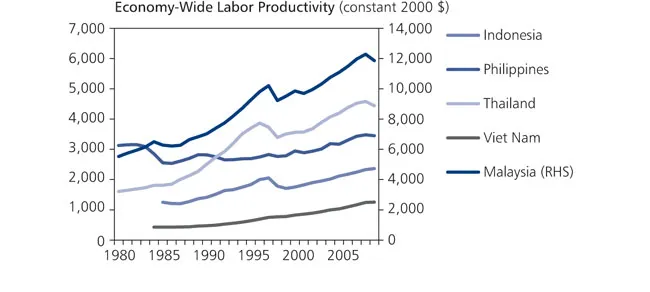
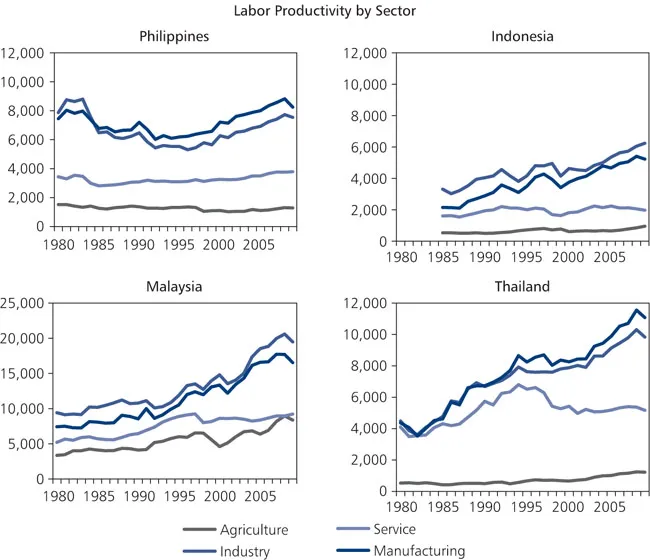
Source: Author’s calculation.
Appendix 2
Labor Productivity—Manufacturing, 1980–2006
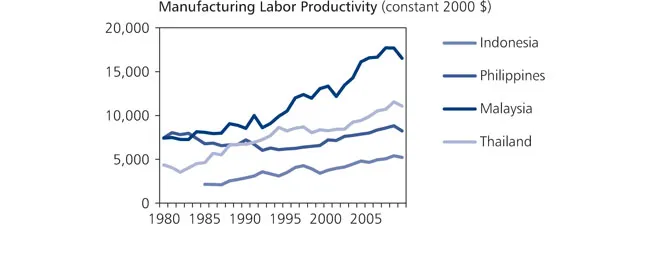
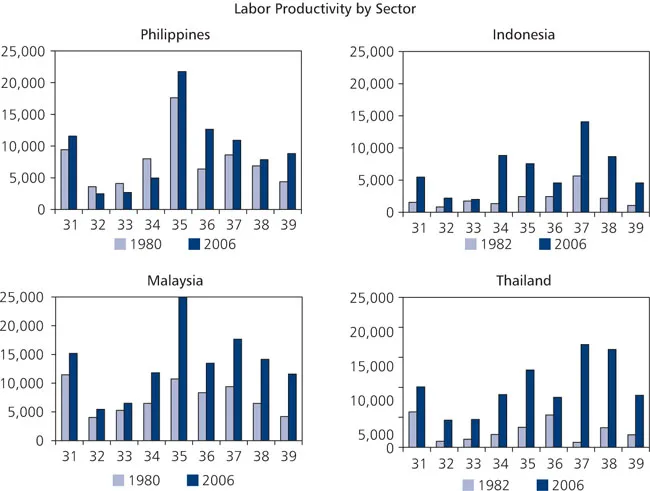
Note: Subsector classification is based on the ISIC revision 2: code 31 food, beverages and tobacco; 32: textile, wearing apparel and leather; 33: wood and wood products, including furniture; 34: paper and paper products, printing and publishing; 35: chemicals and petroleum, coal, rubber and plastic; 36: nonmetallic mineral products; 37: basic metal; 38: fabricated metal, machinery and equipment; and 39: other manufacturing.
Source: Author’s calculation on UN Industrial Development Organization (UNIDO), INDSTAT3 2005 and INDSTAT4 2010.
Appendix 3
Technical Notes on Key Concepts in Product Space
1. Revealed Comparative Advantage and Diversification
Revealed comparative advantage (RCA): In an in-depth analysis of export data, the so-called marginal exports should not be included. To quantify the significance of an export product, this paper uses the concept of RCA. A country exports a product whenever they have RCA in it. Based on Balassa (1965),68 RCA is defined as:
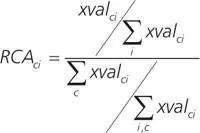
where xvalci is the value of the exports of country c in the producti. RCA is larger than one when the share of exports of a country on a given product is larger than the share of that product on the world trade. This RCA sets a hard threshold for country c’s export. When RCAci > 1 we say that country c exports product i, otherwise, that country is a marginal exporter of that product.
Diversification: Diversification of a country is the total number of export products with comparative advantage.
2. Ubiquity and Standardness
Ubiquity: Ubiquity is defined for each product as the total number of countries exporting the product with RCA > 1.
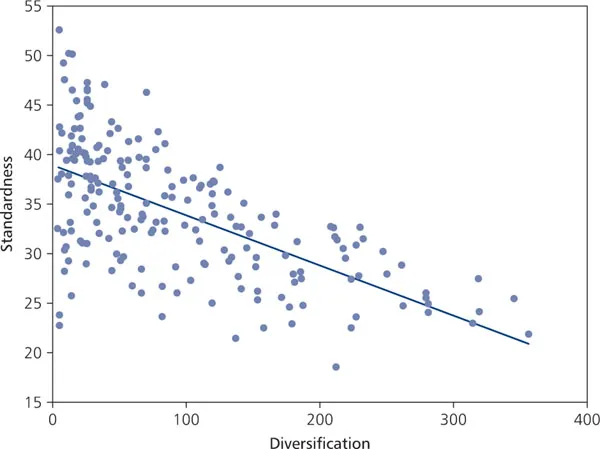
Standardness: Standardness is defined for each country as the average ubiquity of the commodities exported from the country with comparative advantage. A lower value of the standardness means that the country has a more unique export basket. Figure A3-1 shows that countries with more diversified export structure tend to export more unique products.

Figure A3-1 Standardness and Diversification, 2008
Source: Author’s calculation.
3. Level of Sophistication (PRODY and EXPY)
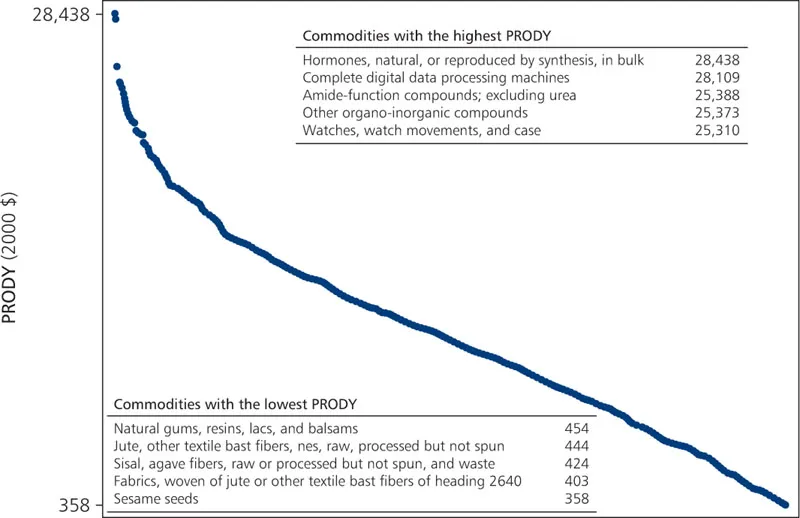
PRODY: PRODY is a measure used in evaluating the level of sophistication at the product level. It is computed using trade data from United Nations Commodity Trade (UN Comtrade) website at 4-digit SITC Revision 2 codes and real gross domestic product (GDP) per capita (constant 2000 $) data from the United Nations Statistics Division website. A sample of 204 countries is included in the calculation for 3 years, from 2004 to 2006. Only countries that reported trade data and had available GDP per capita data are considered in the sample. Import data (by country of origin) from the point of view of the importer countries were used to approximate the export data of the country of origin. The average of the resulting export data across 3 years were used to estimate the PRODY. Figure A3-2 shows the distribution of PRODY of the 773 products, which ranges from $358 to $28,438 (constant 2000 $).
Figure A3-2 Distribution of PRODY
Source: Author’s calculation.
EXPY: EXPY defines the level of sophistication at the country level. It measures the level of sophistication of overall export basket of a country by calculating a weighted average of export products with comparative advantage. The EXPY is calculated for all countries reporting trade data from 1962 to 2008. The trade data set used in the study is a combination of the data set from Feenstra et al. (2005)69 for 1962-2000 and the original estimates based on the latest data from UN Comtrade for 2001-2008.
PRODY (of product i) and EXPY (of country c) are defined as:
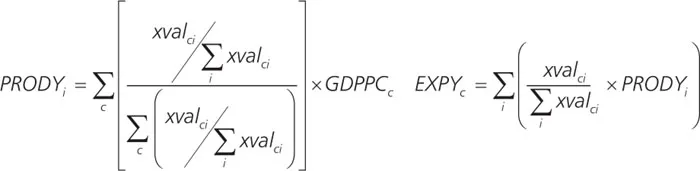
where xvalci is the export value of product i by country c, and GDPPCc is per capita GDP of country c.
4. Proximity and Path
Proximity: If every country that exports a product also exports another product, then these two products must involve similar capabilities. On the other hand, if every country that exports a product does not export another product, then these two products must involve different capabilities. This led to the use of conditional probabilities to measure the similarity between the two products. “Proximity” is measured as the minimum between the probability that countries export product i given that they already export product j; and the probability that countries export product i given that they already export producti. The reason for taking the minimum of the two probabilities is to create a symmetric measure of distance for a pair of products. Formally, the proximity between products i and j is defined as:
φi,j = min{P(xi = 1 | Xj = 1), P(Xj = 1|xj = 1)}
where xj = 1 implies that, for every country c and commodity i, RCAci > 1.
Path: For each product, we measure the strength of the linkages with other products by simply adding up the proximities leading to that product. This index,...
Table of contents
- Front Cover
- Title Page
- Copyright Page
- Contents
- List of Tables and Figures
- Abbreviations
- Acknowledgments
- Executive Summary
- Introduction
- Structural Transformation—Aggregate Productivity Growth
- Structural Transformation—Evolution of Product Space
- Service-Led Growth—Can Services Alone Drive Inclusive Growth?
- Policy Options for Economic Diversification—Product Identification and Targeted Public Sector Support
- Concluding Remarks
- Road Map
- Appendixes
- Back Cover
Trusted by 375,005 students
Access to over 1.5 million titles for a fair monthly price.
Study more efficiently using our study tools.
Frequently asked questions
Yes, you can cancel anytime from the Subscription tab in your account settings on the Perlego website. Your subscription will stay active until the end of your current billing period. Learn how to cancel your subscription
No, books cannot be downloaded as external files, such as PDFs, for use outside of Perlego. However, you can download books within the Perlego app for offline reading on mobile or tablet. Learn how to download books offline
Perlego offers two plans: Essential and Complete
- Essential is ideal for learners and professionals who enjoy exploring a wide range of subjects. Access the Essential Library with 800,000+ trusted titles and best-sellers across business, personal growth, and the humanities. Includes unlimited reading time and Standard Read Aloud voice.
- Complete: Perfect for advanced learners and researchers needing full, unrestricted access. Unlock 1.5M+ books across hundreds of subjects, including academic and specialized titles. The Complete Plan also includes advanced features like Premium Read Aloud and Research Assistant.
We are an online textbook subscription service, where you can get access to an entire online library for less than the price of a single book per month. With over 1.5 million books across 990+ topics, we’ve got you covered! Learn about our mission
Look out for the read-aloud symbol on your next book to see if you can listen to it. The read-aloud tool reads text aloud for you, highlighting the text as it is being read. You can pause it, speed it up and slow it down. Learn more about Read Aloud
Yes! You can use the Perlego app on both iOS and Android devices to read anytime, anywhere — even offline. Perfect for commutes or when you’re on the go.
Please note we cannot support devices running on iOS 13 and Android 7 or earlier. Learn more about using the app
Please note we cannot support devices running on iOS 13 and Android 7 or earlier. Learn more about using the app
Yes, you can access Taking the Right Road to Inclusive Growth by Norio Usui in PDF and/or ePUB format, as well as other popular books in Economía & Economía del desarrollo. We have over 1.5 million books available in our catalogue for you to explore.