This report summarizes the results of an extensive survey of the business community on the challenges of doing business in Papua New Guinea. It finds that despite some improvement in the business environment following a similar survey conducted in 2002, progress has been disappointing. Many of the issues identified then still have a negative impact on investment and entrepreneurship. To ensure that the current resource boom is translated into sustainable prosperity, substantial reform is needed.

- 20 pages
- English
- ePUB (mobile friendly)
- Available on iOS & Android
eBook - ePub
About this book
Information
Introduction
This report describes the results of a 2007 survey of 243 businesses in Papua New Guinea (PNG).1 Businesses were asked to provide their views on a wide range of issues that affect the way they do business, the factors that influence their investment decisions, and the relationship between the business community, government, and the public sector more generally. A similar survey, which provides a unique opportunity to compare how the business climate has evolved through time, was undertaken in 2002.2 The comparisons are especially interesting in light of the political stability of the past 5 years and the resource boom that PNG has recently been experiencing. In addition, a private sector assessment (PSA)3 analyzing the constraints to doing business in PNG was recently completed. The survey results provide further insight into PNG’s business environment that complement the PSA as well as additional data against which to test its conclusions.
This summary highlights the main findings of the survey and should be read as a supplement not only to the full report, but also in conjunction with the recently completed PSA by the Asian Development Bank.
Summary of the Findings
The survey identified a number of concerns that impact the cost of doing business and the propensity to invest. The most important are:
• Political uncertainty: even though the previous government (2002–2007) completed its full 5-year term and the current coalition government retains many members who were in the previous administration, businesses still fear possible political instability.
• Business security: law and order problems impose substantial costs on businesses, with many respondents indicating that this had adversely affected their decision to invest or expand.
• Government regulations and policies: instability in laws, regulations, and rules that adversely affect businesses.
• Business–Government relationships: Corruption remains a considerable problem, as is the lack of consultation by the government before the promulgation of laws or regulations that affect business.
• Infrastructure and public services: the quality of infrastructure and services is poor and reported to have declined since the previous survey.
The Survey Sample
Every effort was made to ensure a representative sample. Of the businesses surveyed, slightly over half were PNG owned, about a quarter were foreign owned, and the rest were jointly owned. The sample consisted almost exclusively of formally registered businesses, 80% of which have been in business for at least 5 years. Nearly half of the businesses operated outside the main centers of Port Moresby and Lae. Fortyfive percent of these were classified as large businesses, having a turnover of more than K5 million, and the other 55% were small- or mediumsized enterprises. About 20% of the respondents cater to both local and foreign markets.
The businesses surveyed were from 10 broad economic industry groups:
• agriculture, forestry and fisheries;
• building and construction;
• finance, business and investment;
• hotels, restaurants and bars;
• manufacturing;
• mining and quarrying;
• retail and wholesale;
• transportation and communication;
• utilities; and
• other services (e.g., gaming, hairdressing, etc.).
Methodology and Themes Surveyed
The survey was conducted between May and June 2007. It consisted of 26 questions grouped into the following themes:
• impact of political uncertainty on businesses,
• business security,
• effect of government regulations and policies,
• business–government relationships,
• effectiveness of government services, and
• constraints to business and investment.
Political Uncertainty
Business is inherently risky. Investors and entrepreneurs commit capital and time in attempts to take advantage of commercial opportunities. Even in large developed countries, however, a significant number of businesses fail. In one sense, this is good because it encourages productivity and weeds out the inefficient. Nevertheless, when business risk, which in the first place is already quite considerable, is aggravated by political risk, the impact on investment is negative—investors will demand higher returns and shorter payback periods to reduce their exposure to uncertainty, and this lowers potential growth.
Furthermore, experience in many countries indicates that investors’ memories are long—when policy reforms are introduced, they do not immediately rush to invest. Rather, they adopt a wait-and-see approach to make sure that the changes are permanent.
During the 1990s, businesses in PNG experienced considerable instability arising from frequent changes in government, a breakdown in macroeconomic discipline, and erratic and frequent changes in policies affecting the private sector. This began to change in 1999, when the newly elected Morauta government introduced a wide range of reforms aimed at enhancing policy and political stability, including the Organic Law on the Integrity of Political Parties and Candidates in 2000. Notwithstanding these efforts, a breakdown in fiscal discipline in 2001 and early 2002 contributed to a
When business risk is aggravated by political risk, the impact on investment is negative
weakening of business confidence, which may have served to undermine the Morauta government’s earlier achievements.
However, economic conditions in PNG have improved considerably since 2002, and the Somare government (2002–2007) was the first in PNG’s history to complete a full 5-year term. Moreover, following the 2007 elections, a coalition government with much the same composition has continued in office.
This period of continuity of government provides an excellent opportunity to assess the effects of greater political stability over the past 6 years and whether the business community has changed its investment behavior, or is still holding back, waiting to see if the improvement in the political climate is permanent.
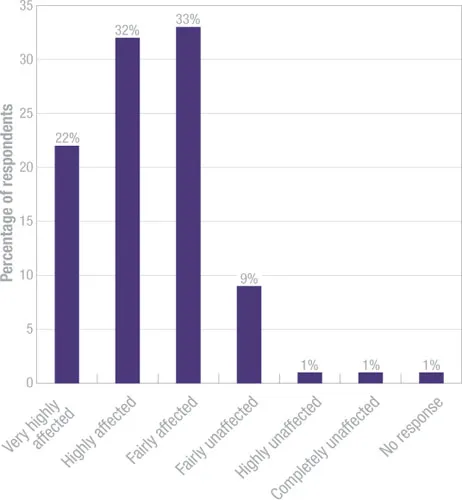
The extent to which political instability harms businesses in PNG is shown in Figure 1. Fully 87% of respondents indicated that they were negatively affected by periods of political instability and uncertainty. Having almost the same number of respondents indicating concern in the 2002 survey suggests that the effect of unchanged government has yet to produce a positive response in the business community.
Figure 1: Impact of Political Instability on Business
Source: Institute of National Affairs. 2008. The Business and Investment Environment in Papua New Guinea in 2007: Private Sector Perspective—A Private Sector Survey. Port Moresby.
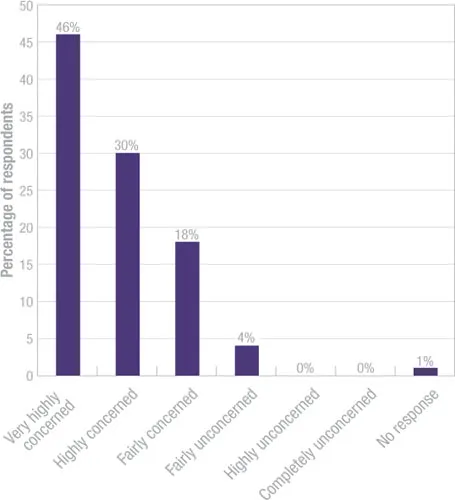
Furthermore, in the 2007 survey, businesses were asked how concerned they were regarding the stability of the political environment. Fully 76% indicated that they were either “very highly concerned” or “highly concerned” regarding future political stability (Figure 2).4
Figure 2: Concern over Future Political Stability
Source: Institute of National Affairs. 2008. The Business and Investment Environment in Papua New Guinea in 2007: Private Sector Perspective—A Private Sector Survey. Port Moresby.
Business Security
A strong and effective legal system, contributing to a safe and secure society, is essential for a wellfunctioning private sector. Indeed, law and order is required to help ensure security over physical assets and, more importantly, of employees. Apart from the costs associated with theft, high crime levels deter business and investment by increasing insurance premiums, raising the cost of internally provided security (e.g., guards and security systems) and bringing up the costs associated with the employment of skilled labor from abroad. High crime levels can also impact adversely on the productivity of a business if employees are unwilling or unable to work night shifts.
A strong and effective legal system is required to ensure that property rights and business contracts can be readily secured and effectively enforced. Without a degree of certainty in the legal enforceability of property rights, security over ownership of assets will be diminished and the incentive to accumulate wealth and invest in productive capacity will be eroded.
Poor law and order in PNG has attracted considerable attention and debate over the past two decades, both in country and abroad. It has regularly been cited as a major constraint to business activity and investment. The 2007 survey provides an opportunity to assess whether the situation has improved in recent years, or whether it remains one of the foremost constraints faced by businesses.
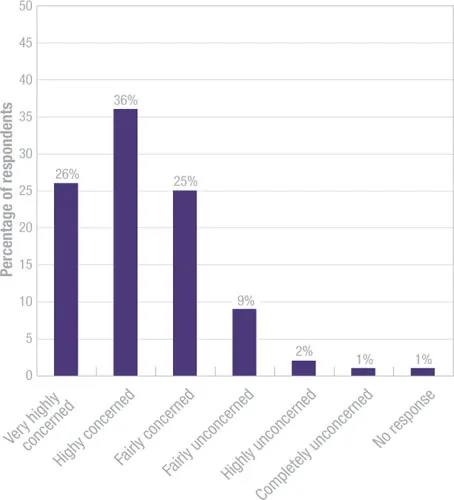
Participants in the survey were asked to indicate the extent to which law and order problems have affected their businesses. Fully 87% indicated that they were “fairly concerned,” “highly concerned,” or “very highly concerned” by issues of crime and security (Figure 3).
Figure 3: Concern over Crime and Security
Source: Institute of National Affairs. 2008. The Business and Investment Environment in Papua New Guinea in 2007: Private Sector Perspective—A Private Sector Survey. Port Moresby.
The costs of dealing with crime are substantial. Figure 4 shows the security costs to bus...
Table of contents
- Front Cover
- Title Page
- Copyright Page
- Contents
- Figures
- Abbreviations
- Introduction
- Summary of the Findings
- Back Cover
Trusted by 375,005 students
Access to over 1.5 million titles for a fair monthly price.
Study more efficiently using our study tools.
Frequently asked questions
Yes, you can cancel anytime from the Subscription tab in your account settings on the Perlego website. Your subscription will stay active until the end of your current billing period. Learn how to cancel your subscription
No, books cannot be downloaded as external files, such as PDFs, for use outside of Perlego. However, you can download books within the Perlego app for offline reading on mobile or tablet. Learn how to download books offline
Perlego offers two plans: Essential and Complete
- Essential is ideal for learners and professionals who enjoy exploring a wide range of subjects. Access the Essential Library with 800,000+ trusted titles and best-sellers across business, personal growth, and the humanities. Includes unlimited reading time and Standard Read Aloud voice.
- Complete: Perfect for advanced learners and researchers needing full, unrestricted access. Unlock 1.5M+ books across hundreds of subjects, including academic and specialized titles. The Complete Plan also includes advanced features like Premium Read Aloud and Research Assistant.
We are an online textbook subscription service, where you can get access to an entire online library for less than the price of a single book per month. With over 1.5 million books across 990+ topics, we’ve got you covered! Learn about our mission
Look out for the read-aloud symbol on your next book to see if you can listen to it. The read-aloud tool reads text aloud for you, highlighting the text as it is being read. You can pause it, speed it up and slow it down. Learn more about Read Aloud
Yes! You can use the Perlego app on both iOS and Android devices to read anytime, anywhere — even offline. Perfect for commutes or when you’re on the go.
Please note we cannot support devices running on iOS 13 and Android 7 or earlier. Learn more about using the app
Please note we cannot support devices running on iOS 13 and Android 7 or earlier. Learn more about using the app
Yes, you can access The Challenges of Doing Business in Papua New Guinea by in PDF and/or ePUB format, as well as other popular books in Business & Business Development. We have over 1.5 million books available in our catalogue for you to explore.