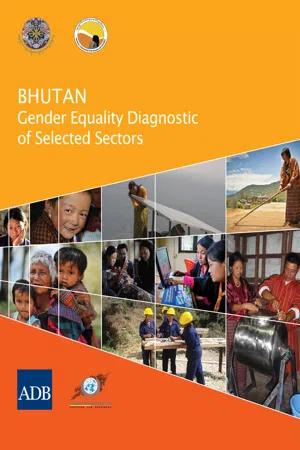
Bhutan has experienced extraordinary change since the 1960s when it opened itself to the world and started the process of planned development. It has transformed itself from a subsistence economy into a middle-income country with rising human development indicators. Yet progress comes with new challenges. These include differences in living conditions and opportunities between rural and urban areas that fuel rural-urban migration, labor shortages in agriculture, and unemployment. There are gender dimensions to each of these challenges, prompting the Government of Bhutan and its development partners to mainstream gender in its policies, programs, and projects. This publication intends to support this process by providing insights into gender issues in agriculture and rural livelihoods, education, energy, environment, private sector development, transport, urban development, and work and unemployment.
- 126 pages
- English
- ePUB (mobile friendly)
- Available on iOS & Android
eBook - ePub
About this book
Information
Toward Gender-Equitable Opportunities and Outcomes:
Urban
Development
Summary | |
| Sector context | •The urban population is projected to rise to 50% of the total by 2020. •Rapid urbanization is putting pressure on current centers. •The 2008 National Urbanization Strategy sets out a growth center approach aimed at balanced regional development. •As yet, only four urban areas have full municipal status, but some 30 urban plans are in process with local government involvement. |
| Gender equality issues relevant to sector activities and outcomes | •Rural–urban migration patterns may be skewed toward men. •Unemployment rates are higher and opportunities fewer for women in urban areas. •Limited child care options may also be a constraint to urban employment for women. •Urban services are important for all but particularly for women. •Poverty is lower in urban areas but is an emerging issue. •Domestic violence and tolerance of it are also urban issues. •Few women participate in local decision making. |
| Government commitments to support women or gender equality in the sector | •The national government recognizes the desirability of more balanced representation of women and men in local government. •Planning by local governments uses the same framework as the national five-year plan, which includes gender mainstreaming. •Local governments are also bound by constitutional commitments and national policies for gender equality. |
| Looking forward: issues and opportunities to consider | •Data and information needs for informed urban and spatial planning •Women’s interests and economic activities (women as actors and agents, not just a “vulnerable group”) •Gender perspectives on spatial and infrastructure planning •Women’s participation in employment opportunities in urban and infrastructure planning and management •Making cities and towns safe places for women |
| Appendixes | •Tip Sheet on Integrating Gender Perspectives in the Sector •Useful Resources on Gender Analysis in the Sector |
Sector Context
The annual growth of the urban population in Bhutan has been as high as 7.3% in recent years and the urban population is projected to increase to at least 50% of the total population by 2020. Part of the increase is due to natural growth, which can be expected to be higher in urban than rural areas given the number of young people migrating to complete their education and then remaining to find work. Rural–urban migration is also a response to higher levels of poverty and fewer opportunities in rural and farming communities.1
The adverse effects of rapid urbanization being experienced in urban centers were summarized in 2009 in the Tenth Five-Year Plan as including “…water shortages, housing scarcity, sanitation and waste disposal problems, deteriorating air quality through pollution and the proliferation of squatter settlements in sensitive environment areas.”2
Another concern is the loss of agricultural land to urban uses, particularly given the relatively limited additional land suitable for agriculture and the constitutional requirement to maintain 60% forest cover.3 Food security issues include the loss of land and the labor shortages already being experienced in farming communities as a result of rural–urban migration.4
In this context, the 2008 Bhutan National Urbanization Strategy aimed for balanced regional development that seeks to realize the benefits of urban dynamism while mitigating existing disparities by “tapping the synergies of rural–urban interdependence.”5 The Eleventh Five-Year Plan reiterates the strategy of focusing on a human settlements approach that aims for balanced regional development and the improvement in the quality of life and socioeconomic well-being of both rural and urban residents.6 Challenges that the plan aims to address include the lack of legislation for national spatial planning and the shortage of professionals in critical fields.7
The national urban system envisaged includes the two national cities (Thimphu and Gelephu), five regional growth centers, 16 Dzongkhags (district centers), 12 medium-sized towns, 23 small towns or Gewog centers, and four corridors that link the cities and regional and national centers.8
An urban area with a specific municipal status is called a Thromde (Box 1 and Box 2). Powers and functions were set out in the Local Government Act, 2009, and further clarified in the Thromde Rules drawn up the same year.9 A Class A Thromde has an elected council (Thromde Tshogde) and is supported by a secretariat. As yet, there are only four Class A Thromde (Thimphu, Phuentsholing, Gelephu, and Samdrup Jongkhar). Thromde Tshogde are responsible for essential services and for land use and development plans. They have regulatory authority over health and safety matters, advertising, land use and building activities, commercial activities, and squatter settlements.
| Box 1. Glossary of key terms in local government | |
| Terms related to Thromde (municipalities) | |
| Th... | |
Table of contents
- Front Cover
- Title Page
- Copyright Page
- Contents
- Boxes and Appendixes
- Message from the Minister, National Commission for Women and Children, Bhutan
- Foreword, Director General, South Asia Department, ADB
- Preface, United Nations Resident Coordinator, Bhutan
- Acknowledgments
- Abbreviations
- Glossary
- Overview
- Agriculture and Rural Livelihoods
- Education
- Energy
- Environment
- Private Sector Development
- Transport: Roads and Services
- Urban Development
- Work and Unemployment
- Back Cover
Trusted by 375,005 students
Access to over 1.5 million titles for a fair monthly price.
Study more efficiently using our study tools.
Frequently asked questions
Yes, you can cancel anytime from the Subscription tab in your account settings on the Perlego website. Your subscription will stay active until the end of your current billing period. Learn how to cancel your subscription
No, books cannot be downloaded as external files, such as PDFs, for use outside of Perlego. However, you can download books within the Perlego app for offline reading on mobile or tablet. Learn how to download books offline
Perlego offers two plans: Essential and Complete
- Essential is ideal for learners and professionals who enjoy exploring a wide range of subjects. Access the Essential Library with 800,000+ trusted titles and best-sellers across business, personal growth, and the humanities. Includes unlimited reading time and Standard Read Aloud voice.
- Complete: Perfect for advanced learners and researchers needing full, unrestricted access. Unlock 1.5M+ books across hundreds of subjects, including academic and specialized titles. The Complete Plan also includes advanced features like Premium Read Aloud and Research Assistant.
We are an online textbook subscription service, where you can get access to an entire online library for less than the price of a single book per month. With over 1.5 million books across 990+ topics, we’ve got you covered! Learn about our mission
Look out for the read-aloud symbol on your next book to see if you can listen to it. The read-aloud tool reads text aloud for you, highlighting the text as it is being read. You can pause it, speed it up and slow it down. Learn more about Read Aloud
Yes! You can use the Perlego app on both iOS and Android devices to read anytime, anywhere — even offline. Perfect for commutes or when you’re on the go.
Please note we cannot support devices running on iOS 13 and Android 7 or earlier. Learn more about using the app
Please note we cannot support devices running on iOS 13 and Android 7 or earlier. Learn more about using the app
Yes, you can access Bhutan by in PDF and/or ePUB format, as well as other popular books in Social Sciences & Gender Studies. We have over 1.5 million books available in our catalogue for you to explore.