The Joint Crediting Mechanism (JCM) is an emerging project-based bilateral offset crediting mechanism initiated by the Government of Japan to facilitate implementation of advanced low-carbon technologies for mitigating greenhouse gas (GHG) emissions in host countries. The Government of Japan has signed bilateral agreements with 16 countries for implementing JCM projects, including 10 developing member countries of the Asian Development Bank. As of September 2016, four of 15 projects registered as JCM projects have been issued JCM credits. JCM credits may be used to meet respective GHG emission reduction targets of relevant governments and project participants. This handbook provides project participants and stakeholders the procedural steps of JCM project development cycle leading up to the issuance of JCM credits.
- 129 pages
- English
- ePUB (mobile friendly)
- Available on iOS & Android
eBook - ePub
About this book
Information
MODULE 1:
OVERVIEW OF THE JOINT CREDITING MECHANISM
1.1INTRODUCTION TO THE MODULE
Module 1 provides an introduction to the Joint Crediting Mechanism (JCM).1 It explains what the JCM is, how it works and who the key stakeholders are. This module is divided into five subsections: (1.1) Introduction to the Module, (1.2) Objectives and Concepts, (1.3) Stakeholders and Governance Structure, (1.4) Rules and Guidelines, and (1.5) JCM Eligible Project Types.
1.2OBJECTIVES AND CONCEPTS
1.2.1Objectives
The JCM aims to facilitate the diffusion of leading low-carbon technologies, products, systems, services, and infrastructure resulting in the mitigation of greenhouse gas (GHG) emissions. JCM projects also contribute to the sustainable development and GHG reduction efforts of the host countries. The GHG emission reductions or removals achieved through the JCM projects are intended to be used by Japan, and the host countries, to achieve their respective GHG emission reduction targets.
1.2.2Relationship between Japan and host country
JCM projects are implemented through bilateral agreements between Japan and individual host countries. As of September 2016, 16 countries have signed these bilateral agreements. The resulting GHG emission reductions that meet all of the requirements of the JCM process may be credited to the project participants of both participating countries. In this way, Japan and the host country will be able to use their portion of JCM credits towards their GHG emission reduction target. Japan can also provide financing for JCM projects through various financing schemes (outlined in Section 1.3).
Figure 1.1 shows an overview of the scheme between Japan and each host country.
Figure 1.1: Overview of the Joint Crediting Mechanism Scheme
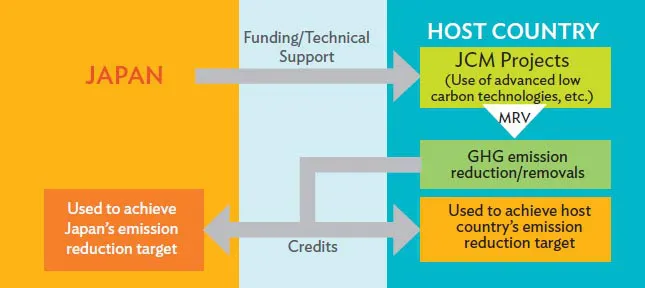
GHG = greenhouse gas, JCM = Joint Crediting Mechanism, MRV = monitoring, reporting, and verification.
Source: Adapted from Government of Japan documents.
1.2.3Concept of calculating emission reductions
The JCM was designed to take into consideration robust methodologies, transparency, and environmental integrity of its procedures, rules, and guidelines, while maintaining simplicity and practicality. Under the JCM, emission reductions are calculated as the difference between “reference emissions” and “project emissions.” Reference emissions are set at emissions estimated below business-as-usual (BAU) level. The details of calculating emission reductions are discussed in Module 3.
1.2.4Preventing double counting of emissions
JCM procedures also address potential double counting of emission reductions by establishing registries in each host country and Japan, to track issued credits and corresponding registry account details. The use of these registries will also prevent registered JCM projects from being used under any other international climate mitigation mechanisms.
1.2.5Total greenhouse gas emission reductions to date
As of September 2016, there are 15 registered JCM projects with a potential to reduce 3,332 tons of carbon dioxide (tCO2) annually. The full list of registered projects can be found in Appendix 1.
1.3STAKEHOLDERS AND GOVERNANCE STRUCTURE
Figure 1.2 provides an overview of the various stakeholders involved in the JCM and their interface during the implementation of a JCM project.
Figure 1.2: Joint Crediting Mechanism Stakeholders and Roles
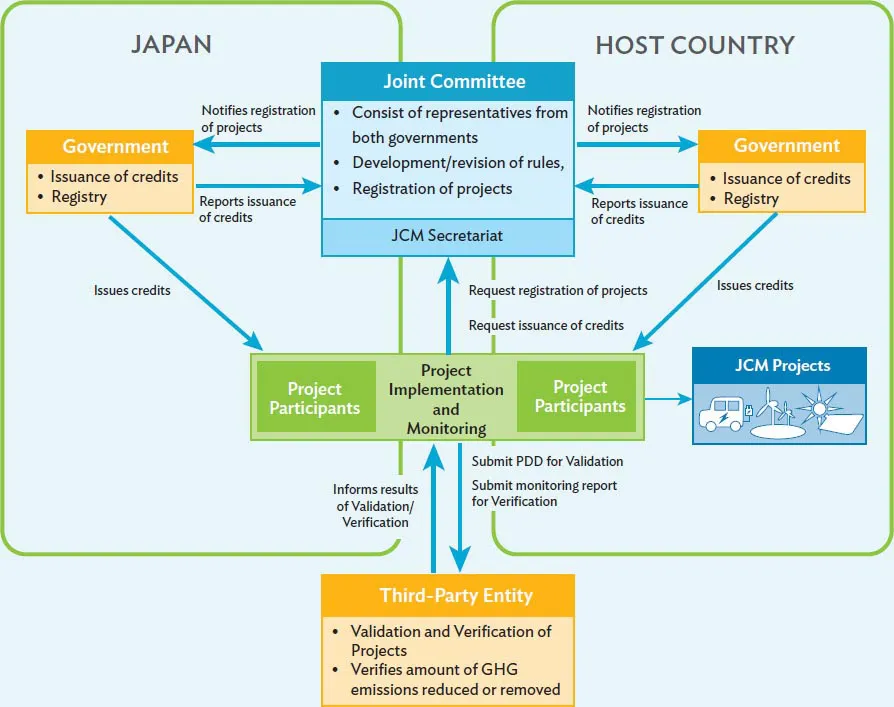
GHG = greenhouse gas, JCM = Joint Crediting Mechanism, PDD = project design document.
Source: Adapted from Government of Japan documents.
The roles of individual stakeholders are explained below.
Project Participants. A JCM project typically has two project participants: the main proponent of a JCM project (the project owner in the host country) and a project developer or a technology provider. The project participants prepare and submit a methodology (if required) and the project design document (PDD), implements the JCM project, monitors the project (including GHG emission reductions), and gets the project validated and verified by an accredited third-party entity (TPE). The project participants are accordingly eligible to receive the issued JCM credits.
Joint Committee. The Joint Committee is the governing body for the JCM in a particular host country. It comprises representatives from both the governments of Japan and the host country. It is responsible for, among others, the development of rules and guidelines for the implementation of the JCM, the approval of new methodologies, approval or rejection of proposed methodologies, registration of JCM projects, accreditation of TPEs, approval or rejection of requests for credit issuance, and developing the registries.
Secretariat. The secretariat is established by the Joint Committee to manage the implementation of the JCM in a particular host country. The JCM secretariat services the Joint Committee and relevant stakeholders and is responsible for information dissemination to all parties. This includes publishing documents such as proposed methodologies and PDDs, conducting completeness check of PDDs and Monitoring Reports, and notifying and announcing decisions of the Joint Committee.
Third-party entities. The TPEs are independent auditors designated by the Joint Committee to conduct validation and verification activities under the JCM i...
Table of contents
- Front Cover
- Title Page
- Copyright Page
- Contents
- Tables, Figures, and Boxes
- Foreword
- Acknowledgments
- Abbreviations
- Introduction
- Module 1: Overview of the Joint Crediting Mechanism
- Module 2: Development of Joint Crediting Mechanism Projects
- Module 3: Methodology Development
- Module 4: Project Design Document
- Module 5: Validation
- Module 6: Registration
- Module 7: Monitoring and Reporting
- Module 8: Verification and Issuance
- Module 9: Post-Registration Project Changes
- Appendixes
- Back Cover
Trusted by 375,005 students
Access to over 1.5 million titles for a fair monthly price.
Study more efficiently using our study tools.
Frequently asked questions
Yes, you can cancel anytime from the Subscription tab in your account settings on the Perlego website. Your subscription will stay active until the end of your current billing period. Learn how to cancel your subscription
No, books cannot be downloaded as external files, such as PDFs, for use outside of Perlego. However, you can download books within the Perlego app for offline reading on mobile or tablet. Learn how to download books offline
Perlego offers two plans: Essential and Complete
- Essential is ideal for learners and professionals who enjoy exploring a wide range of subjects. Access the Essential Library with 800,000+ trusted titles and best-sellers across business, personal growth, and the humanities. Includes unlimited reading time and Standard Read Aloud voice.
- Complete: Perfect for advanced learners and researchers needing full, unrestricted access. Unlock 1.5M+ books across hundreds of subjects, including academic and specialized titles. The Complete Plan also includes advanced features like Premium Read Aloud and Research Assistant.
We are an online textbook subscription service, where you can get access to an entire online library for less than the price of a single book per month. With over 1.5 million books across 990+ topics, we’ve got you covered! Learn about our mission
Look out for the read-aloud symbol on your next book to see if you can listen to it. The read-aloud tool reads text aloud for you, highlighting the text as it is being read. You can pause it, speed it up and slow it down. Learn more about Read Aloud
Yes! You can use the Perlego app on both iOS and Android devices to read anytime, anywhere — even offline. Perfect for commutes or when you’re on the go.
Please note we cannot support devices running on iOS 13 and Android 7 or earlier. Learn more about using the app
Please note we cannot support devices running on iOS 13 and Android 7 or earlier. Learn more about using the app
Yes, you can access Handbook for Developing Joint Crediting Mechanism Projects by in PDF and/or ePUB format, as well as other popular books in Business & Project Management. We have over 1.5 million books available in our catalogue for you to explore.