Managing solid waste is one of the major challenges in urbanization. A survey conducted in all 58 municipalities of Nepal in 2012 found that the average municipal solid waste generation was 317 grams per capita per day. This translates into 1,435 tons per day or 524,000 tons per year of municipal solid waste generation in Nepal. Many of these technically and financially constrained municipalities are still practicing roadside waste pickup from open piles and open dumping, creating major health risks.
- 67 pages
- English
- ePUB (mobile friendly)
- Available on iOS & Android
eBook - ePub
About this book
Information
APPENDIX 1
Main Outputs of the Technical Assistance
Output 1: Supporting the establishment of an effective framework for solid waste management. Under the overall direction defined in the Solid Waste Management Act, the establishment of an effective national solid waste management policy and institutional framework has been supported. In accordance with the act, solid waste management regulations and a national solid waste management policy and strategy have been drafted. A proposed organizational structure, job description, and human resources as well as a 3-year business plan for the Solid Waste Management Technical Support Center (SWMTSC) have been prepared in accordance with the new roles and functions given to the SWMTSC.
Output 2: Strengthening the technical capacity of the Solid Waste Management Technical Support Center. The technical assistance (TA) supported strengthening the capacity of government officials—mainly in the Ministry of Federal Affairs and Local Development and the SWMTSC.1 The capacity development programs have been implemented in the areas of developing an integrated solid waste management system; planning, designing, and operating sanitary landfills, including leachate treatment; promotion of 3R (reduce, reuse, and recycle); and organic composting. Butwal and Siddharthanagar municipalities were selected as pilot cases, where public awareness raising on 3R and training on household composting were conducted, among other activities.
Output 3: Supporting the development of relevant regulations, standards and/or guidelines for improving solid waste management at the regional and local levels. The TA drafted the following guidelines and standards in close consultation with the government and stakeholders: (i) guidelines and standards for planning, design, construction, and management of sanitary landfills; (ii) organic composting guidelines; (iii) compost quality standards; (iv) guidelines on service tariff, based on the review of existing practices; (v) key performance indicators and targets of solid waste management services; and (vi) health care waste management rules. Based on the request from the SWMTSC, a baseline survey of all 58 municipalities was also undertaken, which became the basis of this report.
All the outputs are available on the ADB website.
1 Toward the end of the TA, the Ministry of Urban Development was established, and the SWMTSC was transferred to the Ministry of Urban Development from the Ministry of Federal Affairs and Local Development.
APPENDIX 2
Area and Population of the 58 Municipalities of Nepal
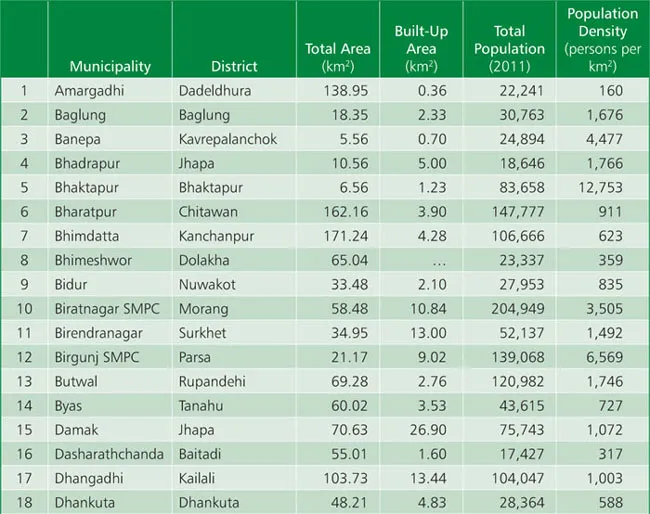
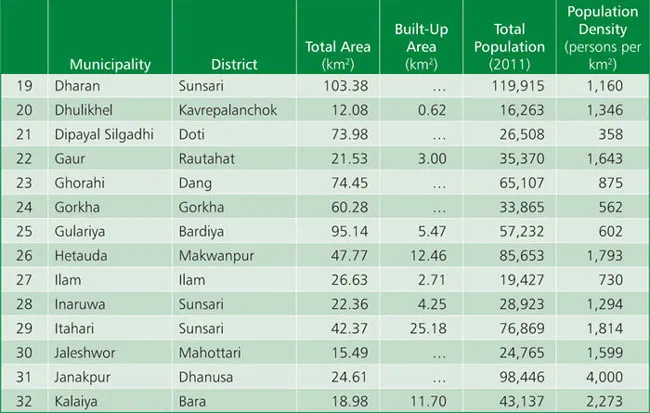
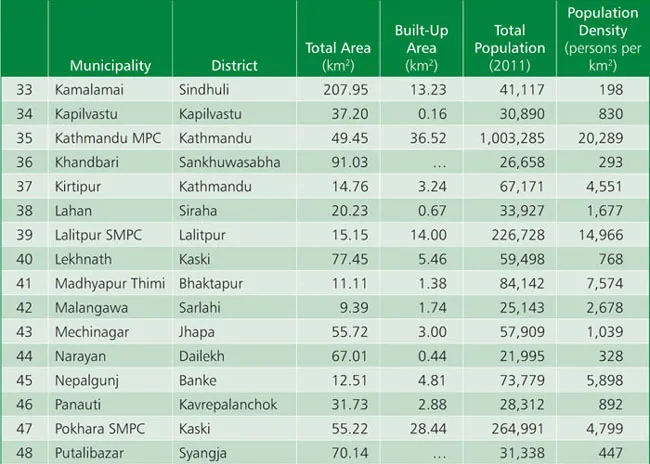
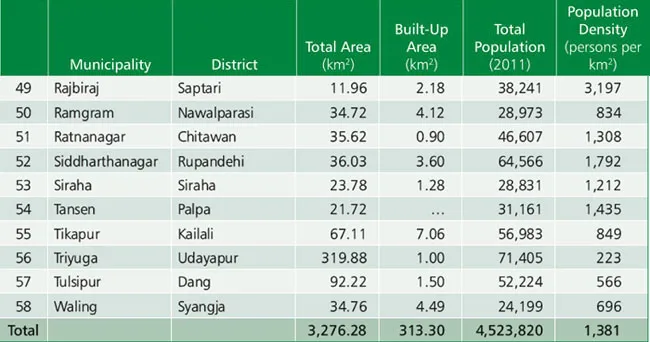
… = not available, km2 = square kilometer, MPC = metropolitan city, SMPC = submetropolitan city.
Source: Asian Development Bank; Government of Nepal, Central Bureau of Statistics. 2012.
APPENDIX 3
Methodology for Sampling and Field Work
I. Sampling Design
The survey covered 58 municipalities with a sample size of 3,233 households, and 627 institutions (schools and offices) and 627 commercial establishments (shops, hotels, and restaurants). The survey employed random (probability) sampling. This size of sample produces results with +/–1.7% of the error margin at a 95% confidence level at the national level.1
A. Household Sampling
Sampling for the selection of respondents was done in four stages. The sampling framework is outlined in the following flowchart:
Sample Design for Household Waste Survey
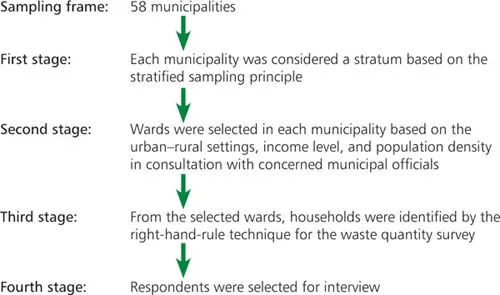
In the first stage, 58 municipalities in Nepal were considered as strata using stratified sampling. The sample size for each stratum was determined by probability proportional to size sampling technique (i.e., the greater the stratum size; the greater the sample size). However, the minimum sample size for each stratum was set at 50 households.
In the second stage, proportional numbers of wards were selected from every municipality, mainly based on factors such as the urban–rural settings, income level, and population density, in consultation with concerned municipal officials. The number of sample wards varied according to the size of the municipality. One ward was selected for every 10 households; for example, if 100 households were to be selected from a municipality, 10 wards, each with 10 households, were selected. In this study, 220, 150, and 100 households were selected in Kathmandu Metropolitan City, Lalitpur, and Bhaktapur, while a minimum of 50 households were selected in other municipalities.2
In the third stage, households in each sample ward were selected randomly by employing the “right-hand-rule technique.”3 Finally, in the fourth stage, the household head, if possible, was selected as the interview respondent to provide information about solid waste management (SWM) practices.
B. Sampling of Institutional and Commercial Establishments
Waste quantity and quality surveys of institutional and commercial establishments were also conducted simultaneously. A total of 627 schools and nongovernment offices were selected. These institutional establishments were spread across the 58 municipalities. At a minimum, five schools and five nongovernment offices were selected from each municipality. Generally, the same wards selected for the household survey were also chosen for the sampling of institutions and commercial establishments. One school and one office from each ward were selected, except in wards where there are either no schools or no offices. In such cases, two or more schools or offices were sampled from a single ward.
Similarly, 627 shops, hotels, and restaurants were selected for the survey. These were spread across the 58 municipalities. A minimum of five shops, hotels, and restaurants were selected from each municipality. One shop and one hotel or restaurant were randomly selected from each ward.
Sampling for the selection of institutions and commercial establishments was done in the same manner as in the household survey.
II. Recruitment, Training, and Equipment
A total of 64 graduate students and research assistants in environmental engineering or science or management from Tribhuvan, Kathmandu, and Pokhara universities and the National Academy of Science and Technology were selected as field surveyors. In the selection process, candidates who are well conversant in Nepali and English, as well as the local languages were given preference. A 2-day orientation training program was conducted b...
Table of contents
- Front Cover
- Title Page
- Copyright Page
- Contents
- List of Tables and Figures
- Foreword
- Acknowledgments
- Currency Equivalents
- Abbreviations
- Weights and Measures
- Glossary
- Executive Summary
- I. Introduction
- II. Municipal Solid Waste Generation and Composition
- III. Existing Solid Waste Management System
- IV. Managerial Aspects of Solid Waste Management
- V. Nepal’s Solid Waste Management Status in the Region
- VI. Key Policy Challenges and Recommendations
- VII. Conclusions
- Appendixes
- Back Cover
Trusted by 375,005 students
Access to over 1.5 million titles for a fair monthly price.
Study more efficiently using our study tools.
Frequently asked questions
Yes, you can cancel anytime from the Subscription tab in your account settings on the Perlego website. Your subscription will stay active until the end of your current billing period. Learn how to cancel your subscription
No, books cannot be downloaded as external files, such as PDFs, for use outside of Perlego. However, you can download books within the Perlego app for offline reading on mobile or tablet. Learn how to download books offline
Perlego offers two plans: Essential and Complete
- Essential is ideal for learners and professionals who enjoy exploring a wide range of subjects. Access the Essential Library with 800,000+ trusted titles and best-sellers across business, personal growth, and the humanities. Includes unlimited reading time and Standard Read Aloud voice.
- Complete: Perfect for advanced learners and researchers needing full, unrestricted access. Unlock 1.5M+ books across hundreds of subjects, including academic and specialized titles. The Complete Plan also includes advanced features like Premium Read Aloud and Research Assistant.
We are an online textbook subscription service, where you can get access to an entire online library for less than the price of a single book per month. With over 1.5 million books across 990+ topics, we’ve got you covered! Learn about our mission
Look out for the read-aloud symbol on your next book to see if you can listen to it. The read-aloud tool reads text aloud for you, highlighting the text as it is being read. You can pause it, speed it up and slow it down. Learn more about Read Aloud
Yes! You can use the Perlego app on both iOS and Android devices to read anytime, anywhere — even offline. Perfect for commutes or when you’re on the go.
Please note we cannot support devices running on iOS 13 and Android 7 or earlier. Learn more about using the app
Please note we cannot support devices running on iOS 13 and Android 7 or earlier. Learn more about using the app
Yes, you can access Solid Waste Management in Nepal by in PDF and/or ePUB format, as well as other popular books in Technology & Engineering & Environmental Management. We have over 1.5 million books available in our catalogue for you to explore.