This report aims to highlight and raise awareness on the exposure and vulnerability of the energy sector to climate change. It also identifies adaptation options available to each source of energy generation as well as for the distribution and end use of electrical energy.
- 80 pages
- English
- ePUB (mobile friendly)
- Available on iOS & Android
eBook - ePub
About this book
Information
Climate Change and the Electric Power Sector
A. The Case for Action
There is strong scientific consensus that climate change is happening and that this is mostly due to anthropogenic activities. In early 2007, the Intergovernmental Panel on Climate Change (IPCC) released its Fourth Assessment Report. In the report, the IPCC noted that over the past 150 years, global average surface temperature had increased by 0.76°C, and that most of the observed increase in global average temperatures since the mid-20th century is very likely due to the observed increase in anthropogenic (human) greenhouse gas concentrations.4 The World Meteorological Organization (WMO 2011) has reported that 2010 tied for the warmest year on record since 1880, with an estimated average global temperature 0.53°C ± 0.09°C above the 1961–1990 average of 14°C, and that the decade 2001–2010 was the warmest on record. The evidence of a warming world is not restricted to the temperature record; changes in precipitation patterns, increases in the frequency and/or intensity of extreme weather events, and a rise in mean global sea levels have all been observed in the recent past. Looking into the future, the IPCC (2007) concluded that world temperatures may rise by between 1.1°C and 6.4°C during the 21st century (relative to the period 1980–1999),5 depending on the emissions scenario that is realized (the “best estimate” range is between 1.8°C and 4.0°C). More recent assessments suggest that temperatures may be higher than those estimated by the IPCC (Potsdam Institute 2008, World Bank 2010, and Norden 2010).
Changes in climate, such as higher temperatures and sea level rise, may result in consequences such as the following:
• Increases in water temperature (both gradual and extreme) are likely to reduce electric power generation efficiency, especially where water availability is affected.
• Increases in air temperature will reduce generation efficiency and output and increase customers’ cooling demands, stressing the capacity of generation and grid networks.
• Changes in precipitation patterns and surface water discharges as well as an increasing frequency and/or intensity of droughts or floods may adversely impact hydropower generation and affect water availability for cooling purposes to thermal and nuclear power plants. Climate change may also affect competition for water availability by other sectors.
• Extreme weather events, such as stronger and/or more frequent storms, can reduce the supply and sometimes quality of fuel (coal, oil, gas), reduce the input of energy (e.g., water, wind, sun), damage generation and grid infrastructure, reduce output, and affect security of supply.
• Rapid changes in cloud cover or wind speed (e.g., gusts) can affect the stability of those grids that have a sizable input of renewable energy, and longer-term changes in these and precipitation patterns can affect the viability of a range of renewable energy systems.
• Sea level rise can affect electric power sector infrastructure in general and limit the choice of location of power plants and grids, which are often in low-lying areas.
The electric power sector can be highly vulnerable to projected changes in climate variables, as further illustrated in Box 1 for Ho Chi Minh City in Viet Nam.
A climate change vulnerability index prepared by the global risks advisory firm Maplecroft assessed the vulnerability of 193 countries to climate change, considering exposure to climate-related natural disasters and sea level rise, human sensitivity, and the adaptive capacity of the government and infrastructure to combat climate change (Maplecroft 2012). Nine of the 30 countries categorized as “extreme risk” are DMCs: Bangladesh (2), Cambodia (6), Philippines (10), Nepal (13), Myanmar (20), Viet Nam (23), Papua New Guinea (25), Indonesia (27), and India (28).
A similar study ranked 14 DMCs at extreme risk from natural events and climate change. Among the 10 countries most at risk, 7 are DMCs; among the 15 countries most at risk, 10 are DMCs (BündnisEntwicklungHilft 2011). These (from worst to least affected) are Vanuatu, Tonga, the Philippines, Solomon Islands, Bangladesh, Timor-Leste, Cambodia, Papua New Guinea, Brunei Darussalam, and Afghanistan.
Cities as well as countries have been assessed for climate change vulnerability. Of the world’s 20 fastest-growing cities, six have been classified as “extreme risk”: Kolkata, Manila, Jakarta, Dhaka, and Chittagong (Maplecroft 2012). An additional 10 cities globally rated as “high risk” include Guangdong, Mumbai, Delhi, Chennai, and Karachi. In a recent study, Brecht et al. (2012) estimated that 19 of the 25 most exposed urban populations to sea level rise and storm surges were located in DMCs; all 10 most exposed urban populations in the world are estimated to be located in this region.
The majority of ADB’s 14 Pacific DMCs are also believed to be in a high risk or extreme risk category.6
As shown in Figure 1 (upper), there has been a doubling in the number of natural catastrophes globally over the course of the last 30 years, although not all of these are climate related. Financial losses in 2010 values increased by a factor of 3.8 during the same period globally, but the change in the Asia–Pacific region could differ.
Figure 1 Natural Catastophes and Financial Losses, 1980–2010
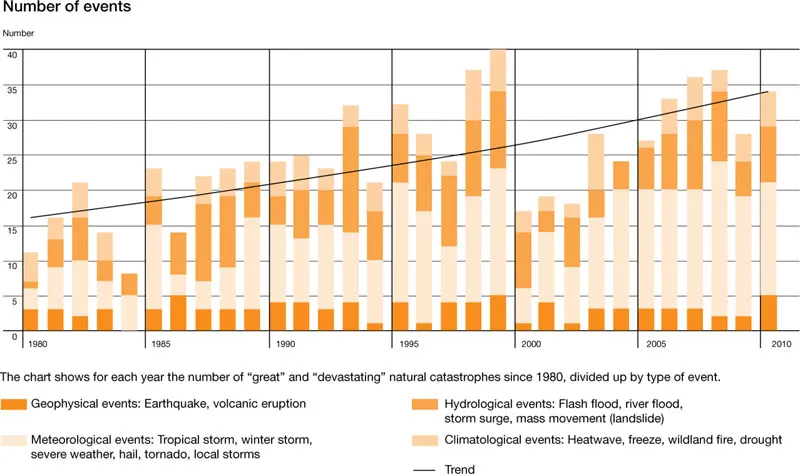
According to Munich RE (Raloff 2012), the trends shown in Figure 1 (lower) provide strong evidence that climate change is already impacting human suffering and the world’s economies, although the climate change impacts cannot be isolated with precision.
Asia and the Pacific is thus projected to experience significant impacts from climate change. Within this region, the electric power sector is highly sensitive to changes in climate. Given the rapidly increasing growth in energy use in the region, and the large investments required in coming decades, attention must be given to ensuring that these investments are made while fully accounting for projected climate change. The next section discusses in more detail the vulnerability of the various electric power supply sources and the nature of adaptation options.
B. Vulnerability of the Electric Power Sector to Climate Change and Options for Adaptation
Much of the Asia–Pacific electric power infrastructure is located where weather and climate are expected to be increasingly variable (IPCC 2012), such as areas that are flood prone, low-lying, drought prone, and highly exposed to severe storms.
Climate change is expected to affect the entire sector, including fuel mining or production, fuel transportation to power plants, electricity generation, high voltage transmission through grid networks, and low voltage distribution to consumers. Patterns of energy load growth and end-use demand by consumers will also be altered by climate change. Vulnerability to projected changes and options for adaption are discussed below for each of these components of the electric power production and supply chain.
Technically, it is generally feasible to adapt effectively to the possible impacts of climate change over short-, medium-, and long-term periods. Much of the electric power infrastructure is already designed and built with a significant degree of flexibility and resilience, at least regarding the short term. However, electric power is not an isolated system: energy, transport, and water infrastructure tend to be highly interconnected with each other and with information and communications technology (ICT), which increasingly monitors and controls electricity operations. Climate change impacts on power systems can seriously affect water and transport, and vice versa, with complex and cascading impacts. Understanding the vulnerability of these interactions to climate change and the potential effects of multiple hazards is critical for the energy sector (URS 2010).
Overall Losses (in 2010 values) Trend: Overall losses—Absolute values and long-tem trends
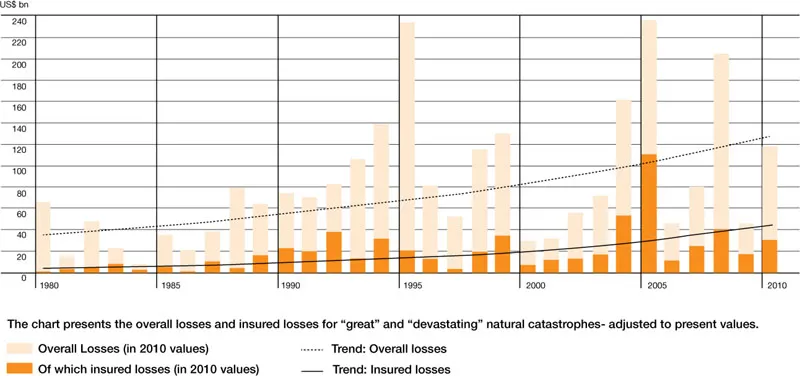
Source: Munich Re. 2011. Natural Catastrophes 2010: Analysis, Assessments, Positions. Asia Version.
Adaptation to climate change is the adjustment in natural or human systems in response to actual or expected climatic stimuli or their effects, which moderates harm or exploits beneficial opportunities (GIZ 2011). Decision makers need to understand the limitations of climate projections before integrating these data into adaptation processes. In situations of high uncertainty, it may often be an appropriate response to implement design or operational changes that make sense even if climate conditions were assumed not to change (or change minimally).
Many vulnerability management and adaptation responses require appropriate development policies, especially economic policies, that often lie outside the energy sector decision-making framework but nonetheless are important determinants on the energy sector. Adaptation measures specific to the electric power sector can generally be divided into engineering (design) specifications (e.g., safe temperature and humidity limits for generation plant and components, higher wind and seismic stresses, redundancy in control systems, multiple transmission routes) and non-engineering options (e.g., revised operational and maintenance procedures, land use planning, flood control, policies and regulations to improve energy security, minimum energy performance standards for buildings and appliances). In some specific circumstances, a “do nothing” response, such as allowing infrastructure to deteriorate and be ...
Table of contents
- Front Cover
- Title Page
- Copyright Page
- Contents
- List of Tables, Figures, and Boxes
- Foreword
- Acknowledgments
- Abbreviations
- Glossary
- Executive Summary
- I. Introduction
- II. Climate Change and the Electric Power Sector
- III. Building Adaptation Strategies into Electricity Power Sector Policy and Planning
- IV. Conclusions
- References
- Back Cover
Trusted by 375,005 students
Access to over 1.5 million titles for a fair monthly price.
Study more efficiently using our study tools.
Frequently asked questions
Yes, you can cancel anytime from the Subscription tab in your account settings on the Perlego website. Your subscription will stay active until the end of your current billing period. Learn how to cancel your subscription
No, books cannot be downloaded as external files, such as PDFs, for use outside of Perlego. However, you can download books within the Perlego app for offline reading on mobile or tablet. Learn how to download books offline
Perlego offers two plans: Essential and Complete
- Essential is ideal for learners and professionals who enjoy exploring a wide range of subjects. Access the Essential Library with 800,000+ trusted titles and best-sellers across business, personal growth, and the humanities. Includes unlimited reading time and Standard Read Aloud voice.
- Complete: Perfect for advanced learners and researchers needing full, unrestricted access. Unlock 1.5M+ books across hundreds of subjects, including academic and specialized titles. The Complete Plan also includes advanced features like Premium Read Aloud and Research Assistant.
We are an online textbook subscription service, where you can get access to an entire online library for less than the price of a single book per month. With over 1.5 million books across 990+ topics, we’ve got you covered! Learn about our mission
Look out for the read-aloud symbol on your next book to see if you can listen to it. The read-aloud tool reads text aloud for you, highlighting the text as it is being read. You can pause it, speed it up and slow it down. Learn more about Read Aloud
Yes! You can use the Perlego app on both iOS and Android devices to read anytime, anywhere — even offline. Perfect for commutes or when you’re on the go.
Please note we cannot support devices running on iOS 13 and Android 7 or earlier. Learn more about using the app
Please note we cannot support devices running on iOS 13 and Android 7 or earlier. Learn more about using the app
Yes, you can access Climate Risk and Adaptation in the Electric Power Sector by in PDF and/or ePUB format, as well as other popular books in Scienze biologiche & Riscaldamento globale e cambiamento climatico. We have over 1.5 million books available in our catalogue for you to explore.