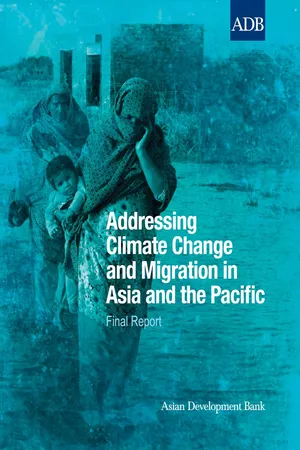
Climate change will increase the frequency of extreme weather events, making more geographic places inhospitable to human habitation and secure livelihoods. This report presents a detailed picture of the potential impacts of climate change on migration in Asia and the Pacific. It draws upon a wealth of research to provide policy makers with informed analysis of an emerging phenomenon requiring urgent attention by governments and the international community. The report also suggests that climate-induced migration should be seen not only as a threat to human well-being but also as a potential tool to promote human adaptation to climate change.
- 92 pages
- English
- ePUB (mobile friendly)
- Available on iOS & Android
eBook - ePub
About this book
Information
Part I
Assessing the Evidence
1. Methodological Issues and Caveats
23. Any assessment of the impacts of climate change is compounded by a set of methodological difficulties. An initial problem lies in identifying the flows of environmental migration; so far, no agreed-upon definition has emerged to characterize these migration flows. A second problem relates to the quantitative assessment of the number of people who are on the move, or could be in the future. This problem of numbers is deeply connected with the definition: the broader the definition, the larger the numbers. To estimate future flows of migration, a vulnerability assessment is often resorted to. This assessment, however, introduces additional methodological problems, and no consensus exists on the relative weight of the different components of vulnerability. Finally, much uncertainty remains about the local impacts of climate change, and about the way these impacts will interplay with other environmental changes and socioeconomic transformations.
A. Definitional Issues
24. Among the core issues is the definition of “environmental migration.” Despite numerous attempts and proposals, no single internationally agreed definition has emerged, and this void has lead to great confusion over the terms used to describe the people displaced by environmental events. “Environmental refugees,” “ecological migrants,” “climate refugees,” or “environmentally displaced people” are all terms frequently used by scholars and the media to describe what they assume is a common reality. The definitional issue is directly linked to the conceptualization and typologies of environmental migration, its estimates and forecasts, and the policy responses aimed at addressing it. Furthermore, the debate is marked by a number of confusions over different concepts, and the term “environmental migration” has become a catch-all for different migration dynamics that often have little in common.
25. A number of reasons account for this lack of definition: the difficulty of isolating environmental factors from other drivers of migration, the absence of a legal definition, and also the confusion between forced and voluntary migration. A common assumption is that environmental disruptions trigger only forced—and often brutal—displacements, an assumption emphasized in the term “environmental refugees.” Many authors stress, however, that environmental factors also induce voluntary migration (Hugo 1996; Renaud et al. 2007; Suhrke 1994). Though the distinction between forced and voluntary migrants is to an extent blurred, it remains fundamental in migration studies and policies. For this reason, many authors have distinguished between migration, which is assumed to be voluntary, and displacement, which is forced migration (Foresight 2011).
26. Definitions and typologies do matter, and not only for the scholarly debate. Environmental migration as a social phenomenon is generally apprehended through its definition, which bears high responsibility for the development of normative framework and policy responses. Without a clear definition, it’s not possible to identify which populations are of concern and require assistance, nor can accurate estimates be made of the number of people displaced or prompted to migrate because of environmental factors. Words and typologies also matter for the populations themselves because of the images and meaning they carry: empirical studies show that many people described as environmental refugees object angrily to the use of this terminology. Thus, getting the wording right is important; in this report, “climate-induced migration” or “climate migrants” will refer to the persons or groups of persons who, for compelling reasons of climate-induced changes in the environment that adversely affect their lives or living conditions, are obliged to move from their habitual homes, or choose to do so, within their country of residence or abroad. This definition is derived from the International Organization for Migration (IOM) working definition of environmental migration.1 “Displacement” in this report refers to a situation where a person is compelled to move from their habitual home, for example due to extreme weather conditions.
B. Limitations and Caveats of a Quantitative Analysis
27. The media has reported excitedly on reports of mass migration due to climate change. Figures ranging from tens of millions of people to 1 billion were to be found not only in headlines of the mainstream press but also in official communications and research reports. Current interest in the topic is due not only to the specific nature of these migration flows but also to their potential magnitude and impact on migrant-receiving countries.
28. Yet no consensual estimate exists, let alone a commonly agreed methodology. As a result, predictions and estimates have become one of the most contentious issues in the debates on climate-induced migration. Numerous authors have criticized the existing estimates as artificially inflated, excessively alarmist, or “guesstimates” (Kolmannskog 2008). Crisp notes that “while all of the standard works on refugees are replete with numbers, few even begin to question the source or accuracy of those statistics” (Crisp 1999). The remark applies to many works on environmental migration, as most of them reproduce previous statistics without critically assessing them (Gemenne 2011b).
29. For now, the only robust estimates of people displaced by environmental changes are those related to natural disasters. In the current state of research, it is impossible to reliably forecast—the number of people who will migrate as a result of slow-onset environmental degradation. This is due to a quadruple difficulty.
30. First, the multicausality of displacement, as well as the confusion between forced and voluntary migration, makes it difficult to identify an exact number of environmental migrants. Second, the quest for numbers is hampered by the debates about the concept and very definition of environmental migration; without a clear definition, providing accurate data seems a daunting task. Third, as most environmental migration is internal migration, the absence of border crossing poses a further statistical problem, since counting cross-border movements is easier than counting intranational movements: “the machinery to collect data on these movements simply does not yet exist” (Brown 2008,). Fourth, as will be discussed in this report, much uncertainty remains about the actual local impacts of climate change, and about how populations will react to these changes.
31. It is possible to mitigate the impacts of climate change through adaptation strategies, and to mitigate climate change itself by reducing greenhouse gas emissions. Thus, future impacts of climate change on societies will greatly depend on future levels of greenhouse gas emissions and on the amount of funding that is allocated for the development of adaptation strategies in vulnerable regions. Put simply, future displacements depend to a large extent on what we do today.
32. The importance of time frames is also of crucial importance: do the predicted numbers describe an accumulation of migration flows over a certain period of time, or do they account for a stock of environmental migrants at a certain period of time? Are those who have been able to return home included in the predictions or not? Though these questions are of crucial importance, they are rarely addressed and fuel the suspicion that the numbers are artificially inflated.
33. Despite these difficulties, getting the numbers right is an important step towards developing adequate policies. The programming of assistance and mobilization of resources, including funding, depend on accurate numbers (Crisp 1999). In the absence of reliable statistics, numbers can be easily inflated and manipulated in order to attract attention to some populations, sometimes at the expense of other needy populations. Given these uncertainties and caveats, in the current state of science it is simply not possible to provide robust estimates and projections of the number of people displaced by climate change.
34. For this reason, vulnerability assessment is often relied upon when making an assessment of the actual and potential numbers of people migrating because of environmental changes. Such an assessment, however, brings further methodological caveats.
C. Limitations of Assessing Vulnerability
35. Several recent studies have attempted to conceptualize vulnerability to environmental hazards and climate change. It is found that an individual or group’s vulnerability to climate change and climate-related disasters is influenced by the complex array of social, economic, political, and environmental factors operating at a variety of levels that in combination affect vulnerability (O’Brien et al. 2008). Another key learning from these studies is that vulnerability is not evenly distributed across and within countries, and some individuals, households, or groups are likely to be disproportionately affected by climate change or disasters (O’Brien et al. 2008). Even though there is no one definition of vulnerability, we can identify three main elements that constitute the conceptual framework of vulnerability—exposure, sensitivity, and adaptive capacity.2 Again however, there are differences in the way these elements have been defined.
36. Adger specifically examines social vulnerability to climate change and defines it as
the exposure of groups or individuals to stress as a result of the impacts of climate change and related climate extremes... Stress encompasses disruption to groups or individuals’livelihoods and forced adaptation to the changing physical environment. Vulnerability can therefore be explained by a combination of social factors and environmental risk, where risks are those physical aspects of climate related hazards exogenous to the social system. (Adger 1999)
37. The IPCC Third Assessment Report defines vulnerability as
the degree to which a system is susceptible to, or unable to cope with, adverse effects of climate change, including climate variability and extremes. Vulnerability is a function of the character, magnitude, and rate of climate variation to which a system is exposed, its sensitivity, and its adaptive capacity. (IPCC 2001)
38. Adger (2006) reviews the evolution of different traditions of vulnerability to environmental change and conceptualizes it as “the state of susceptibility to harm from exposure to stresses associated with environmental and social change and from the absence of capacity to adapt.” Generally, vulnerability is now conceived as a combination of exposure, sensitivity, and adaptive capacity, even though the relative weight of each of these three components remains a subject of considerable debate.
1. Exposure
39. Adger (2006) defines exposure as “the nature and degree to which a system experiences environmental or socio-political stress. The characteristics of these stresses include their magnitude, frequency, duration, and areal extent of the hazard.” Some studies merge exposure and sensitivity.
2. Sensitivity
40. The IPCC (2001) defines sensitivity as “the degree to which a system is affected by or responsive to climate stimuli.” Adger (2006) defines it as “the degree to which a system is modified or affected by perturbations.” However, some researchers choose not to distinguish between exposure and sensitivity. For example, Smit and Wandel (2006) argue that “exposure and sensitivity are almost inseparable properties of a system (or community) and are dependent on the interaction between the characteristics of the system and on the attributes of the climate stimulus.”
3. Adaptive Capacity
41. A system or community’s coping capacity or capacity to respond to climate change is referred to as adaptive capacity. Adger (2006) defines adaptive capacity as “the ability of a system to evolve in order to accommodate environmental hazards or policy change and to expand the range of variability with which it can cope.” The IPCC (2001) defines adaptive capacity as “the ability of a system to adjust to climate change (including climate variability and extremes), to moderate potential damages, to take advantage of opportunities or to cope with the consequences.” A crucial point made by Smit and Wandel (2006), and which is particularly important when looking at climate-induced migration, is that “adaptive capacity is context-specific and varies from country to country, from community to community, among social groups and individuals, and over time.”
42. Adaptive capacity is often perceived as depending primarily upon the level of development. This view neglects other important determinants, such as social cohesion and governance (Tubiana, Gemenne, and Magnan 2010). In some situations, the ability to migrate will be part of the adaptive capacity, and migration itself will be an adaptation strategy. In other cases, arguably more frequent, migration will be the result of an adaptive capacity unable to cope with climate impacts in situ.
D. Uncertainty in Local Impacts of Climate Change
43. Climate change will affect societies through an extensive range of impacts. The magnitude of these impacts depends, to a large extent, on the efforts currently undertaken to curb greenhouse gas emissions and to mitigate global warming. Hence, predicting these impacts, particularly on a regional level, is a daunting task, since many uncertainties remain (Barnett 2001; Webster et al. 2003). To account for these uncertainties, the IPCC has classified projections of climate change impacts into different families of scenarios, according to the various policies that could be implemented and different hypotheses about climate sensitivity.
44. Amongst these impacts, three seem most likely to have effects on migration patterns, although these effects are not certain and are highly discussed (Black, Kniveton et al. 2008; Piguet 2008): extreme weather events, water stress and land degradation, and sea-level rise.
45. It is important to appreciate that the relationship between environmental change and migration is much more complex than an “e...
Table of contents
- Front Cover
- Title Page
- Copyright Page
- Contents
- List of Tables, Figures and Boxes
- Acknowledgments
- Foreword
- Executive Summary
- Introduction
- Part I Assessing the Evidence
- Part II Addressing the Issue
- Bibliography
- Footnote
- Back Cover
Trusted by 375,005 students
Access to over 1.5 million titles for a fair monthly price.
Study more efficiently using our study tools.
Frequently asked questions
Yes, you can cancel anytime from the Subscription tab in your account settings on the Perlego website. Your subscription will stay active until the end of your current billing period. Learn how to cancel your subscription
No, books cannot be downloaded as external files, such as PDFs, for use outside of Perlego. However, you can download books within the Perlego app for offline reading on mobile or tablet. Learn how to download books offline
Perlego offers two plans: Essential and Complete
- Essential is ideal for learners and professionals who enjoy exploring a wide range of subjects. Access the Essential Library with 800,000+ trusted titles and best-sellers across business, personal growth, and the humanities. Includes unlimited reading time and Standard Read Aloud voice.
- Complete: Perfect for advanced learners and researchers needing full, unrestricted access. Unlock 1.5M+ books across hundreds of subjects, including academic and specialized titles. The Complete Plan also includes advanced features like Premium Read Aloud and Research Assistant.
We are an online textbook subscription service, where you can get access to an entire online library for less than the price of a single book per month. With over 1.5 million books across 990+ topics, we’ve got you covered! Learn about our mission
Look out for the read-aloud symbol on your next book to see if you can listen to it. The read-aloud tool reads text aloud for you, highlighting the text as it is being read. You can pause it, speed it up and slow it down. Learn more about Read Aloud
Yes! You can use the Perlego app on both iOS and Android devices to read anytime, anywhere — even offline. Perfect for commutes or when you’re on the go.
Please note we cannot support devices running on iOS 13 and Android 7 or earlier. Learn more about using the app
Please note we cannot support devices running on iOS 13 and Android 7 or earlier. Learn more about using the app
Yes, you can access Addressing Climate Change and Migration in Asia and the Pacific by in PDF and/or ePUB format, as well as other popular books in Sciences biologiques & Réchauffement climatique et changement climatique. We have over 1.5 million books available in our catalogue for you to explore.