Grid-level energy storage is likely to dominate the conversation in the power industry in the coming years, just like renewable energy did in the past 2 decades. This report targets investors, developers, utility planners, power sector policy makers, and readers who wish to understand the role energy storage is likely to play in the smart grid of the future. For developing countries, the report provides an introduction to the necessary technical background on energy storage, the role it is likely to play as penetration of renewable energy increases in the grid, and the policy prescriptions to realize the wide range of benefits of energy storage.
- 48 pages
- English
- ePUB (mobile friendly)
- Available on iOS & Android
eBook - ePub
About this book
Information
1 Introduction to Grid Energy Storage
The advantages of energy storage in the grid are well understood. Pumped-storage hydroelectricity is one of the oldest forms of grid-level energy storage and was first used in the 1890s. These storage systems have provided a wide range of services to the grid including load balancing, load following, reserve generation, and frequency and voltage support. With increased penetration of variable generation like solar and wind, there will be higher demand for such services, therefore energy storage will become critical to the grid.
At the 21st Conference of Parties in Paris in December 2015, there was wide spread recognition that for the individual countries to meet the Intended Nationally Determined Contributions, the following transformation needs to occur in the power generation sector:1
(i)widespread deployment of mature and commercially available low-carbon technologies like wind and solar; and
(ii)as the penetration of wind and solar increases, energy storage technologies will be required to safeguard the reliability of the grid.2
Since energy storage is the key enabler to high level of renewable energy penetration, significant research and development investments are planned to achieve the cost reductions and efficiency increases seen in solar photovoltaics and wind.
“I believe energy storage is the single most important area for investment in research and demonstration into the marketplace today,”
— Sir David King, United Kingdom Foreign Office permanent representative, 21st Conference of Parties, Paris, December 2015.
Capacity Versus Energy
Energy is defined as the ability to do work, and power is defined as the rate at which energy is supplied. Energy is measured in kilowatt-hours (kWh) or megawatt-hours, while power is measured in kilowatts (kW) or megawatts (MW). This concept can be best explained with examples. Consider a flywheel energy storage device with a power rating of 500 kW that can deliver energy for 30 seconds, when fully charged. Such a device is useful for delivering a large amount of power for a short duration, for example during a transient disturbance caused by a loss of a large generator on the grid; this burst of power from a storage device prevents the frequency from dropping in the grid, giving governors of other online generators time to react in order to make up for the loss. The flywheel therefore has a low amount of energy (500kW*30 sec=4.17 kWh) and a large amount of power (large power relative to the amount of energy).
Next, consider a battery with a power rating of 500 kW that can deliver energy for 2 hours, when fully charged. This has an energy rating of 1,000 kWh, which is a large amount of energy relative to the amount of power. For applications that involve peak shaving or load shifting, storage units with higher energy rating are required—for example, storing energy during periods when renewable energy resource is high but load is low and discharging energy during periods when load is high and there is no renewable energy resource.
Applications such as long-duration load shift require a large volume of energy storage capacity, making energy cost (dollars per kWh or megawatt-hour) a particularly important consideration for selecting an appropriate storage technology. Similarly, applications such as grid frequency and grid voltage stability require power to be absorbed or injected, making power cost (in dollars per kW or MW) a particularly important consideration in choosing the appropriate storage technology.
Different Types of Storage
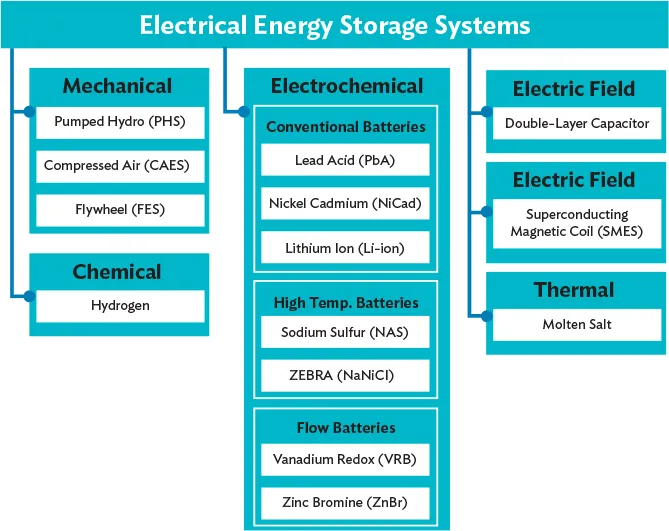
There are different types of storage units commercially available in the market. These units are mainly classified based on the form of energy that the unit stores. Figure 1.1 gives the classification of storage technologies and its grouping.
Figure 1.1: Classification of Storage-Based on Technologies
Source: R. Carnegie et al. 2013. Utility Scale Energy Storage Systems: Benefits, Applications, and Technologies. West Lafayette.
Thermal Energy System
In this storage technology type, the storage unit has the capability to store energy in the form of thermal energy, for example, ice or heat. There are a number of thermal storage technologies that could be employed to provide benefits to the electric power grid but this report briefly describes only one technology that is widely used. A simple, two-tank, direct molten salt energy storage system utilizes a receiver to reflect sunlight onto a heating chamber. Fluid from a cool tank is pumped to a heating chamber where it is brought to a very high temperature. It is then transferred to a tank containing heated fluid for storage. When heat energy needs to be recovered, it is used to create steam that powers a generator. There are other configurations, but the overall principle remains the same.
Mechanical System
The term “mechanical” determines the type of energy that is used to store energy in these storage technologies. This category of energy storage technologies includes
(i)pumped hydroelectric storage – potential gravitational energy,
(ii)compressed air energy storage – pressure potential energy, and
(iii)flywheel energy storage – rotational kinetic energy.
Pumped hydroelectric and compressed air energy storages are primarily energy storage technologies, whereas flywheels are primarily used for power applications.
Electrical and Magnetic Field Storage System
Under this category there are two main types of storage units. The first is a double layer capacitor, which is a capacitor consisting of two electrical conductors separated by a nonconducting material. It is used to store energy in the form of an electric field. The other is a superconducting magnetic energy storage system, which uses the flow of direct current superconducting coil to generate a magnetic field. This magnetic field is used to store energy. Both discharge in very short durations and are thus suitable for power applications.
Electrochemical Storage System
This category contains storage technologies that convert electrical energy into chemical energy when charging. Electrochemical batteries use chemical reactions within a battery cell to facilitate the flow of electrons through a connected load, thereby generating an electric current. Storage units under this category are lead acid battery, nickel cadmium battery, lithium ion battery, sodium sulfur battery, sodium nickel battery, vanadium redox flow battery, and zinc bromine flow battery.
Comparison of Energy Storage Technologies
Figure 1.2 illustrates the relative positioning of various energy storage technologies. The x-axis is the power capacity, the y-axis is the discharge time, which is a measure of energy capacity (= power × discharge time), and the second x-axis is categorization of energy storage technologies for different applications.
Figure 1.2: Positioning of Energy Storage Technologies with Respect to Discharge Time, Application, and Power Rating
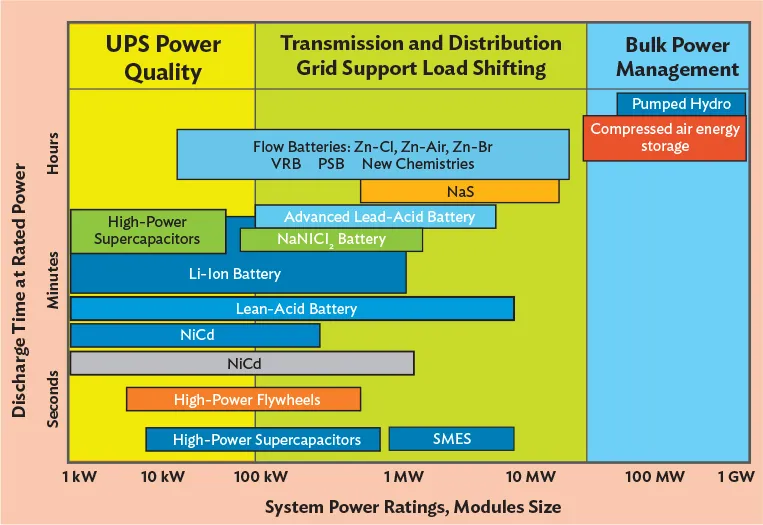
NaNiCl=Sodium Nickel Chloride, NaS=Sodium Sulfide, NiCd=Nickel Cadmium, PSB=Polysulfide Bromide, SMES=superconducting magnetic energy storage, UPS=Uninterrupted Power Supply, VRB=Vanadium Redox Battery, Zn-Air=Zinc Air, ZnCl=Zinc Chloride.
Source: A. A. Akhil. 2015.
Pumped hydroelectric and compressed air energy storage are used for bulk power management with largest power and energy capacities. Chemical batteries with 30 minutes to multiple hours of storage are commonly used for load shifting with project size in the range of 100kW to approximately 30MW. Flywheels, super capacitors, and superconducting magnetic energy storage can provide large amounts of power for very short amounts of time (seconds) and hence are valuable...
Table of contents
- Front Cover
- Title Page
- Copyright Page
- Contents
- Tables and Figures
- Acknowledgments
- Executive Summary
- Abbreviations
- 1 Introduction to Grid Energy Storage
- 2 Role of Energy Storage in Integrating Renewable Energy
- 3 The Goal of Energy Storage in Grids
- 4 Smart Control Systems for Managing Energy Storage in Grid
- 5 Grid Integration and Sizing of Storage
- 6 Financial Modeling and Economics of Energy Storage
- 7 Policies for Grid Storage
- 8 Conclusions
- References
- Appendixes
- Footnote
- Back Cover
Trusted by 375,005 students
Access to over 1.5 million titles for a fair monthly price.
Study more efficiently using our study tools.
Frequently asked questions
Yes, you can cancel anytime from the Subscription tab in your account settings on the Perlego website. Your subscription will stay active until the end of your current billing period. Learn how to cancel your subscription
No, books cannot be downloaded as external files, such as PDFs, for use outside of Perlego. However, you can download books within the Perlego app for offline reading on mobile or tablet. Learn how to download books offline
Perlego offers two plans: Essential and Complete
- Essential is ideal for learners and professionals who enjoy exploring a wide range of subjects. Access the Essential Library with 800,000+ trusted titles and best-sellers across business, personal growth, and the humanities. Includes unlimited reading time and Standard Read Aloud voice.
- Complete: Perfect for advanced learners and researchers needing full, unrestricted access. Unlock 1.5M+ books across hundreds of subjects, including academic and specialized titles. The Complete Plan also includes advanced features like Premium Read Aloud and Research Assistant.
We are an online textbook subscription service, where you can get access to an entire online library for less than the price of a single book per month. With over 1.5 million books across 990+ topics, we’ve got you covered! Learn about our mission
Look out for the read-aloud symbol on your next book to see if you can listen to it. The read-aloud tool reads text aloud for you, highlighting the text as it is being read. You can pause it, speed it up and slow it down. Learn more about Read Aloud
Yes! You can use the Perlego app on both iOS and Android devices to read anytime, anywhere — even offline. Perfect for commutes or when you’re on the go.
Please note we cannot support devices running on iOS 13 and Android 7 or earlier. Learn more about using the app
Please note we cannot support devices running on iOS 13 and Android 7 or earlier. Learn more about using the app
Yes, you can access Energy Storage in Grids with High Penetration of Variable Generation by in PDF and/or ePUB format, as well as other popular books in Politics & International Relations & Environment & Energy Policy. We have over 1.5 million books available in our catalogue for you to explore.