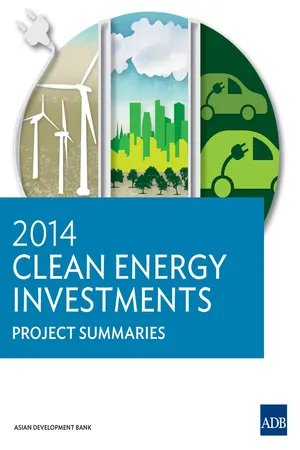
This report summarizes the investments in clean energy made by the operations departments of the Asian Development Bank (ADB) in 2014, condensing information from project databases and formal reports in an easy-to-reference format. This report was prepared by ADB's Clean Energy Program which provides the cohesive agenda that encompasses and guides ADB's lending and nonlending assistance, initiatives, and plan of action for sustainable growth in Asia and the Pacific.
- 94 pages
- English
- ePUB (mobile friendly)
- Available on iOS & Android
eBook - ePub
About this book
Information
Private Sector Operations Department
Investment Number: 7436/3236-BAN
Project Number: 44951-014
Summit Bibiyana II Power (Bibiyana II Gas Power Project)
Rationale
In Bangladesh, about 62% of the population had access to electricity as of May 2014. Many industrial and commercial establishments depend on expensive and inefficient captive power generation (burning diesel or heavy oil) during power interruptions. Bangladesh faces the challenge of increasing access to electricity and removing power-related constraints on economic development. The government has embarked on a program of fast-track measures to develop power generation capacity, including developing new gas supply facilities and dual-fuel and coal-based power plants to generate 15 gigawatts of power capacity by 2016.
The consortium of Summit Industrial & Mercantile and GE Energy was awarded the Bibiyana II project in November 2010. After being formally awarded the project, the consortium approached ADB to discuss financing for the project, given ADB’s pioneering role and experience in financing the Meghnaghat gas power independent power producer project, one of the first major private sector independent power producer projects in Bangladesh, and its strong support for the power sector through sovereign lending.
Description
The project involves design, engineering, construction, and operation of a 341 megawatt combined-cycle, gas-fired power plant to be located on the south bank of the Khushiyara River about 180 kilometers (km) northeast of Dhaka and 30 km southwest of the town of Sylhet in the district of Habiganj. The project comprises one combined-cycle equipment train and utilizes a single General Electric 9FA combustion turbine generator, coupled to a heat recovery steam generator and a single steam turbine generator, as well as other plant and equipment. Gas will be supplied to the project through an 8.8 km long, 50.8-centimeter high-pressure pipeline from the existing Bibiyana gas field. Power will be evacuated from the power plant by means of 230 kilovolt or 400 kilovolt transmission lines.
Total Loan Amount: $75.00 million (OCR)
Clean Energy Investment: $22.83 million
Project Category: Supply-side energy efficiency
Energy Savings: 7,799 terajoules/year
Greenhouse Gas Emission Reduction: 437,500 tCO2e/year
Board Approval: 5 December 2014
Project Life: 30 years
Impacts | • Improved access to electricity in Bangladesh • Increased investments by the private sector in power generation in Bangladesh |
Outcome | Increased combined cycle power generation |
Output | Construction and operation of a power plant running on indigenous gas |
Division | Infrastructure Finance Division 1, PSOD |
Project Team | |
Team Leader | H. Hoshi, Senior Investment Specialist, PSOD |
Team Members | I. Chauche, Investment Specialist, PSOD |
E. David, Associate Investment Officer, PSOD | |
J. Gomez, Safeguards Officer, PSOD | |
M. Greenhow, Senior Counsel, OGC | |
S. Noda, Senior Safeguards Specialist, PSOD | |
B. Quang, Safeguards Specialist, PSOD | |
S. Rahman, Project Officer, Bangladesh Resident Mission, SARD | |
R. Samiano, Safeguards Officer, PSOD | |
K. Taniguchi, Senior Economist, PSOD |
Investment Number: 7407/3130-GEO
Project Number: 47919-014
Adjaristsqali Georgia (Adjaristsqali Hydropower Project)
Rationale
Georgia has made significant progress in its energy sector, going from chronic power shortages and poor financial condition of electricity and gas companies to becoming an electricity exporter in 2007 thanks to the Government of Georgia’s effort to increase the generation capacity of hydropower plants. While Georgia imports electricity in winter when supply is low, it has significant excess generation in summer, and the volume of exports is increasing each year. In view of its rich but underdeveloped hydro resources, Georgia has set a strategic goal to become a regional energy hub by trading energy with neighboring countries. The proposed project is the second private hydropower plant designed for energy export and the first to be financed on a limited recourse basis.
In March 2013, Tata Power and Clean Energy Invest (CEI and, collectively with Tata Power, the sponsors), approached the Asian Development Bank (ADB) to request a loan for the project. Such request was made based on ADB’s long partnership history with Tata Power and the International Finance Corporation, and ADB’s experience in financing private hydropower projects. The project team also had a preliminary discussion with the European Bank for Reconstruction and Development, which was also approached by the sponsors. Through these initial discussions, the Private Sector Operations Department believed that the project possesses sound fundamentals, ADB’s participation will bring significant developmental benefits and demonstration impact, financing from ADB is absolutely necessary to make the project happen, and the success of the project will send an important signal to the market and help build confidence for private sector participation in Georgia’s hydropower development and cross-border energy trade.
Description
The project involves the const...
Table of contents
- Front Cover
- Title Page
- Copyright Page
- Contents
- Figures
- Abbreviations
- Executive Summary
- Central and West Asia Department
- East Asia Department
- Pacific Department
- Private Sector Operations Department
- South Asia Department
- Southeast Asia Department
- Appendixes
- Back Cover
Trusted by 375,005 students
Access to over 1.5 million titles for a fair monthly price.
Study more efficiently using our study tools.
Frequently asked questions
Yes, you can cancel anytime from the Subscription tab in your account settings on the Perlego website. Your subscription will stay active until the end of your current billing period. Learn how to cancel your subscription
No, books cannot be downloaded as external files, such as PDFs, for use outside of Perlego. However, you can download books within the Perlego app for offline reading on mobile or tablet. Learn how to download books offline
Perlego offers two plans: Essential and Complete
- Essential is ideal for learners and professionals who enjoy exploring a wide range of subjects. Access the Essential Library with 800,000+ trusted titles and best-sellers across business, personal growth, and the humanities. Includes unlimited reading time and Standard Read Aloud voice.
- Complete: Perfect for advanced learners and researchers needing full, unrestricted access. Unlock 1.5M+ books across hundreds of subjects, including academic and specialized titles. The Complete Plan also includes advanced features like Premium Read Aloud and Research Assistant.
We are an online textbook subscription service, where you can get access to an entire online library for less than the price of a single book per month. With over 1.5 million books across 990+ topics, we’ve got you covered! Learn about our mission
Look out for the read-aloud symbol on your next book to see if you can listen to it. The read-aloud tool reads text aloud for you, highlighting the text as it is being read. You can pause it, speed it up and slow it down. Learn more about Read Aloud
Yes! You can use the Perlego app on both iOS and Android devices to read anytime, anywhere — even offline. Perfect for commutes or when you’re on the go.
Please note we cannot support devices running on iOS 13 and Android 7 or earlier. Learn more about using the app
Please note we cannot support devices running on iOS 13 and Android 7 or earlier. Learn more about using the app
Yes, you can access 2014 Clean Energy Investments by in PDF and/or ePUB format, as well as other popular books in Business & Industria energetica. We have over 1.5 million books available in our catalogue for you to explore.