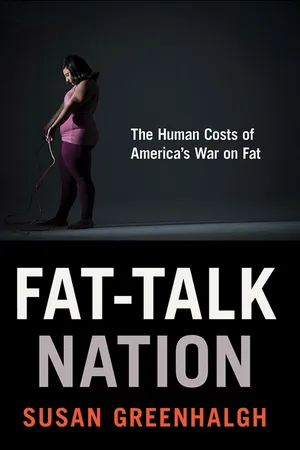
In recent decades, America has been waging a veritable war on fat in which not just public health authorities, but every sector of society is engaged in constant "fat talk" aimed at educating, badgering, and ridiculing heavy people into shedding pounds. We hear a great deal about the dangers of fatness to the nation, but little about the dangers of today's epidemic of fat talk to individuals and society at large. The human trauma caused by the war on fat is disturbing—and it is virtually unknown. How do those who do not fit the "ideal" body type feel being the object of abuse, discrimination, and even revulsion? How do people feel being told they are a burden on the healthcare system for having a BMI outside what is deemed—with little solid scientific evidence—"healthy"? How do young people, already prone to self-doubt about their bodies, withstand the daily assault on their body type and sense of self-worth? In Fat-Talk Nation, Susan Greenhalgh tells the story of today's fight against excess pounds by giving young people, the campaign's main target, an opportunity to speak about experiences that have long lain hidden in silence and shame.Featuring forty-five autobiographical narratives of personal struggles with diet, weight, "bad BMIs," and eating disorders, Fat-Talk Nation shows how the war on fat has produced a generation of young people who are obsessed with their bodies and whose most fundamental sense of self comes from their size. It reveals that regardless of their weight, many people feel miserable about their bodies, and almost no one is able to lose weight and keep it off. Greenhalgh argues that attempts to rescue America from obesity-induced national decline are damaging the bodily and emotional health of young people and disrupting families and intimate relationships.Fatness today is not primarily about health, Greenhalgh asserts; more fundamentally, it is about morality and political inclusion/exclusion or citizenship. To unpack the complexity of fat politics today, Greenhalgh introduces a cluster of terms—biocitizen, biomyth, biopedagogy, bioabuse, biocop, and fat personhood—and shows how they work together to produce such deep investments in the attainment of the thin, fit body. These concepts, which constitute a theory of the workings of our biocitizenship culture, offer powerful tools for understanding how obesity has come to remake who we are as a nation, and how we might work to reverse course for the next generation.
- 280 pages
- English
- ePUB (mobile friendly)
- Available on iOS & Android
eBook - ePub
About this book
Information
Topic
Ciencias socialesSubtopic
Nutrición, dietética y bariatríaPart 1
The Politics and Culture of Fat in America
1
A Biocitizenship Society to Fight Fat
When I was an 8-pound baby who was a week early, it should have been a sign that being skinny would never be my destiny. In high school and college I have been bothered and ashamed by my weight. I noticed that food is my “support” and I abuse it. When I am stressed, I eat. When I am depressed, I eat. When I am angry, I eat. When I am bored, I eat, creating a vicious cycle that is spinning out of control, snuffing out the person I am inside. Looking to food to comfort my hormonal and emotional episodes is unhealthy because, if during one of my “feeding frenzies” I happen to gain weight, even just one or two pounds, I flip out and feel disgusted with myself. I can feel the disgust manifest in the pit of my stomach like it has a voice, and with every growl and every grubble, it is like a knife into my self-esteem telling me I am too fat and asking why I eat so much.
I believe my problems with my weight began when I was a little girl. My father’s side of the family is very materialistic and looks-based; if you’re not rich, pretty, and skinny, you are nothing. My mother is quite a large woman, and so my father’s mother didn’t like her and always ignored her. When my brother and I were born, my mother gained 60 pounds and my grandmother’s cruel words became more vocal, to the point where as a second grader I knew my grandmother thought my mother was too fat to be with her son. Yet as the years went by and my mother didn’t lose any weight, and I began to grow rounder, her hurtful needle-like words became aimed at me. I will never forget the pain and disgust I felt when I was about in fifth grade. My grandmother, father, and I were at the family restaurant Islands. I was eating a chicken tenders kid’s meal, yet my grandmother thought this was too much for me. So in the middle of the meal, she looked at me and told me to “stop eating, because if you don’t then one day you will look like that.” “That” happened to be an extremely large woman in the restaurant, with my grandmother’s finger pointed directly at her. I felt confused and hurt. All these thoughts swarmed in my head: I knew I was big, but was I fat? That day changed my life forever. I have not been able to look at myself the same way again.
Elise, twenty years old, Caucasian from Sherman Oaks, California; from her personal story “A Rock Weighing My Spirit Down”
When I was ten years old, I went to the doctor’s office for a routine check-up. Little did I know I was about to experience one of the most traumatic events of my life. I knew I had weight problems, but no one had ever called me fat directly. This doctor told my mom that if she did not do anything soon, I would be in danger of contracting diseases like high blood pressure, diabetes, and hypertension. I did not realize it at the time, but those words caused lasting trauma. My self-confidence was shot down. Since then I have always thought of myself as a big girl; even though I have now lost more than 35 pounds and kept it off, I still think of myself as big.
Society is very cruel toward overweight people, especially young children. When I was in elementary school, we were all playing outside during recess when this boy tore up my self-confidence. There was a game of basketball and I wanted the ball, but no one would give it to me. Finally I asked for it. The boy said to me: “Why do you want the ball? You are fat, I’m sure you can’t even shoot!” I froze for a couple seconds. I could not believe that someone would say something so insensitive and rude to me. I ran to the girls’ bathroom and cried for a few minutes. That day is one I will never forget. He broke me down. For years after that I felt ugly, fat, disgusting, and not good enough. I assumed that every boy was as mean and disrespectful as that one. So I began to eat. Food was delicious and it made me feel good. Slowly but surely, I gained more and more weight until I became borderline obese.
Lauren, nineteen years old, Salvadoran American from Lynnwood, California; from her personal story “Overcoming the Abuse”
A National War on Fat: Narrative of a Nation in Decline
By all accounts, America is in the midst of an obesity epidemic of catastrophic scale in which rising proportions of the public—now two-thirds of adults, and one-third of children and adolescents—are obese or overweight. Between the late 1970s and 2012, the proportion of Americans who are obese rose from 15 to 34.9 percent among adults and from 5 to 16.9 percent among the young.1 Although the rate of increase has recently slowed or stabilized in some groups, the now-heavy burden of fat, influential voices maintain, continues to threaten the nation. In the dominant story told by government, public health, and media sources, the country’s fatness is eroding the nation’s health, emptying its coffers, and threatening its security by depriving it of fit military recruits.2 The response has been an urgent, nationwide public health campaign, officially launched by the U.S. surgeon general in 2001, to get people—and especially the young—to eat more healthfully and be more active in an effort to achieve a “normal” body mass index (BMI).3 Toward that end, the surgeon general’s office and other government departments concerned with the public’s health have repeatedly urged all sectors of American society—from parents to elected officials, to school administrators, health-care professionals, leaders of nonprofits, and private companies—to help reduce the burden of fat. First Lady Michelle Obama’s “Let’s Move!” campaign, which aims to “solve the challenge of childhood obesity within a generation,” is only the latest initiative in what has been the nation’s standard approach to remedying the problem of growing girth for the last decade and a half.4
American antipathy toward fatness is nothing new. For roughly the last 150 years, being fat has been seen as a cultural, moral, and aesthetic transgression that marked one as irresponsible, immoral, and ugly—“grotesque” in the indelicate language of former Surgeon General C. Everett Koop (who served 1982–1989).5 In the last few decades, however, there has been a critical cultural shift in our concern about fatness, from “self-control” (or virtue) to “health.” The now routine definition of excess weight as a disease, the rapid growth in medical research, and the proliferation of news on obesity and overweight mark this cultural shift.6 As the sociologist Abigail C. Saguy argues, the biomedical frame for understanding obesity has become so naturalized that people do not even realize it is a conceptual frame, one among many possible frames.7
While weight as an attribute has been medicalized, that is, defined as a medical condition requiring diagnosis, two categories of weight— overweight and obesity—have been pathologized, treated as diseases in themselves. No longer are chunky and fat people merely “lazy”; in the current discourse they are also biologically defective; chronically ill; at risk of yet other, obesity-related diseases; and in need of ongoing medical treatment. It is this “diseasification” of higher weights, and its framing within a narrative of obesity-induced national decline, that has justified our government’s intervention in the obesity “epidemic” and the use of taxpayer dollars to support these interventions. With two-thirds of American adults and one-third of children now deemed abnormal and in need of remediation, there would appear to be strong grounds for taxpayer-supported government involvement, including not just public health actions but also financial support for a mushrooming research enterprise devoted to understanding the causes and consequences of this new disease. This disease model of weight, requiring government management, has not replaced the moral model of body size but has built on it in ways that greatly intensify the already heavy pressures to be thin.8
Because personal health in our culture is a mega-value, equivalent to the good life itself, the medicalization of weight has had huge societal consequences. In the national anxiety that has grown up around the obesity problem—what sociologists such as Natalie Boero call a moral panic, marked by exaggerated concern about the threat to core American values9—these broader consequences of treating heaviness as a disease have received scant notice. But they deserve our closest attention. The shift to health as the primary grounds for concern about adipose bodies has led to a dramatic expansion of the social forces seeking to intervene. The result has been an explosion of fat-talk of all kinds. By fat-talk I mean communications of all sorts about weight—spoken words, written texts, visual images, and moving videos—along with the associated practices, such as dieting, exercising, and many others. Where do we hear fat-talk?
In the news there has been a veritable explosion of articles on obesity. Between the early 1990s and 2010, the number of published news reports on obesity rose from virtually none to 6,000 a year.10 Feature articles in news, women’s, and science magazines appear regularly, accompanied by cover images of fat babies holding gigantic tubs of french fries or fat children snorfing down double-scoop ice cream cones. (Such images have become less common in recent years.) In the political sphere, anti-fat legislation aimed at limiting food ads for children, requiring food labeling in restaurants, or reengineering car-centric environments is advancing at the federal, state, and municipal levels, producing noisy debates over the “nanny state’s” right to tell Americans what they should eat and the ability of hefty officials to govern. The New Jersey politician Chris Christie has received more than his share of press commentary about his size.11
Corporate interests have been a major force behind the escalation of fat-talk. Slimming down has become a huge sector of the economy as the pharmaceutical, biotech, fitness, food, and restaurant industries have figured out how to use a rhetoric of medicine (“it’s good for your health”) to exploit people’s fear of the disease of fat to generate some $60 billion annually in profits.12 In our image-saturated world, the ads of corporate America, with their trim figures and seductive messages, have been powerful forces behind the growing fixation on fat. Building on an already deeply ingrained culture of thinness,13 the new medically driven concern with weight loss has also propelled corpulence to the center of our popular culture. The new genre of Fat TV—featuring weight-loss reality shows such as The Biggest Loser (NBC), Weighing In (Food Network), and Celebrity Fit Club (VH1)—is only the most conspicuous of these new forms of fat culture. Finally, in everyday social life, fat-talk has become a routine way of communicating with one another as we visually size people up; comment on their body size, the fit of their clothing, the food they are eating, and so on; and judge them according to their adherence to the normative thin-body ideal. The harsh warnings of Elise’s grandmother and the cruel jabs of Lauren’s classmate are perfect examples of fat-talk in action. It is no exaggeration to say that fifteen years after the official launching of the war on fat, America is obsessed with fat—what it means for us, how bad it is for us, and what we must do to rid our individual and collective selves of it. We have become, in short, a fat-talk nation, in which fat-talk is ubiquitous, marking good and bad, deserving and undeserving Americans.
In this way, what started as an urgent public health call to action in the early 2000s has grown into a massive society-wide war on fat that involves virtually every sector of American society and leaves few domains of life untouched. In the late 1990s, former Surgeon General Koop, one of the most outspoken and influential warriors in the battle against tobacco, coined the term war on obesity to draw attention to the need for a national mobilization against fat that was every bit as forceful as the nation’s war on tobacco.14 In 2004, in the wake of 9/11, then–Surgeon General Richard Carmona described the rise in childhood obesity as “every bit as threatening to us as is the terrorist threat we face today. It is the threat from within.”15 Such metaphors are not innocent. In likening fat people, including fat children, to terrorists, Carmona was justifying an all-out war against fat individuals that entailed treating them as veritable enemies of the American people and the American way of life. The message was not only that it is un-American to be fat but also that hostility toward large people was warranted and necessary and beneficial to “us all.”
In this book, I call this broad-based campaign a war on fat. I use the term war not just because some government and public health advocates routinely use that metaphor but also because that word captures the feeling of many of its targets that not just their bodies but also their persons are under perpetual attack. I use the colloquial word fat because that is the term many heavy people prefer, finding the official term obesity too objectifying.16 And I focus on the war on fat, rather than on obesity, because this is a war not just on obesity (defined in terms of the BMI) but on every extra pound of flesh, whether the excess is on an “obese,” “overweight,” or “normal” body. The twenty-first-century war on fat is profoundly remaking the political, economic, social, and cultural worlds in which we live in ways that are very partially understood. Although this book deals only with the United States, weights are rising around the world, producing what the World Health Organization calls a “global pandemic of obesity”17 and, in turn, urgent efforts by governments and transnational bodies to contain it. The problem, then, is not only an American problem; increasingly, it is a global problem. Given the centrality of America in the world, how we respond is likely to affect policymakers and ordinary people in the tens of millions around the globe. Will the warlike approach to obesity championed by the United States be a positive model for the rest of the world? That question is rarely asked in public and health forums, but it should be.
Whatever its broader consequences, the war on fat has not yet reduced the national waistline. Despite the huge investment of public and private resources to fight fat, rates of obesity have scarcely budged. Between 2003–2004 and 2011–2012, there was no significant change in obesity prevalence among youth or adults. There was, however, a substantial decline in obesity among preschool children ages two to five, a finding that appears promising but remains unexplained.18 The reasons obesity has stopped climbing in most groups remain unclear; the slowdown could be related to basic biology—a saturation of the population that is genetically vulnerable to weight gain in our environment—and have little to do with the war on fat.19 The response has not been to step back and rethink the nature of the adversary and the warlike approach to its eradication; the response has been to hunker down and fight even harder. For example, health officials in some areas have turned up the heat on fat kids and their parents. In late 2013, Child...
Table of contents
- Preface
- Part 1. The Politics and Culture of Fat in America
- Part 2. My BMI, My Self
- Part 3. Uncharted Costs and Unreachable Goals
- Part 4. What Now?
- Appendix
- Notes
- References
- Index
Trusted by 375,005 students
Access to over 1.5 million titles for a fair monthly price.
Study more efficiently using our study tools.
Frequently asked questions
Yes, you can cancel anytime from the Subscription tab in your account settings on the Perlego website. Your subscription will stay active until the end of your current billing period. Learn how to cancel your subscription
No, books cannot be downloaded as external files, such as PDFs, for use outside of Perlego. However, you can download books within the Perlego app for offline reading on mobile or tablet. Learn how to download books offline
Perlego offers two plans: Essential and Complete
- Essential is ideal for learners and professionals who enjoy exploring a wide range of subjects. Access the Essential Library with 800,000+ trusted titles and best-sellers across business, personal growth, and the humanities. Includes unlimited reading time and Standard Read Aloud voice.
- Complete: Perfect for advanced learners and researchers needing full, unrestricted access. Unlock 1.5M+ books across hundreds of subjects, including academic and specialized titles. The Complete Plan also includes advanced features like Premium Read Aloud and Research Assistant.
We are an online textbook subscription service, where you can get access to an entire online library for less than the price of a single book per month. With over 1.5 million books across 990+ topics, we’ve got you covered! Learn about our mission
Look out for the read-aloud symbol on your next book to see if you can listen to it. The read-aloud tool reads text aloud for you, highlighting the text as it is being read. You can pause it, speed it up and slow it down. Learn more about Read Aloud
Yes! You can use the Perlego app on both iOS and Android devices to read anytime, anywhere — even offline. Perfect for commutes or when you’re on the go.
Please note we cannot support devices running on iOS 13 and Android 7 or earlier. Learn more about using the app
Please note we cannot support devices running on iOS 13 and Android 7 or earlier. Learn more about using the app
Yes, you can access Fat-Talk Nation by Susan Greenhalgh in PDF and/or ePUB format, as well as other popular books in Ciencias sociales & Nutrición, dietética y bariatría. We have over 1.5 million books available in our catalogue for you to explore.