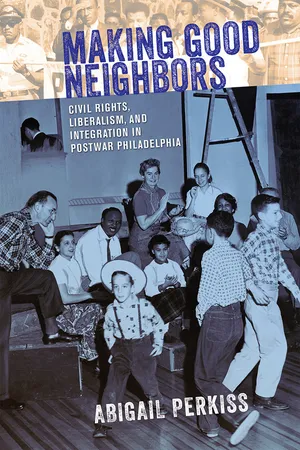
Making Good Neighbors
Civil Rights, Liberalism, and Integration in Postwar Philadelphia
- 224 pages
- English
- ePUB (mobile friendly)
- Available on iOS & Android
Making Good Neighbors
Civil Rights, Liberalism, and Integration in Postwar Philadelphia
About this book
In the 1950s and 1960s, as the white residents, real estate agents, and municipal officials of many American cities fought to keep African Americans out of traditionally white neighborhoods, Philadelphia's West Mount Airy became one of the first neighborhoods in the nation where residents came together around a community-wide mission toward intentional integration. As West Mount Airy experienced transition, homeowners fought economic and legal policies that encouraged white flight and threatened the quality of local schools, seeking to find an alternative to racial separation without knowing what they would create in its place. In Making Good Neighbors, Abigail Perkiss tells the remarkable story of West Mount Airy, drawing on archival research and her oral history interviews with residents to trace their efforts, which began in the years following World War II and continued through the turn of the twenty-first century.The organizing principles of neighborhood groups like the West Mount Airy Neighbors Association (WMAN) were fundamentally liberal and emphasized democracy, equality, and justice; the social, cultural, and economic values of these groups were also decidedly grounded in middle-class ideals and white-collar professionalism. As Perkiss shows, this liberal, middle-class framework would ultimately become contested by more militant black activists and from within WMAN itself, as community leaders worked to adapt and respond to the changing racial landscape of the 1960s and 1970s. The West Mount Airy case stands apart from other experiments in integration because of the intentional, organized, and long-term commitment on the part of WMAN to biracial integration and, in time, multiracial and multiethnic diversity. The efforts of residents in the 1950s and 1960s helped to define the neighborhood as it exists today.
Frequently asked questions
- Essential is ideal for learners and professionals who enjoy exploring a wide range of subjects. Access the Essential Library with 800,000+ trusted titles and best-sellers across business, personal growth, and the humanities. Includes unlimited reading time and Standard Read Aloud voice.
- Complete: Perfect for advanced learners and researchers needing full, unrestricted access. Unlock 1.4M+ books across hundreds of subjects, including academic and specialized titles. The Complete Plan also includes advanced features like Premium Read Aloud and Research Assistant.
Please note we cannot support devices running on iOS 13 and Android 7 or earlier. Learn more about using the app.
Information
Table of contents
- Acknowledgments
- List of Abbreviations
- Introduction: Civil Rights’ Stepchild
- 1. “A Home of One’s Own”: The Battle over Residential Space in Twentieth-Century America
- 2. Finding Capital in Diversity: The Creation of Racially Integrated Space
- 3. Marketing Integration: Interracial Living in the White Imagination
- 4. Integration, Separation, and the Fight for Black Identity
- 5. “Well-Trained Citizens and Good Neighbors”: Educating an Integrated America
- 6. Confrontations in Black and White: The Crisis of Integration
- 7. The Choice to Live Differently: Reimagining Integration at Century’s End
- Epilogue: West Mount Airy and the Legacy of Integration
- Notes
- Bibliography