![]()
1
Wares of Love
Socialist Romance and the Commodity
Wann lernen Sie, daß Liebe…auch ihre Grenzen hat?
When will you learn that love also has its borders?
—Willi, factory-militia captain, stopping East German call girls
from crossing the newly closed border to the West, in Gerhard
Klein’s 1966 film, Geschichten jener Nacht (Stories from That Night)
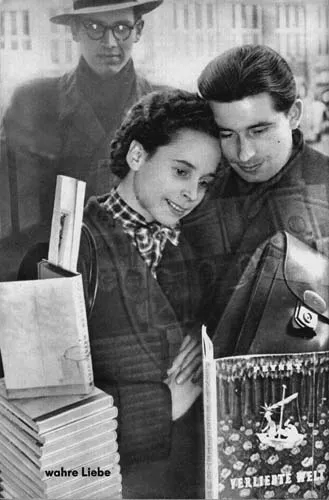
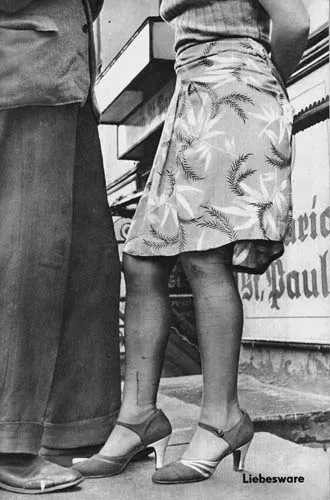
The problem is summed up by a pair of juxtaposed photographs in the May 1954 issue of the East German entertainment magazine Das Magazin. The first looks outward from a bookshop at a young couple window-shopping arm in arm (fig. 1). Both are gazing intently at a book entitled Verliebte Welt, (World in Love). The caption reads: “wahre Liebe” (True Love). On the facing page is a photograph of another couple, from the waist down (fig. 2). He is wearing a wrinkled sportscoat and pointed shoes; she a tight sweater, a short floral-print skirt, and stockings. On a billboard behind them we can see most of the words “St. Pauli,” a reference to the red-light district of Hamburg. The caption reads: “Liebesware” (Wares of Love).
At first, the intended moral of the story seems fairly clear. Against the Cold War backdrop of the early 1950s, “Wares of Love” seems to point to the decadent West, where love is for sale, literally and figuratively. The couple’s clothes suggest that they are Halbstarken (literally, “half-strong”), the German version of the rebels-without-a-cause who appeared all over Europe and the United States in the 1950s. In consuming the latest fashion trends, in buying the products that are supposed to make them more desirable, these young West Germans are in fact selling themselves.
Figure 1. “True Love.” A young couple window-shops at a bookstore. Source: Das Magazin, May 1954, 38.
Figure 2. “Wares of Love.” Behind this pair we can see the words “St. Pauli,” a reference to the red-light district of Hamburg. Source: Das Magazin, May 1954, 39.
The East, we may infer, is the land of “True Love,” where young lovers are brought together by culture and ideas, rather than fashion. The pair in the bookstore, however, are not not consuming: their romantic moment is created and defined by commodities—in this case, books. In fact, the books are not even products of the socialist bloc: one title, faintly visible, identifies a translation of British author David Severn’s 1946 children’s novel Forest Holiday, while Verliebte Welt is a picture book by the popular French cartoonist Raymond Peynet. Both “true love” and “love-for-sale,” it seems, may involve the act of consumption—even of Western products. The determining difference seems to lie in the intention behind the consumption. Perhaps this need for qualitative discernment explains the third figure in the “wahre Liebe” photograph, a man wearing a trenchcoat, hat, and glasses, standing behind the couple and watching them. Implicit or explicit supervision appears frequently in East German love stories from this period. With such a thin line between “true love” and “love-for-sale,” only constant vigilance could prevent the former from giving way to the latter.
This chapter will examine the ideological friction generated at the intersection of romance and consumer culture. In particular, my analysis will focus on the ways in which commodities become imbricated in the ideals and practices of romantic love, the subtle or conspicuous ways in which commodities come to mediate even—indeed, especially—this, the most intimate of interpersonal relationships. In the case of the GDR, this scandal (for, as we will see, the threat of scandal is never far from the commodified relationship) is doubled: within the East German context, a love affair with the commodity implies a deeper betrayal, a refutation of the system’s most basic commitments and principles. Yet, by the end of the 1950s, the East’s flirtation with consumer culture had given way to a deeper and more permanent attachment—and the party, for its part, seemed content to help its rival move in. The following analysis will unpack the grounds and terms of these developments and explore their broader implications for the history of romantic narratives in East German culture. The guiding question of this chapter might be phrased as follows: How did socialist East Germany end up with a capitalist libidinal economy?
As the “Liebesware” photograph reminds us, the limit-case of commodity-mediated romance would be prostitution, the direct exchange of money for sex. If, as I have argued in the introduction, one of the primary elements of modern romance is a suspension of the prevailing economies (political, financial) in favor of a temporary and unique libidinal economy, then prostitution would represent the opposite: the incursion of market conditions into the purview of romance, the sphere of sexual intimacy. A number of social critics from Marx on have argued that capitalist conditions render prostitution not the exception, but the norm: Engels’s famous critique of marriage, for instance, claims that bourgeois marriage “turns often enough into the crassest prostitution—sometimes of both partners, but far more commonly of the woman, who only differs from the ordinary courtesan in that she does not let out her body on piecework as a wage worker, but sells it once and for all into slavery” (134). Engels uses prostitution both literally and rhetorically here: he has in mind not only the exchange of sex for money, but also the mediation of any relationship through material calculation or necessity. Engels’s polemical strategy calls attention to the inconsistency of a system that encourages commodity-mediated relationships in some contexts (from fashion to marriage) while condemning—in fact criminalizing—them in others.
As I have argued in the introduction, such ideological contradictions are the stuff of romance, and this case is no exception. Particularly in the eighteenth and nineteenth centuries, a great number of love plots go out of their way to assure the protagonists—and the reader—that there are no covert material interests informing their romantic destiny. Thus in Lessing’s Minna von Barnhelm Tellheim marries Minna only when it seems that she has lost her considerable fortune, Elizabeth refuses Darcy’s first proposal in Austen’s Pride and Prejudice, and Ferdinand and Luise follow their star-crossed love to its tragic end in Schiller’s Kabale und Liebe (Cabal and Love). In such narratives, the possibility that interpersonal relationships might be subject to economic conditions is held at a distance from the central romantic pair, instead projected wholesale or piecemeal onto the society surrounding them. Often the specter of material interest is foisted onto a few straw men (or women), whose only affinities are those from which they are likely to profit. The romantic code prohibits an attraction to wealth as such, reserving such undignified, unromantic behavior for gold diggers and social climbers. At the same time, however, the habitus of wealth—the manners, style, education, and taste of the upper classes—are the very objects of romantic desire: thus, in the end, the love-object, chosen for every trait besides wealth, usually happens to be rich as well. In this sense, romantic plots can have it both ways: they insist on the possibility of a “pure,” materially disinterested relationship without denying the desirability of wealth and status. The forced choice of economic dependency—and thus by no means coincidentally a “choice” usually given to a female protagonist—is recast as a real choice from a position of romantic independence. These love stories, we might say, mediate the social fact of commodity mediation.
In the twentieth century, the role of commodities in romantic ideals and practices became both more diffuse and more pronounced: more diffuse as buying power dispersed somewhat more evenly across lines of gender and class (a “good match” being no longer a matter of survival for middle-class women, nor “romantic” practices reserved only for the upper classes), yet more pronounced with the ever-greater imbrication of consumer goods into daily life. In Consuming the Romantic Utopia: Love and the Cultural Contradictions of Capitalism, Eva Illouz argues that twentieth-century romantic tropes are inseparable from consumption—that romance, despite its antimaterialist precepts, has become the commodity-mediated relationship par excellence. Illouz analyzes the development of modern “romantic” imagery, especially in advertising, and traces the gradual replacement of such courtship practices as “calling” with modern forms such as “dating.” The culture of dating, according to Illouz, is the quintessential form of “commodified” romance:
In modern dating…the consumption of commodities becomes an end in itself…. [The] dating period is often one of intense consumerist activity whereby two people interact with the surrounding public culture and come to know each other within this framework. In the modern romantic ideal it is the very act of consumption that constitutes and creates the romantic moment. (76)
The notion that capitalist romance is fueled by commodity consumption is unlikely to shock anyone: similar arguments have been made in a number of forums. It would be more surprising, however, to see the same dynamics playing out in socialist East Germany. And more astonishing still to find the SED (East Germany’s ruling Socialist Unity Party) actively encouraging policies and rhetoric that legitimated, even promoted, both the commodification of romance and the romanticization of commodities. As we will see, in the course of the GDR’s first decade both situations came to pass. In the East German cultural imagination from the late 1950s on, “wahre Liebe” (true love) and “Liebesware” (wares of love) were not as far apart as one might expect.
Aufbau or Wirtschaftswunder: Reconstruction and Legitimation
The state of East Germany’s cultural landscape at the beginning of the 1950s makes such a correlation between romance and commodities appear highly improbable. For one thing, there was not yet a consumer culture to romanticize. One of the most significant differences between the postwar Germanys was the fact that a Wirtschaftswunder (economic miracle) never happened in the East. While Western Europe was rebuilding industry and infrastructure with capital from the Marshall Plan, large-scale démontage in the Soviet Occupied Zone was slowing down the already devastated economy. Though the citizens of the GDR were working just as hard as their neighbors to the west, less material enjoyment was to be had in the fruits of their labor. Where the Wirtschaftswunder made itself felt in high wages and a market flush with consumer goods, the GDR’s Aufbau (reconstruction) was primarily concerned with building up the infrastructure of heavy industry. And as impressive as the construction sites in Stalinstadt or Hoyerswerda may have been, they could not promise gratification like that offered by the resplendent shop windows of West Berlin’s Kurfürstendamm.
The symbolic order of the fledgling GDR, however, did offer compensation for its sluggish economic growth. While the literal and libidinal economies of the Federal Republic coalesced around the new Deutschmark, East Germans were given a new object of cathexis and ego-identification in the personality cult around the figure of Stalin. Despite his importance as a political focal point, there is a danger in overstating the importance of Stalin himself in the symbolic machinery known as “Stalinism.” To judge from official cultural artifacts of the time—state-sanctioned literature, films, posters, and so on—the Soviet premier occupied a central place in the GDR’s collective imagination. Yet it is hard to say how thoroughly the personality cult penetrated GDR society as a whole. Peter Skyba, for instance, suggests that among GDR youth in the early 1950s “the Stalin cult had a far smaller effect outside of functionary circles than party and youth organizations expected” (163). Since it is beyond the scope of this inquiry to speculate on the actual depth and breadth of the Stalin cult, I will assert only that the figure of Stalin provided a “good-enough” legitimating object. Good enough, that is, to anchor a symbolic mechanism whereby the legitimacy of socialism—or more precisely, of socialism’s claim to represent best the interests of the working class—was grounded not in the horizontal conditions of production, but in the vertical relations of authority.
A glance at the GDR workplace during the Aufbau period will make it clear that the East German worker did not experience an improvement in working conditions corresponding to his or her p...