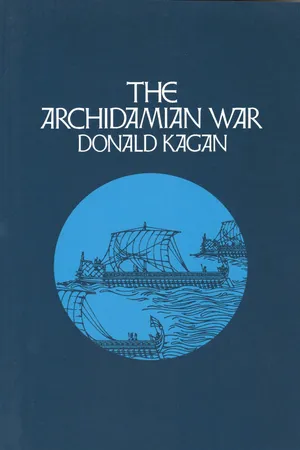
This book, the second volume in Donald Kagan's tetralogy about the Peloponnesian War, is a provocative and tightly argued history of the first ten years of the war. Taking a chronological approach that allows him to present at each stage the choices that were open to both sides in the conflict, Kagan focuses on political, economic, diplomatic, and military developments. He evaluates the strategies used by both sides and reconsiders the roles played by several key individuals.
- 400 pages
- English
- ePUB (mobile friendly)
- Available on iOS & Android
eBook - ePub
The Archidamian War
About this book
Information
1. Plans and Resources1
In the spring of 431 a band of more than three hundred Thebans, under cover of darkness, launched a surprise attack on the neighboring city of Plataea. Because Thebes was an ally of Sparta and the Plataeans were allied to Athens, this action was an open breach of the Thirty Years’ Peace of 445. So began the great Peloponnesian War, which lasted, with several interruptions, for twenty-seven years. Since ancient times the first ten years of the great war, concluded by the Peace of Nicias in 421, have been regarded as a unit and called, after the name of the Spartan king who led its early campaigns, the Archidamian War.
Examination of the Archidamian War as a unit apart from the events that followed is useful and revealing. Although many surprises took place in the decade of its course, the war was fought essentially within the framework established by those who embarked on it. Departures from the original strategies were necessary, but none compared with the great changes that followed the Peace of Nicias. The sending of an Athenian army into the heart of the Peloponnese in 418, the invasion of Sicily, the shift of the center of warfare from the mainland to the Aegean and the Hellespont, all were unforeseen by the men who began the war. They could not have anticipated what happened after 421, when conditions and personnel presented a completely new situation. Although most of the events of the Archidamian War itself do not in retrospect seem entirely surprising, it is interesting for us to ask how well the several states and their leaders anticipated the course of action. How promising were the strategies followed by each side? Did the Athenians’ and Spartans’ estimation of the situation in 431 justify their decisions to run the risks of war?
A successful strategy must rest on a clear understanding of the aims for which a war is undertaken and an accurate assessment of one’s own resources and weaknesses and those of the enemy. It aims at employing one’s own strength against the enemies’ weakness. It makes use of, but is not bound by, the experience of the past. It adjusts to changes in conditions, both material and psychological. It considers in advance that its first expectations may be disappointed and has an alternate plan ready. Rarely, however, has a state or statesman embarking upon war been well enough prepared strategically.
Sparta’s declared aim in breaking the Thirty Years’ Peace was “to liberate Greece,”2 that is, to restore autonomy to the Greek states subject to Athens.3 Thucydides tells us that the Spartans’ true motive was their fear of Athens’ growing power.4 Although the Spartans were always slow to go to war, Athens’ use of her power against Sparta’s allies made the situation unendurable, “and the Spartans decided they must try with all their might to destroy that power if they could and to launch this war.”5 Whether the Spartans made war to free the Greeks, to defend their allies against Athens and thus to continue to enjoy the security provided by the Spartan alliance, or to restore the uncontested primacy that Sparta had enjoyed in the time of the Persian War, or for all these reasons, makes no difference. Each of these goals seemed to the Spartans to require the destruction of Athenian power, that is, of Athens’ walls, which made her secure against the power of the Spartan army, of her fleet, which gave her command of the seas, and of her empire, which provided the money that supported her navy. A strategy aiming at a peace that left these intact was of no value. Sparta’s war aims required that she must take the offensive.
When the war began, the Peloponnesian forces included all the states in the Peloponnese with the exception of the neutral states, Argos and the towns of Achaea other than Pellene.6 Outside the Peloponnese the members of the Spartan alliance included the Megarians, Boeotians, northern Locrians, and Phocians,7 and in the west the Corinthian colonies of Ambracia, Leucas, and Anactorium. In Sicily the Spartans were allied to Syracuse and all the Dorian cities except Camarina, and in Italy to Locri and their own colony Taras.8 The great strength of the Spartan alliance lay in its splendid, heavily armed infantry made up of Peloponnesians and Boeotians. This was two or three times the size of the Athenian hoplite phalanx and universally regarded as abler and more experienced.9
At the beginning of the war Pericles had to admit that in a single battle the Peloponnesian army was a match for all the rest of Greece,10 and recent history had shown that the Athenians had long been aware of the relative weakness in their hoplite army. In 446 a Spartan army had invaded Attica. Instead of fighting, the Athenians made a truce which soon led to the end of the First Peloponnesian War with the Thirty Years’ Peace. The Athenians abandoned their land empire in central Greece and conceded Spartan hegemony on the Greek mainland.11 The Spartans had good reason to believe that they would be invincible in a land battle against Athens. Such considerations were behind the eagerness of the Spartan war party to undertake the war and their unwillingness to heed the cautious warnings of their King Archidamus. To them the proper strategy was obvious and success inevitable: the Spartans needed merely to invade Attica during the growing season. Almost surely the Athenians would not stay behind their walls and watch their crops, homes, and property destroyed. Either they would yield as they had in 446, or, if their courage allowed, they would come out to fight and be destroyed. In either case the war would be short and Spartan victory certain.
To be sure, the Spartans realized that the Athenians might choose neither to fight nor to surrender immediately, for Athens was like no other Greek city—it was defended by stout walls, as was its port, Piraeus, and the two were connected by the Long Walls, no less strong. Greek armies rarely took a fortified place by assault, and the Spartans were less skillful at siege warfare than most.12 The Athenians, because of their navy and their empire, could hold out by bringing supplies from abroad even though deprived of their own lands. Still, the Spartans did not believe that any people could put up with such conditions for long: the Athenians might hold out for a year or two, but certainly not more. When the war began the Spartans expected that “they would destroy the power of the Athenians in a few years if they wasted their land.”13 Nor did that expectation seem rash, for the Athenians themselves were in a pessimistic mood,14 and Thucydides tells us that at the beginning of the war the Greeks in general shared their view: if the Peloponnesians should invade Attica, “some thought that Athens could hold out for a year, some for two, but no one for more than three years.”15
King Archidamus was more cautious. He expected that Athens could hold out indefinitely without either giving battle or surrendering. In such circumstances superiority in arms and numbers would be of no use. The Spartans would need another strategy, but what could it be? The only alternative was to incite rebellion among the allies of Athens and thereby deprive her of the men, ships, and money she needed to survive. But, since the Athenian Empire was chiefly maritime, this strategy required that Sparta have the ships necessary to encourage and support rebellions of the islanders, and these, in turn, required money. As Archidamus pointed out, the Peloponnesians were vastly inferior in financial resources, “having neither money in the public treasury nor being able readily to raise money from taxation.”16
On the eve of the war the Peloponnesians had a fleet of about 100 triremes,17 most of these recently built by Corinth for the war against Corcyra. These required rowers, steersmen, and captains skilled in the maneuvers of modern naval warfare which had been perfected by the Athenians. Such men were in short supply in the Peloponnese; for their war against Corcyra the Corinthians had been forced to hire rowers at high pay from all over Greece.18 Most of these must have come from the Aegean, the Athenian sphere of influence, and they would no longer be available to the Peloponnesians in a war against Athens. At the battle of Sybota both the Corinthian and Corcyrean fleets had employed archaic tactics.19 In a naval war the Peloponnesians would be inferior in ships, sailors, and tactics.
Conscious of these weaknesses, Archidamus advised the Spartans to consider the Athenian offer of arbitration rather than go to war immediately. If negotiation failed he urged them at least to wait until they had repaired their naval and financial deficiencies.20 The Corinthians, eager for war, tried to make light of the difficulties described by Archidamus, because of the Peloponnesian superiority in numbers, military experienc...
Table of contents
- Abbreviations and Short Titles
- 1. Plans and Resources
- 2. The First Year of the War
- 3. The Plague and Its Consequences
- 4. The Third Year of the War: Phormio
- 5. The Revolt at Lesbos
- 6. Sicily and Corcyra
- 7. Demosthenes
- 8. Pylos and Sphacteria
- 9. Megara and Delium
- 10. The Coming of Peace
- Conclusions
- Appendix A: Pericles and Athenian Income
- Appendix B: Pericles’ Last Speech
- Bibliography
- General Index
- Index of Modern Authors
- Index of Ancient Authors and Inscriptions
Trusted by 375,005 students
Access to over 1.5 million titles for a fair monthly price.
Study more efficiently using our study tools.
Frequently asked questions
Yes, you can cancel anytime from the Subscription tab in your account settings on the Perlego website. Your subscription will stay active until the end of your current billing period. Learn how to cancel your subscription
No, books cannot be downloaded as external files, such as PDFs, for use outside of Perlego. However, you can download books within the Perlego app for offline reading on mobile or tablet. Learn how to download books offline
Perlego offers two plans: Essential and Complete
- Essential is ideal for learners and professionals who enjoy exploring a wide range of subjects. Access the Essential Library with 800,000+ trusted titles and best-sellers across business, personal growth, and the humanities. Includes unlimited reading time and Standard Read Aloud voice.
- Complete: Perfect for advanced learners and researchers needing full, unrestricted access. Unlock 1.5M+ books across hundreds of subjects, including academic and specialized titles. The Complete Plan also includes advanced features like Premium Read Aloud and Research Assistant.
We are an online textbook subscription service, where you can get access to an entire online library for less than the price of a single book per month. With over 1.5 million books across 990+ topics, we’ve got you covered! Learn about our mission
Look out for the read-aloud symbol on your next book to see if you can listen to it. The read-aloud tool reads text aloud for you, highlighting the text as it is being read. You can pause it, speed it up and slow it down. Learn more about Read Aloud
Yes! You can use the Perlego app on both iOS and Android devices to read anytime, anywhere — even offline. Perfect for commutes or when you’re on the go.
Please note we cannot support devices running on iOS 13 and Android 7 or earlier. Learn more about using the app
Please note we cannot support devices running on iOS 13 and Android 7 or earlier. Learn more about using the app
Yes, you can access The Archidamian War by Donald Kagan in PDF and/or ePUB format, as well as other popular books in History & Greek Ancient History. We have over 1.5 million books available in our catalogue for you to explore.