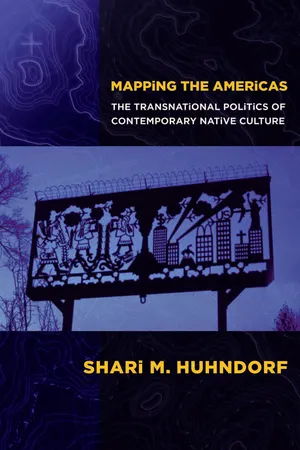
In Mapping the Americas, Shari M. Huhndorf tracks changing conceptions of Native culture as it increasingly transcends national boundaries and takes up vital concerns such as patriarchy, labor and environmental exploitation, the emergence of pan-Native urban communities, global imperialism, and the commodification of indigenous cultures.While nationalism remains a dominant anticolonial strategy in indigenous contexts, Huhndorf examines the ways in which transnational indigenous politics have reshaped Native culture (especially novels, films, photography, and performance) in the United States and Canada since the 1980s. Mapping the Americas thus broadens the political paradigms that have dominated recent critical work in Native studies as well as the geographies that provide its focus, particularly through its engagement with the Arctic.Among the manifestations of these new tendencies in Native culture that Huhndorf presents are Igloolik Isuma Productions, the Inuit company that has produced nearly forty films, including Atanarjuat, The Fast Runner; indigenous feminist playwrights; Leslie Marmon Silko's Almanac of the Dead; and the multimedia artist Shelley Niro. Huhndorf also addresses the neglect of Native America by champions of "postnationalist" American studies, which shifts attention away from ongoing colonial relationships between the United States and indigenous communities within its borders to U.S. imperial relations overseas.This is a dangerous oversight, Huhndorf argues, because this neglect risks repeating the disavowal of imperialism that the new American studies takes to task. Parallel transnational tendencies in American studies and Native American studies have thus worked at cross-purposes: as pan-tribal alliances draw attention to U.S. internal colonialism and its connections to global imperialism, American studies deflects attention from these ongoing processes of conquest. Mapping the Americas addresses this neglect by considering what happens to American studies when you put Native studies at the center.
eBook - PDF
Mapping the Americas
The Transnational Politics of Contemporary Native Culture
- 217 pages
- English
- PDF
- Available on iOS & Android
eBook - PDF
About this book
Information
Table of contents
- Contents
- List of Illustrations
- Acknowledgments
- Note on Terminology
- Introduction: Native American Studies and the Limits of Nationalism
- 1. Colonizing Alaska: Race, Nation, and the Remaking of Native America
- 2. “From the Inside and through Inuit Eyes”: Igloolik Isuma Productions and the Cultural Politics of Inuit Media
- 3. Indigenous Feminism, Performance, and the Gendered Politics of Memory
- 4. Picture Revolution: “Tribal Internationalism” and the Future of the Americas in Leslie Marmon Silko’s 'Almanac of the Dead'
- Coda: Border Crossings
- Works Cited
- Index
Trusted by 375,005 students
Access to over 1.5 million titles for a fair monthly price.
Study more efficiently using our study tools.
Frequently asked questions
Yes, you can cancel anytime from the Subscription tab in your account settings on the Perlego website. Your subscription will stay active until the end of your current billing period. Learn how to cancel your subscription
No, books cannot be downloaded as external files, such as PDFs, for use outside of Perlego. However, you can download books within the Perlego app for offline reading on mobile or tablet. Learn how to download books offline
Perlego offers two plans: Essential and Complete
- Essential is ideal for learners and professionals who enjoy exploring a wide range of subjects. Access the Essential Library with 800,000+ trusted titles and best-sellers across business, personal growth, and the humanities. Includes unlimited reading time and Standard Read Aloud voice.
- Complete: Perfect for advanced learners and researchers needing full, unrestricted access. Unlock 1.5M+ books across hundreds of subjects, including academic and specialized titles. The Complete Plan also includes advanced features like Premium Read Aloud and Research Assistant.
We are an online textbook subscription service, where you can get access to an entire online library for less than the price of a single book per month. With over 1.5 million books across 990+ topics, we’ve got you covered! Learn about our mission
Look out for the read-aloud symbol on your next book to see if you can listen to it. The read-aloud tool reads text aloud for you, highlighting the text as it is being read. You can pause it, speed it up and slow it down. Learn more about Read Aloud
Yes! You can use the Perlego app on both iOS and Android devices to read anytime, anywhere — even offline. Perfect for commutes or when you’re on the go.
Please note we cannot support devices running on iOS 13 and Android 7 or earlier. Learn more about using the app
Please note we cannot support devices running on iOS 13 and Android 7 or earlier. Learn more about using the app
Yes, you can access Mapping the Americas by Shari M. Huhndorf in PDF and/or ePUB format, as well as other popular books in Social Sciences & North American History. We have over 1.5 million books available in our catalogue for you to explore.