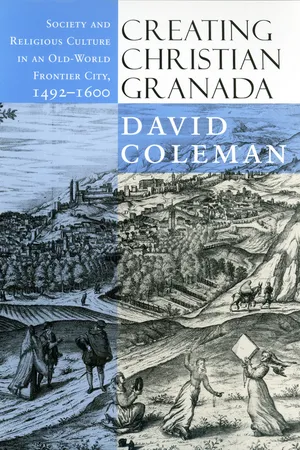
Creating Christian Granada provides a richly detailed examination of a critical and transitional episode in Spain's march to global empire. The city of Granada—Islam's final bastion on the Iberian peninsula—surrendered to the control of Spain's "Catholic Monarchs" Isabella and Ferdinand on January 2, 1492. Over the following century, Spanish state and Church officials, along with tens of thousands of Christian immigrant settlers, transformed the formerly Muslim city into a Christian one.With constant attention to situating the Granada case in the broader comparative contexts of the medieval reconquista tradition on the one hand and sixteenth-century Spanish imperialism in the Americas on the other, Coleman carefully charts the changes in the conquered city's social, political, religious, and physical landscapes. In the process, he sheds light on the local factors contributing to the emergence of tensions between the conquerors and Granada's formerly Muslim, "native" morisco community in the decades leading up to the crown-mandated expulsion of most of the city's moriscos in 1569–1570.Despite the failure to assimilate the moriscos, Granada's status as a frontier Christian community under construction fostered among much of the immigrant community innovative religious reform ideas and programs that shaped in direct ways a variety of church-wide reform movements in the era of the ecumenical Council of Trent (1545–1563). Coleman concludes that the process by which reforms of largely Granadan origin contributed significantly to transformations in the Church as a whole forces a reconsideration of traditional "top-down" conceptions of sixteenth-century Catholic reform.
eBook - ePub
Creating Christian Granada
Society and Religious Culture in an Old-World Frontier City, 1492–1600
- 264 pages
- English
- ePUB (mobile friendly)
- Available on iOS & Android
eBook - ePub
Creating Christian Granada
Society and Religious Culture in an Old-World Frontier City, 1492–1600
About this book
Information
CHAPTER ONE
A Frontier Society
The Christian Immigrant Community, 1492–1570
Juan de la Torre was one of the thousands of Christian immigrants who came to Granada seeking opportunity and fortune in the decades after the city’s 1492 conquest. He had grown up in Toledo as a member of a wealthy judeoconverso merchant family that played a leading role in that city’s endemic violence between Jewish converts and “Old Christians.” Two of his kinsmen had been hanged in 1467 for entering Toledo’s cathedral armed to do battle with Old Christians; another had been hanged for allegedly leading a 1485 plot to murder local inquisitors during the city’s Corpus Christi procession.1 Though Juan did not participate in the violence, he actively shared in the family tradition of shrewd business. Viewed from Toledo, newly conquered Granada appeared to him a golden opportunity for investment. His name first appears in Granada’s records shortly after the city’s conquest, when in 1493 and 1494 he issued loans to Archbishop Talavera and royal secretary Hernando de Zafra.2 He may have purchased from the crown part of the Granada silk-tax contract as early as 1504, and by 1517 his name appears in royal documentation as the primary arrendador (tax collector) of the local silk trade. Along with his in-laws, also from Toledan converso families, Juan de la Torre dominated the Granada silk-tax contract for the better part of the first half of the sixteenth century. Granada was among the principal centers of European silk production, and Juan quickly amassed an enormous fortune.
Meanwhile, he maintained close ties with relatives back in Toledo and even kept a house in his native city. His fortune had, in fact, allowed him to become one of the most powerful men in both cities, and for more than three decades he shuttled back and forth between the two. He purchased an office as municipal council member (regidor) in Toledo in 1529, and served as Toledo’s representative (procurador) in the Castilian Cortes of 1539. In the same year, Granada’s city council borrowed from Juan de la Torre a sum of four thousand ducats. The city of Granada remained indebted to him for years.3 In 1544, he renounced his position on Toledo’s municipal council, and from that point on lived in Granada full time. After losing the silk-tax contract to a higher bidder in 1546, Juan continued to be a major player in Granada’s local power structure. In 1553, he became lord of a village some forty kilometers south of the city, and his fortune allowed his son to purchase a seat as a voting regidor on Granada’s municipal council.4
Unlike Juan de la Torre, Domingo Pérez de Herrasti was not socially scarred by any known Jewish lineage, nor was he blessed by family wealth. Instead, he was a soldier who came, his family later claimed, from a proud but relatively poor noble family from the Basque village of Azcoita. Domingo, like Juan de la Torre, took advantage of the opportunities presented by the Granadan frontier. He served in the Catholic Monarchs’ army during the conquest of the city, and Queen Isabella rewarded him in 1492 with two offices: public scribe of the city of Granada and jurado (nonvoting official at municipal council meetings) of the city, representing the parish of San Pedro y San Pablo. He held a variety of offices, and the powerful captain general of Granada, Iñigo López de Mendoza, repeatedly accused him of corrupt abuse of his position for personal gain. Despite Mendoza’s disfavor, Pérez de Herrasti continued to milk royal patronage, especially through friends such as Isabella’s royal secretary Hernando de Zafra and, later, Charles V’s advisor Francisco de los Cobos. He also forged alliances with powerful local families by arranging the marriages of his sons to daughters of municipal councilmen. Domingo’s ascent culminated in royal grants of seigneurial control of lands near Granada and the purchase by his son Francisco in 1541 of his own seat as a member of Granada’s municipal council.5
If Granada promised opportunity to men such as Domingo Pérez de Herrasti and Juan de la Torre, it did not always deliver. The cases of these two highly successful men must be balanced against the experiences of most immigrants to the frontier city. The husband-and-wife merchant team of Pedro Sánchez and Juana González, for example, came to Granada from the Plasencia region of Extremadura (in southwestern Spain) with similarly high aspirations. Bad business fortune, however, gradually drove the couple into poverty. After the death of her husband, Juana González attempted to continue the business, running up a string of debts that stretched from Granada itself to the nearby towns of Pinos Puente and Ronda to her Extremaduran hometown of Plasencia. In her 1577 last will and testament, she reported that she had been reduced to begging for food in the streets of Granada. Having no money to order funeral masses for herself, Juana entrusted her executors to contact her family back in Plasencia to arrange for masses to be said there for her departed soul.6
Alongside such stereotypical frontier stories of boom and bust, many Christian immigrants found in frontier Granada economic conditions that allowed them simply to make do. During his 1526 visit, Venetian traveler Andrea Navagero reported that, compared with other cities, Granada appeared to him to have relatively few wealthy individuals and families. Most of the immigrants, he claimed, made modest livings working in various professions—above all in the production and trade of silk.7 Still, even if Granada’s promise often proved illusory, the perception of nearly limitless opportunity was powerful enough to attract Christian immigrants by the tens of thousands.
A brief overview of the city’s demographic history from the conquest in 1492 to the end of the sixteenth century makes clear the quantitative significance of Christian immigration to Granada. On the eve of the conquest, Granada housed a population of approximately fifty thousand. This figure, although admittedly swollen significantly by wartime refugees from other, already-conquered areas of the Nasrid kingdom, made Muslim Granada one of the Iberian Peninsula’s largest cities at the time of its surrender.8 This preconquest population, however, included only a handful of Castilian Christians—mostly wartime captives and a small number of fugitives who had fled to the Muslim kingdom to hide from Spanish state or church authorities.9 After 1492, however, Christian immigrants began to stream into the conquered city in numbers that would eventually surpass those of Granada’s remaining indigenous, formerly Muslim population, which declined significantly as a result of emigration to Muslim North Africa. By 1561, the date of the first royal census of the city, Granada housed a Christian immigrant community of slightly more than thirty thousand people—a figure twice as large as the approximately fifteen thousand moriscos who still shared the city with them at that date.10 Most of the moriscos who remained in the city in 1561, however, were driven from Granada during the second rebellion via the crown-mandated expulsions of 1569–1570. By the end of the sixteenth century, the city housed between thirty-five and forty thousand people—the overwhelming majority of them Castilian immigrants or the immediate descendants of such immigrants.11 Overall, Granada’s transformation from a Muslim city to one inhabited almost entirely by Christians of Castilian descent had thus resulted in a net population decline when compared with the preconquest figures. Despite the loss of almost all of the indigenous population, Christian immigration to Granada had nonetheless managed remarkably to produce by 1600 a city that ranked as the fourth largest in the crown of Castile. Only Seville, Toledo, and Madrid had more people.12
The influx of immigrants into the frontier city, however, began slowly. Christian immigrant settlement in Granada in the period under study is, in fact, best understood as a two-stage process. The first wave of Christian immigration in the years immediately after the conquest in 1492 was strictly limited by the legal conditions and protections of Muslim property guaranteed by the treaty of surrender. The lifting of these restrictions as a result of the events of 1498–1499 initiated a second, longer, and much larger wave of immigration that would endure into the middle decades of the sixteenth century.
The conditions surrounding postconquest Granada’s first wave of immigration (1492–1499) restricted Christian settlement in the city itself largely, though not exclusively, to soldiers and royal bureaucrats. During this initial stage, the crown remained bound by the terms of the 1492 surrender agreement to protect the property of the resident Muslim population and thus bar any seizure or direct purchase of that property by Christians. Under these conditions, Christian immigrants could gain access to residence in the city only by two means. First, an immigrant could purchase the house or place of business of a Muslim who had chosen to flee to North Africa rather than live under Christian political control. Second, an immigrant could purchase from the crown the properties that had before the conquest pertained to the Nasrid royal patrimony, which were now in the hands of Isabella and Ferdinand as successors to the sultans. Especially in the first three or four years after the conquest, these constraints greatly impeded Christian immigration to the city. As a result, Granada’s Christian community in these early years consisted mostly of royal administrative appointees, such as the count of Tendilla and crown secretary Hernando de Zafra, and soldiers who, like Domingo Pérez de Herrasti, had participated in the conquest and received rewards and offices in the new city in return for their services.13
Moreover, the vast majority of this nascent Christian community remained concentrated within the Alhambra castle-palace complex on a hill overlooking Granada—largely isolated from the daily life of the Muslim city below. In an account of his visit to the conquered city in October 1494, Tyrolean traveler Hieronymus Münzer made scant mention of Castilians in the city outside the Alhambra. After entering through the Guadix gate on the city’s eastern edge, he rode straight into the heart of the city to the old main mosque without noticing anyone besides those whom he called the “infinite saracens.”14 The Christian immigrant community in the Alhambra complex in the 1490s, Miguel Ángel Ladero Quesada has estimated, probably numbered no more than one thousand permanent residents.15
Though not a large group in numerical terms, this seed of Granada’s Christian immigrant community proved extremely important in the subsequent political development of the city. For the Pérez de Herrasti and many other families, participation in the conquest and presence among Granada’s early Christian community conferred considerable prestige and often provided a basis for later claims to power within the local political order. Juan Arias de Mansilla, for example, rose from an apparently humble childhood in the village of San Ceprián near the Old Castilian city of Zamora to become an infantry captain in the forces of Queen Isabella. After participating in the conquest of Granada in 1492, he took up residence in the Alhambra and there raised four sons. In 1540, Granada’s royal appellate court rejected as ridiculous a claim by these four Arias de Mansilla brothers that their ancestors in San Ceprián had enjoyed the privileges of noble status.16 Nonetheless, their father’s presence in the conquering armies proved politically advantageous, as two of the brothers rose in the 1550s to powerful voting positions on Granada’s municipal council.17 Granada’s governing institutions throughout the period under study were filled with families such as the Pérez de Herrasti and Arias de Mansilla, whose prestige stemmed largely from their recent ancestors’ presence among the conquering armies and Granada’s nascent Christian immigrant community in the 1490s.18
While legal restrictions impeded large-scale Christian entry into the city of Granada itself in these early years, immigrants by the thousands streamed into the nearby villages and other major cities of the formerly Muslim kingdom. In Málaga, for example, the 1487 Christian takeover had resulted from a lengthy and bloody siege rather than a negotiated surrender. Christians who wished to enter this, the kingdom’s principal port city, did not face the sort of legal obstacles that the 1492 surrender agreement created for would-be Christian residents of the kingdom’s capital. As a result, Málaga, unlike Granada, already had in the 1490s a large and vibrant Christian immigrant community.19
Ladero Quesada has estimated from his study of royal land distribution records (repartimientos) that a total of between thirty-five and forty thousand Castilian subjects moved to the towns and villages of the formerly Muslim kingdom of Granada in the 1490s.20 Besides Málaga, other important destinations of these early Christian immigrants included the villages of the area immediately surrounding the city of Granada itself. Hieronymus Münzer, in fact, mentioned in his 1494 travelogue that the possibility of rebellion among the city’s conquered Muslim population was decreasing each day as the surrounding countryside was rapidly filling with Christian immigrants, leaving the local Muslims surrounded.21 Particularly important in this regard was the nearby village of Santa Fe—a new town founded by the Christians on the spot where the Catholic Monarchs had set up their base camp as they prepared for a final attack on the city of Granada in 1491.
The Christians who filled Santa Fe and other villages near Granada included large numbers of Castilian merchants in search of profit in the city’s lucrative silk trade. They exerted considerable political pressure on the crown to disregard the stipulations of the surrender agreement and allow them freely to set up enterprises within the city of Granada itself. Moreover, when properties in the city opened up for sale as the result of Muslim emigration, it was often such traders who had the most money and motivation to make the purchase. Thus, in addition to the aforementioned soldiers and royal administrators, Granada’s early Christian immigrant community in the 1490s included a small but grow...
Table of contents
- Acknowledgements
- Abbreviations
- Introduction
- CHAPTER ONE A Frontier Society
- CHAPTER TWO Mudéjares And Moriscos
- CHAPTER THREE A Divided City, A Shared City
- CHAPTER FOUR The Emergence of a New Order
- CHAPTER FIVE Creating Christian Granada
- CHAPTER SIX Defining Reform
- CHAPTER SEVEN Negotiating Reform
- CHAPTER EIGHT Rebellion, Retrenchment, and the Road to the Sacromonte
- Notes
- Bibliography
Trusted by 375,005 students
Access to over 1.5 million titles for a fair monthly price.
Study more efficiently using our study tools.
Frequently asked questions
Yes, you can cancel anytime from the Subscription tab in your account settings on the Perlego website. Your subscription will stay active until the end of your current billing period. Learn how to cancel your subscription
No, books cannot be downloaded as external files, such as PDFs, for use outside of Perlego. However, you can download books within the Perlego app for offline reading on mobile or tablet. Learn how to download books offline
Perlego offers two plans: Essential and Complete
- Essential is ideal for learners and professionals who enjoy exploring a wide range of subjects. Access the Essential Library with 800,000+ trusted titles and best-sellers across business, personal growth, and the humanities. Includes unlimited reading time and Standard Read Aloud voice.
- Complete: Perfect for advanced learners and researchers needing full, unrestricted access. Unlock 1.5M+ books across hundreds of subjects, including academic and specialized titles. The Complete Plan also includes advanced features like Premium Read Aloud and Research Assistant.
We are an online textbook subscription service, where you can get access to an entire online library for less than the price of a single book per month. With over 1.5 million books across 990+ topics, we’ve got you covered! Learn about our mission
Look out for the read-aloud symbol on your next book to see if you can listen to it. The read-aloud tool reads text aloud for you, highlighting the text as it is being read. You can pause it, speed it up and slow it down. Learn more about Read Aloud
Yes! You can use the Perlego app on both iOS and Android devices to read anytime, anywhere — even offline. Perfect for commutes or when you’re on the go.
Please note we cannot support devices running on iOS 13 and Android 7 or earlier. Learn more about using the app
Please note we cannot support devices running on iOS 13 and Android 7 or earlier. Learn more about using the app
Yes, you can access Creating Christian Granada by David Coleman in PDF and/or ePUB format, as well as other popular books in History & European History. We have over 1.5 million books available in our catalogue for you to explore.