Strategic Adjustment and the Rise of China demonstrates how structural and domestic variables influence how East Asian states adjust their strategy in light of the rise of China, including how China manages its own emerging role as a regional great power. The contributors note that the shifting regional balance of power has fueled escalating tensions in East Asia and suggest that adjustment challenges are exacerbated by the politics of policymaking. International and domestic pressures on policymaking are reflected in maritime territorial disputes and in the broader range of regional security issues created by the rise of China.Adjusting to power shifts and managing a new regional order in the face of inevitable domestic pressure, including nationalism, is a challenging process. Both the United States and China have had to adjust to China's expanded capabilities. China has sought an expanded influence in maritime East Asia; the United States has responded by consolidating its alliances and expanding its naval presence in East Asia. The region's smaller countries have also adjusted to the rise of China. They have sought greater cooperation with China, even as they try to sustain cooperation with the United States. As China continues to rise and challenge the regional security order, the contributors consider whether the region is destined to experience increased conflict and confrontation.ContributorsIan Bowers, Norwegian Defence University College and Norwegian Institute for Defence Studies
Daniel W. Drezner, Tufts University, Brookings Institution, and Washington Post
Taylor M. Fravel, Massachusetts Institute of Technology
Bjørn Elias Mikalsen Grønning, Norwegian Defence University College and Norwegian Institute for Defence Studies
Chung-in Moon, Yonsei University and Chairman, Presidential Committee on Northeast Asia Cooperation Initiative, Republic of Korea
James Reilly, University of Sydney
Robert S. Ross, Boston College and Harvard University
Randall L. Schweller, The Ohio State University
ystein Tunsjø, Norwegian Defence University College and the Norwegian Institute for Defence Studies
Wang Dong, Peking University
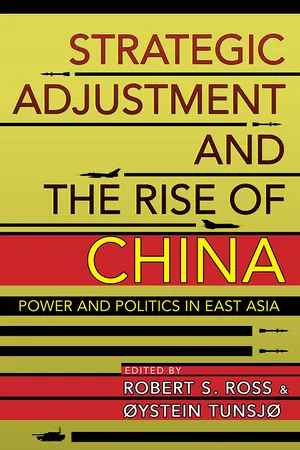
eBook - ePub
Strategic Adjustment and the Rise of China
Power and Politics in East Asia
- 316 pages
- English
- ePUB (mobile friendly)
- Available on iOS & Android
eBook - ePub
Strategic Adjustment and the Rise of China
Power and Politics in East Asia
About this book
Information
Subtopic
Storia cineseI. POWER AND POLITICS IN THE EAST ASIAN TRANSITION
CHAPTER 1
Domestic Politics and Nationalism in East Asian Security
Randall L. Schweller
A world in transition is a deeply uncertain one for both structural and motivational reasons. Emergent systems tend to encounter destabilizing and unpredictable power shifts among the system’s most powerful actors; they also experience changing state motivations associated with relative power positions in flux.1 Regarding intentions, even if a reasonable amount of certainty could be achieved regarding the present motivations of the rising powers (in today’s world, China, India, and—though stumbling of late—Brazil) and those of the incumbents (the European Union, Japan, and the United States), there is no guarantee that current intentions will remain stable over time. Just as we expect people who go from rags to riches (or vice versa) to change their ambitions, rising and declining powers can be expected to expand or contract their goals as power reshuffles at the top of the international pecking order.
Both kinds of uncertainty—structural uncertainty about the global distribution of capabilities and motivational uncertainty about the goals of rising and established major powers—spring from the taproot of domestic politics. In contemporary East Asia, the rise of China and the emerging transformation of the regional security order have contributed to significant uncertainty and policy instability. But structural uncertainty and the trajectory of a state’s power also crucially depend on the kinds of strategies its leaders embrace to mobilize resources (financial, productive, and human) for purposes of national security and economic growth. There is a long tradition within international relations (IR) scholarship of taking into account domestic as well as material factors in the specification of national power. Kenneth Waltz himself includes political stability and competence in his list of key capabilities that determine national rankings within the global hierarchy of power.2
In terms of motivational uncertainty, variance in state preferences across time and space has long been attributed to domestic politics. Even the purest of systemic theories acknowledge a range of state goals and policies. Sometimes these divergences are explained through reference to system structure: states differently situated within the international system hold dissimilar aims and respond differently to comparable external incentives. Among similarly situated states, however, differences in states’ goals and responses to external cues are explained not by international structure but rather by domestic politics. Specifically, national political processes serve as “imperfect” transmission belts (intervening variables) that introduce deviations (residual variance) from the predictions of systemic theory regarding rational responses to external constraints and opportunities.3 East Asian states are subject to structural constraints and shifting distribution of capabilities, but—as the various contributions to this volume point out—their responses to the rise of China differ.
Theories of domestic politics locate the determinants of foreign policy behavior and the national interest within the state itself. They are typically stories about how internal social and political pressures hold sway over the administrative and decision-making apparatuses of the state, causing a variety of state actions and goals that may or may not be responses to external stimuli. Variation in state goals is also a consequence of how elites frame national interests and demands in different ways for different audiences.4
Domestic politics are particularly salient in a changing world. This is because the political environments that develop during global transitions are populated and defined by emerging powers that, though expected to show competitive international faces, are more inward-looking, if not wholly distracted by domestic politics, than outwardly focused. After all, sudden and dramatic national growth induces massive social and political dislocations. As a nation grows, therefore, it becomes increasingly essential for its leaders, continuously mediating between their national societies and the international economy, to periodically recalibrate the balance between citizens, states, and markets as they simultaneously encourage stable and sustained growth.5
We see the primacy of domestic politics in the present world transformation—one driven largely by developments in the political landscape of East Asia, which is being fashioned largely by the domestic politics of the major regional players. Consider the politics of China as it tries to manage the international challenges of its rise. Since late 2012 it has experienced a once-in-a-decade leadership transition, slowing growth, and a show trial that sentenced one of the country’s best-known political personalities, Bo Xilai, to life imprisonment.6 China’s leaders understand that they must initiate sweeping domestic reforms to tackle three key internally generated problems: corruption, debt, and pollution.
Japan, for its part, has seen its politics stirred by resurgent nationalism in recent years, partly as a response to China’s rise and growing assertiveness. Led since 2012 by an overtly nationalist prime minister, Shinzo Abe, Japan has pursued a far more assertive, nationalist foreign policy—one that persistently stokes patriotic fervor, expresses hawkish pride in Japan’s national strength, and argues that the country has behaved no differently from any other colonial power in the last century.7 Predictably, Japan’s relations with its neighbors, especially China and South Korea, have deteriorated. In addition, Japan, like China, faces serious internal challenges that must be dealt with in the coming years. Most important, Japan is the “grayest” country in the history of the earth. Its workforce is barely over 50 percent of its population, and these workers must not only support themselves and their children but also Japan’s retirees, who comprise a whopping 40 percent of the country’s population. The author Bill Emmott got it right back in 1989, when he noted of Japanese economic power that the sun also sets.8
Meanwhile, the United States is trying to reconcile its desire to preserve American hegemony in the face of a rising China and dangerously high national debt, a war-weary public, and dwindling domestic support for anything international, much less foreign entanglements—all of which has forced the administration of President Barack Obama to develop a low-cost model for U.S. global management. In practice this means relying on economic sanctions to punish enemies, targeting terrorists with drones, fighting wars with robots and computerized weapons, avoiding unilateralism in favor of “leading from behind,” and pivoting to Asia within an overall grand strategy of “selective engagement” and balancing China.9 It also means lots of setbacks for valued U.S. foreign policy projects, as well as dubious prospects for the few “achievements” that the administration claims to have made. Most glaringly, neither of the two principal presidential candidates—Hillary Clinton and Donald Trump—supported the Trans-Pacific Partnership signed by the United States and eleven other countries on February 4, 2016, even though it has been forcefully promoted by the Obama administration as a landmark trade deal that undergirds America’s strategic pivot to Asia.10
And reminiscent of HBO’s fantasy drama Game of Thrones, court politics at the apex of the ruling dictatorship in North Korea took a brutal turn with the execution of Jang Song-thaek, the uncle of North Korean leader Kim Jong-un and the regime’s number two man, for treason. North Korea’s supreme leader has ordered the killing of no fewer than seventy officials since he came to power in 2011, according to the South Korean intelligence service. In a particularly disturbing show of Kim Jong-un’s brutality, the country’s defense minister, Hyon Yong Chol, was killed by firing squad using an antiaircraft gun at a military school in front of hundreds of people in Pyongyang on April 30, 2015, after the regime accused him of treason for “dozing off” during a military event.
In addition to reaffirming reports about Kim’s ruthlessness and, perhaps, reducing the Obama administration’s strategic patience with Pyongyang, these executions have heightened Beijing’s worries about North Korean stability. One might expect that China’s leadership would be even less willing to take a tough stance with Pyongyang (on, for instance, denuclearization) for fear of further destabilizing its leadership, possibly leading to the collapse of the North Korean state along its border.11 Nevertheless, in March 2016 the fifteen-member United Nations Security Council passed Resolution 2270, condemning North Korea for its January 6 nuclear test and February 7 missile launch. Negotiated for weeks by American and Chinese officials, the language of the new resolution greatly expands the breadth and depth of previous resolutions (1695, 1718, 1874, 2087, and 2094) on North Korea, undermining the nation’s ability to raise money and secure technology and other resources for its nuclear weapons program.12 The resolution’s impact will, however, ultimately depend on the political will of UN member states, particularly China, to enforce implementation.
Returning to the larger point, the magnitude of internal pressures being exerted on—and aggravated by—the political leaders of China, Japan, North Korea, and the United States makes it a good bet that domestic politics will play a significant, if not decisive, role in shaping the patterns of their foreign policies and, by extension, the dynamics of East Asian regional security.
The rest of this chapter unfolds as follows. I begin by exploring the kinds of causal explanations that are classified under the rubric of second-image theories. This is followed by analysis of how these various causal schemes can play themselves out in a regional security setting (in this case, how China’s assertiveness may be the result of any one domestic political factor or a combination of them). Next, the chapter investigat...
Table of contents
- List of Contributors
- Acknowledgments
- Introduction
- Part I. Power and Politics in the East Asian Transition
- Part II. Japan, South Korea, and the Rise of China
- Part III. Great Power Relations and Regional Conflict
- Conclusion
- Index
Trusted by 375,005 students
Access to over 1.5 million titles for a fair monthly price.
Study more efficiently using our study tools.
Frequently asked questions
Yes, you can cancel anytime from the Subscription tab in your account settings on the Perlego website. Your subscription will stay active until the end of your current billing period. Learn how to cancel your subscription
No, books cannot be downloaded as external files, such as PDFs, for use outside of Perlego. However, you can download books within the Perlego app for offline reading on mobile or tablet. Learn how to download books offline
We are an online textbook subscription service, where you can get access to an entire online library for less than the price of a single book per month. With over 1.5 million books across 990+ topics, we’ve got you covered! Learn about our mission
Look out for the read-aloud symbol on your next book to see if you can listen to it. The read-aloud tool reads text aloud for you, highlighting the text as it is being read. You can pause it, speed it up and slow it down. Learn more about Read Aloud
Yes! You can use the Perlego app on both iOS and Android devices to read anytime, anywhere — even offline. Perfect for commutes or when you’re on the go.
Please note we cannot support devices running on iOS 13 and Android 7 or earlier. Learn more about using the app
Please note we cannot support devices running on iOS 13 and Android 7 or earlier. Learn more about using the app
Yes, you can access Strategic Adjustment and the Rise of China by Robert S. Ross, Øystein Tunsjø, Robert S. Ross,Øystein Tunsjø in PDF and/or ePUB format, as well as other popular books in Politica e relazioni internazionali & Storia cinese. We have over 1.5 million books available in our catalogue for you to explore.