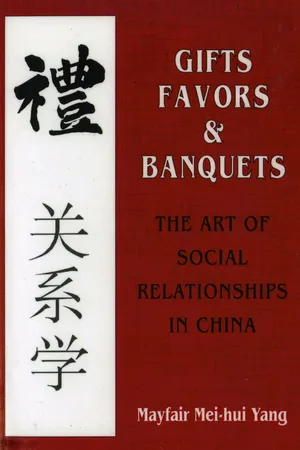
An elaborate and pervasive set of practices, called guanxi, underlies everyday social relationships in contemporary China. Obtaining and changing job assignments, buying certain foods and consumer items, getting into good hospitals, buying train tickets, obtaining housing, even doing business—all such tasks call for the skillful and strategic giving of gifts and cultivating of obligation, indebtedness, and reciprocity. Mayfair Mei-hui Yang's close scrutiny of this phenomenon serves as a window to view facets of a much broader and more complex cultural, historical, and political formation. Using rich and varied ethnographic examples of guanxi stemming from her fieldwork in China in the 1980s and 1990s, the author shows how this "gift economy" operates in the larger context of the socialist state redistributive economy.
eBook - ePub
Gifts, Favors, and Banquets
The Art of Social Relationships in China
- 368 pages
- English
- ePUB (mobile friendly)
- Available on iOS & Android
eBook - ePub
About this book
Information
PART I
AN ETHNOGRAPHY OF MICROPOLITICS IN A SOCIALIST SETTING
A society is . . . composed of certain foregrounded practices organizing its normative institutions and of innumerable other practices that remain “minor,” always there but not organizing discourses, and preserving the beginnings or remains of different (institutional, . . .) hypotheses for that society. . . . It is in this multifarious and silent “reserve” of procedures that we should look for “consumer” practices.—de Certeau 1984:48 (my emphasis)
In the chapters of Part 1 I undertake to describe and illustrate in minute detail a body of everyday practices and discourses in urban China which belong under the rubric of guanxixue. These practices do not organize the dominant discourses of the society, which have to do with such themes as “modernization,” “economic reform,” “socialism with Chinese characteristics,” and so forth. They are not considered an important subject to be taught in schools or to be studied much by serious scholarship. They do not form the major socially recognized institutions of the society, such as factories, families, schools, government organs, stores and markets, and so on. Yet they are so common and pervasive in all aspects of daily life in China that it might take an outsider or foreigner to take notice and attach social significance to them.
Based on first-hand ethnographic inquiry, I lay out in Part 1 the different inflections of meaning in the extensive vocabulary that goes with the art of guanxi. I document the great diversity of situations that call for the practice of guanxixue. I delve into the differences in its practice, such as rural-urban, gender, and occupational class differences. I attempt to convey the internal logic of guanxixue, by describing not only its tactics and methods, its system of personalistic ethics, but also its etiquettes or rules of performance. The art of guanxi is also compared and contrasted with another new field of social transactions in China: that of money and commodified relations. And finally, the recent historical trajectory of guanxixue’s decline, reemergence, and development is also sketched out. Those readers already familiar with the workings of guanxixue in Chinese society can skip Part 1 and go directly to the theoretical formulations in Part 2.
This “minor” set of practices in contemporary China can be seen as the beginnings, or the rebirth, of a realm of social relations independent from state principles. At the same time, these practices are also the remains of a premodern kinship- and locality-oriented social system which placed importance on gift relations as ways of cementing relationships of mutual aid and obligation. And while de Certeau takes “consumer practices” to mean the creative uses made by consumers of modern mass media culture in the West, Part 1 shows how guanxixue is often a creative deployment of a “counter-ethics” which makes room for the personal and the private in a public sphere monopolized by the state.
CHAPTER ONE
Guanxi Dialects and Vocabulary
The term “guanxixue” does not appear in the 1947 edition of The Sea of Words (Ci hai), a Chinese dictionary (Shu 1947) similar to The Oxford English Dictionary, with its quotations from ancient and classical texts. Nor does it seem to be part of everyday speech in Taiwan. We can therefore surmise that “guanxixue” emerged in China in the socialist period. The word guan, however, has two definitions in Ci hai that are relevant to the phenomenon we are studying: “to connect” (lianluo) or “to make a linkage”; and “a pass or gate” that can be closed or guarded (Shu 1947:1412). These two dictionary definitions are directly relevant to modern guanxixue. A basic requirement of contemporary Chinese life is the ability to make social connections that enable a person to negotiate the countless “passes” or “gates” thrown in his or her way. To obtain the full flavor of the various social usages and attitudes toward guanxixue, we need to go beyond dictionary definitions to the thoughts and utterances of living people in everyday life.
Once I had settled on the art of guanxi as the focus of my research, I went around asking people to define the notion of guanxixue. The answers I received revealed that despite my attempts to uncover “the native’s point of view” (Geertz 1984), there was no singular point of view regarding guanxixue. Instead, there were multiple points of view and native definitions. This indeterminacy indicates that guanxixue elicits a corpus of ambiguous and changeable cultural meanings and a correspondingly ambivalent social attitude toward its practices. Multiple and conflicting attitudes toward a social phenomenon suggest not only that there are different occupational, class, gender, or ethnic perspectives in any given society but also that a society is undergoing specific social changes or a historical shift from one worldview and set of habits and interpretations to another. At the same time, the direction of the change and the contours of the new order are still unclear in people’s minds, and there is still no interpretive consensus on the new phenomenon of guanxixue. Therefore, in the midst of this process of open-ended change, when the question of the art of guanxi is raised, it is met with a multiplicity of contending discourses, all of which seek to fit the term into a particular interpretation of history.
This situation is similar to the state of “heteroglossia,” which according to the Russian literary theorist Mikhail Bakhtin is the struggle among sociolinguistic points of view which gives rise to “the dialogic nature of language” (1981). These different points of view as expressed in language take the form of what he called “dialects,” which in language are not restricted to the narrow, phonetic sense of the term but also include the socio-ideological languages of different social groups, generations, and interpretive viewpoints.
In the descriptions of guanxixue I have collected from both oral and written Chinese sources, four distinct “dialects” can be discerned, four sets of meanings and attitudes that are at times in conflict with each other. The first three belong to what can be called popular discourse, the forms of language and types of attitudes in everyday life which one finds expressed in localized and delimited spaces within the family; among friends, relatives, and neighbors; and between friendly but anonymous strangers on trains and buses. These popular forms of expression on guanxixue are usually found in spontaneous, everyday speech acts and seldom in writing, where a more orthodox attitude toward guanxixue is usually found. The three dialects found in popular discourse on guanxixue can be roughly distinguished by their attitudes: the pejorative, the mixed, and the morally neutral and pragmatic.
The fourth set of descriptions of guanxixue displays a certain coherence and a detectable agenda, meriting the label “official discourse.” By “official discourse” I do not mean that its speakers and writers are only officials; rather, I mean the style of language which projects the authority and political correctness which plays a hegemonic role in unifying public discourse. Anyone, whether official, worker, or intellectual, woman, man, or child, can speak, write, or think in it. Indeed, people either feel constrained to do so in public contexts or fall into the habit of doing so. Official discourse also dominates the various forms of state-run media such as radio, television, newspapers, books, and even scholarly publications. Needless to say, even where official discourse replicates or coincides with certain elements of popular discourse, other aspects of its style, content, tone, and evaluative mode render it recognizably distinct.
Popular Discourse
First, guanxixue, as it is conceptualized in popular discourse, can have the pejorative connotation of an antisocial practice, an aberrant instrumental behavior based on self-interest, which should be morally rejected:
Guanxixue is using people [liyong ren]. (Woman factory labor union director)Guanxixue is when you treat someone differently than you otherwise would because of how much that person is of use to you. Guanxixue is not upright [bu zhen]; it is crooked and sly. (Woman middle-school teacher)
Chen Zhongwang, a woman school teacher, had a slightly different reason for disapproving of the art of guanxi:
“I hate guanxixue because it’s so demeaning. It’s so obvious when you give someone a gift that you have a particular motivation in mind. So I never wanted to do it . . . but then, I had to win favor with the office in charge of giving out passports so I could go abroad. I had to wear a thick skin on my face [daizhe hou lianpi] and present a gift to the person in charge. Afterward I almost threw up [in disgust], but I did get the passport,” she said, her face screwed up with distaste.
Also faulting guanxixue is Liang Xiaoming, part of a new breed of urban entrepreneurs involved in linking factory producers, distributors, and markets, who said, “Guanxixue is bad for society, because when you help your friends and relatives, they may benefit, but somewhere down the line, someone else without the guanxi will suffer. They won’t get the thing that your friends got.
A woman factory worker surmised that guanxixue is part of the turn toward a general treacherousness in social relations. Her tracing of this turn to the period of the Cultural Revolution follows a common narrative motif in China in the 1980s, when the Cultural Revolution was regarded as a watershed or turning point for every conceivable aspect of the society. Before the Cultural Revolution, she reminisced, people were “honest” (laoshi), “simple” (danchun), and “straightforward” (zhi). Because of their experiences during the Cultural Revolution, people started “turning bad” (bian huai); and they came to harbor ill-will for one another, to use one another; they began to utter “falsehoods and deceptions” (shuo jiahua); and now they “do not speak from the heart” (bu shuo xinlihua). The woman lamented that she had especially suffered for being too frank and direct in speech in the past, so that many were the occasions when people took what she said out of context and used it against her. She resolved to learn guanxixue so that her words could not be distorted and she would be less vulnerable in the future.
Her association of guanxixue with a turn toward “badness,” “deception,” and the instrumental manipulation of relationships represents another explanation of guanxixue as a symptom of declining moral standards in society. There is something about guanxixue which makes it distasteful and morally objectionable to a lot of people. At the same time that she laments the moral decline, however, she also resolves to learn guanxixue herself. Guanxixue in this usage refers not to the substantive outcome or material benefit of a relationship of exchange, but to the very form, quality, and characteristic techniques of the relationship itself, to include the discernment, acuity, and cunning needed to get by in life. Thus the negative definitions of guanxixue in popular discourse can occasionally be found to contain a recognition and admiration of its style of operations and its potential benefits as a form of self-protection.
It is significant that four of the above five negative views of guanxixue came from women. I found that women, more than men, objected to the aggressive tactics sometimes found in guanxi dealings, to the use and manipulation of people. Men tended to have an accepting attitude toward guanxixue’s instrumentalism, regarding it in a realistic light as something one had to do in order to accomplish certain tasks.
Another negative understanding of guanxixue in popular discourse in the economic reform period is the view that equates it with official corruption. A middle-aged relative of mine, who is an agricultural expert from the south, expressed a common anger and bitterness toward how officials engage in guanxixue to further their own political and economic positions. “Their guanxi network is very large, they exchange favors with one another, their children benefit from their fathers’ position and use it to enrich themselves too.” I asked innocently if officials were also acting responsibly since they were living up to their obligations to their kin and friends by helping them. With eyes flashing in indignation, he replied, “If they want to help their friends and relatives, they should find other ways, they should not turn their [official] positions into their private property [siren caichan]!”
Throughout the 1980s there was increasing popular resentment at the way officials employed their guanxi to secure “special privileges” (tequan) for themselves and their families. Indeed, during the spring of 1989, one of the most powerful rallying cries of the student movement in Beijing was the condemnation of official corruption. One “big-character poster” decried the art of guanxi among officials:
Though I could see all the smaller spiders busily and carefully weaving exquisitely intricate, far-flung webs of relationships from which they would extract benefits, it never occurred to me that the . . . “high-level leaders, whom I so respected were also endowed with this instinct and talent for weaving webs, and indeed had, whether consciously or unconsciously, woven for themselves “magic webs.” Our Party is becoming ensnared in these spiders’ webs, its vision impaired, its ears stopped up, its throat strangled, its strength sapped. (Han and Hua 1990:37)
The passage duly notes the pervasiveness of guanxi networks among ordinary people (“smaller spiders”), but evinces surprise and disgust at guanxi among supposedly upright Party officials. The metaphor of becoming ensnared and put out of commission in spiders’ webs presents guanxixue as a practice that harms the Party and society.
Wang Xiaobing, a male graduate student, also disparaged guanxi practices, but he focused not on the selfish and particularistic benefits guanxi networks can gain for a person, but on what they deny. He described guanxi networks as “suffocating” (bu touqi), a way of exerting social pressure on a person so that he cannot do what he really wants. For example, he has for many years tried to get a divorce from his wife, who only has a lower-middle-school (junior high) education. Although they are incompatible in education, personality, and style of life, she refuses to divorce him and is backed up by the community.1 When he tried to apply for a divorce, the neighborhood committee where he lived mobilized his whole guanxi network of family, neighbors, and friends to take turns talking him out of it. So for Xiaobing, one’s guanxi can put great pressure on a person to conform to social conventions and to accept the decisions of higher authorities. He knows the power of this pressure firsthand and eventually gave in to guanxi pressure and stayed with his wife.
A second approach to explaining the art of guanxi takes the instrumental aspect of guanxi relations into account, but also stresses that guanxi operates according to a morality of its own and serves a necessary social function. Liu Fuqiang, a male factory worker, commented thoughtfully: “Guanxixue includes both ethical and unethical practices; both high moral principles and petty calculations. It’s just like in mathematics, there are both positive and negative numbers.” Amid the thundering roar of factory machinery one day in the winter of 1984, this worker explained the dual nature of guanxixue.
For example, guanxixue does not only have to take place between two people who know each other very well. Say, one dark and rainy night you’re riding your bicycle home and something on the bike breaks down and you don’t know how to fix it. It’s late and you really want to go home. A stranger rides by and f...
Table of contents
- Acknowledgments
- Introduction: Fieldwork, Politics, and Modernity in China
- PART I AN ETHNOGRAPHY OF MICROPOLITICS IN A SOCIALIST SETTING
- PART II THEORETICAL FORMULATIONS
Trusted by 375,005 students
Access to over 1.5 million titles for a fair monthly price.
Study more efficiently using our study tools.
Frequently asked questions
Yes, you can cancel anytime from the Subscription tab in your account settings on the Perlego website. Your subscription will stay active until the end of your current billing period. Learn how to cancel your subscription
No, books cannot be downloaded as external files, such as PDFs, for use outside of Perlego. However, you can download books within the Perlego app for offline reading on mobile or tablet. Learn how to download books offline
Perlego offers two plans: Essential and Complete
- Essential is ideal for learners and professionals who enjoy exploring a wide range of subjects. Access the Essential Library with 800,000+ trusted titles and best-sellers across business, personal growth, and the humanities. Includes unlimited reading time and Standard Read Aloud voice.
- Complete: Perfect for advanced learners and researchers needing full, unrestricted access. Unlock 1.5M+ books across hundreds of subjects, including academic and specialized titles. The Complete Plan also includes advanced features like Premium Read Aloud and Research Assistant.
We are an online textbook subscription service, where you can get access to an entire online library for less than the price of a single book per month. With over 1.5 million books across 990+ topics, we’ve got you covered! Learn about our mission
Look out for the read-aloud symbol on your next book to see if you can listen to it. The read-aloud tool reads text aloud for you, highlighting the text as it is being read. You can pause it, speed it up and slow it down. Learn more about Read Aloud
Yes! You can use the Perlego app on both iOS and Android devices to read anytime, anywhere — even offline. Perfect for commutes or when you’re on the go.
Please note we cannot support devices running on iOS 13 and Android 7 or earlier. Learn more about using the app
Please note we cannot support devices running on iOS 13 and Android 7 or earlier. Learn more about using the app
Yes, you can access Gifts, Favors, and Banquets by Mayfair Mei-Hui Yang in PDF and/or ePUB format, as well as other popular books in Social Sciences & Chinese History. We have over 1.5 million books available in our catalogue for you to explore.