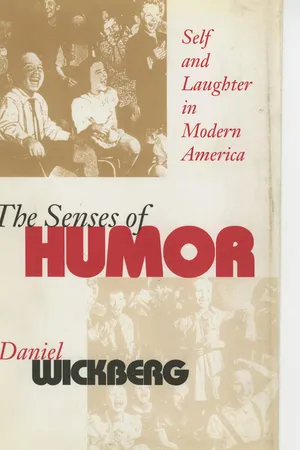
Why do modern Americans believe in something called a sense of humor and how did they come to that belief? Daniel Wickberg traces the cultural history of the concept from its British origins as a way to explore new conceptions of the self and social order in modern America. More than simply the history of an idea, Wickberg's study provides new insights into a peculiarly modern cultural sensibility.The expression "sense of humor" was first coined in the 1840s and the idea that such a sense was a personality trait to be valued developed only in the 1870s. What is the relationship between Medieval humoral medicine and this distinctively modern idea of the sense of humor? What has it meant in the past 125 years to declare that someone lacks a sense of humor? How is the joke, as a twentieth-century quasi-literary form, different from the traditional folktale? Wickberg addresses these questions, among others, using the history of ideas to throw new light on the way contemporary Americans think and speak.The context of Wickberg's analysis is Anglo-American; the specifically British meanings of humor and laughter from the sixteenth century forward provide the framework for understanding American cultural values in the nineteenth and twentieth centuries. The genealogy of the sense of humor is, like the study of keywords, an avenue into a significant aspect of the cultural history of modernity. Drawing on a wide range of sources and disciplinary perspectives, Wickberg's analysis challenges many of the prevailing views of modern American culture and suggests a new model for cultural historians.
- English
- ePUB (mobile friendly)
- Available on iOS & Android
eBook - ePub
About this book
Information
Table of contents
- Acknowledgments
- Introduction
- 1 The Idea of Humor
- 2 Humor, Laughter, and Sensibility
- 3 Bureaucratic Individualism and the Sense of Humor
- 4 The Commodity Form of the Joke
- 5 The Humorous and the Serious
- Conclusion
- Notes
Trusted by 375,005 students
Access to over 1.5 million titles for a fair monthly price.
Study more efficiently using our study tools.
Frequently asked questions
Yes, you can cancel anytime from the Subscription tab in your account settings on the Perlego website. Your subscription will stay active until the end of your current billing period. Learn how to cancel your subscription
No, books cannot be downloaded as external files, such as PDFs, for use outside of Perlego. However, you can download books within the Perlego app for offline reading on mobile or tablet. Learn how to download books offline
Perlego offers two plans: Essential and Complete
- Essential is ideal for learners and professionals who enjoy exploring a wide range of subjects. Access the Essential Library with 800,000+ trusted titles and best-sellers across business, personal growth, and the humanities. Includes unlimited reading time and Standard Read Aloud voice.
- Complete: Perfect for advanced learners and researchers needing full, unrestricted access. Unlock 1.5M+ books across hundreds of subjects, including academic and specialized titles. The Complete Plan also includes advanced features like Premium Read Aloud and Research Assistant.
We are an online textbook subscription service, where you can get access to an entire online library for less than the price of a single book per month. With over 1.5 million books across 990+ topics, we’ve got you covered! Learn about our mission
Look out for the read-aloud symbol on your next book to see if you can listen to it. The read-aloud tool reads text aloud for you, highlighting the text as it is being read. You can pause it, speed it up and slow it down. Learn more about Read Aloud
Yes! You can use the Perlego app on both iOS and Android devices to read anytime, anywhere — even offline. Perfect for commutes or when you’re on the go.
Please note we cannot support devices running on iOS 13 and Android 7 or earlier. Learn more about using the app
Please note we cannot support devices running on iOS 13 and Android 7 or earlier. Learn more about using the app
Yes, you can access The Senses of Humor by Daniel Wickberg in PDF and/or ePUB format, as well as other popular books in History & North American History. We have over 1.5 million books available in our catalogue for you to explore.