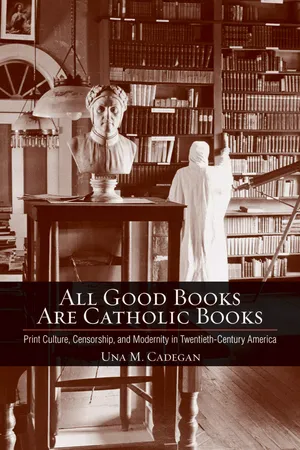
Until the close of the Second Vatican Council in 1965, the stance of the Roman Catholic Church toward the social, cultural, economic, and political developments of the twentieth century was largely antagonistic. Naturally opposed to secularization, skeptical of capitalist markets indifferent to questions of justice, confused and appalled by new forms of high and low culture, and resistant to the social and economic freedom of women—in all of these ways the Catholic Church set itself up as a thoroughly anti-modern institution. Yet, in and through the period from World War I to Vatican II, the Church did engage with, react to, and even accommodate various aspects of modernity. In All Good Books Are Catholic Books, Una M. Cadegan shows how the Church's official position on literary culture developed over this crucial period.The Catholic Church in the United States maintained an Index of Prohibited Books and the National Legion of Decency (founded in 1933) lobbied Hollywood to edit or ban movies, pulp magazines, and comic books that were morally suspect. These regulations posed an obstacle for the self-understanding of Catholic American readers, writers, and scholars. But as Cadegan finds, Catholics developed a rationale by which they could both respect the laws of the Church as it sought to protect the integrity of doctrine and also engage the culture of artistic and commercial freedom in which they operated as Americans. Catholic literary figures including Flannery O'Connor and Thomas Merton are important to Cadegan's argument, particularly as their careers and the reception of their work demonstrate shifts in the relationship between Catholicism and literary culture. Cadegan trains her attention on American critics, editors, and university professors and administrators who mediated the relationship among the Church, parishioners, and the culture at large.
eBook - ePub
All Good Books Are Catholic Books
Print Culture, Censorship, and Modernity in Twentieth-Century America
- 232 pages
- English
- ePUB (mobile friendly)
- Available on iOS & Android
eBook - ePub
All Good Books Are Catholic Books
Print Culture, Censorship, and Modernity in Twentieth-Century America
About this book
Information
Subtopic
North American HistoryIndex
HistoryCHAPTER 1
U.S. Catholic Literary Aesthetics
In 1921, Condé B. Pallen published an article in America entitled “Free Verse.” Pallen by this time had been prominent in Catholic literary culture for decades. As editor of Church Progress and Catholic World of St. Louis, poet, literary scholar and critic, popular lecturer on literary topics, and managing editor of the Catholic Encyclopedia, Pallen in his career linked literary and nonliterary work, institution building with scholarly and creative productivity. In “Free Verse,” he wrote, “‘Shredded prose’ is an apt description, if not an exact definition of what its advocates call free verse. That it is free, as free as madcap caprice, may be granted; that it is verse, which is built on metrical units, is to be denied. People may speak of a square circle, but there is no such thing; contradictions in terms are only a way of registering the impossible.” So far, a formal argument from a disgruntled conservator of ossified stylistic convention. But as Pallen continues, an alternative cosmology becomes apparent. “The free-verse movement, like many other radical movements of the day, is a reaction from law and order. . . . Like free verse, cubism and futurism have flared up, the dawn of new things, only to be consumed in the lurid flame of their own incandescent folly. Free verse is only another ignis fatuus blown from the miasmic jungles of disorder. You cannot escape the law. God made the world in measure, weight and number, and in measure, weight and number it will endure.”1 This is an argument not just about literary style, but about the nature of the world. Its alternative cosmology is theocentric, and the order and purpose of the universe are discernible to humanity.2
Pallen was not alone in his conviction that the literary was connected to every other aspect of reality. Indeed, he shares with his co-religionists this and other beliefs that put them at odds with many of their contemporaries—not just religiously, but also philosophically, politically, historically, and literarily. For this generation, the “root source of modern disorder,” as Philip Gleason puts it, lay in society’s rejection of Catholicism’s perennial truth and legitimate authority. Equally important, Catholics also believed they knew how—and were obligated—to address modernity’s deepest discontents.3 Catholics who took up this obligation via literary work needed not just institutions and publications, not just organizations and printing presses; they needed an aesthetic—a conscious, explicit philosophical framework for defining and evaluating literature. Such a framework had already been shaping U.S. Catholic literary work for some time, as Condé Pallen’s critique suggests. Its role in the cultural work of Catholic literature can be more clearly demonstrated by sketching its contours, describing some of its major elements, and examining its role in appraising one of the major literary movements of the generation before the era of the Great War, realism.
Interwar Catholic Literary Culture
Catholics involved in literary work were shaping and employing their literary aesthetic in an era when changes in the secular literary academy significantly affected the nature of their task. Two of these changes are especially important here. Beginning in the early 1920s, American literary culture was becoming simultaneously professionalized and nationalized. In the generation of the “genteel tradition,” late Victorians writing between the U.S. Civil War and World War I, literature had been more avocation than profession, the province of “men of letters” who wrote and read primarily in mainstream middle-class periodicals.4 As university study and research became more specialized in the first decades of the twentieth century, departments of “English” began appearing, and literature increasingly became the province of the universities, requiring professional study and credentialing, especially to undertake the work of the critic. A cause and consequence of this change was the growing legitimacy of American literature as an object of serious study. Earlier generations had considered reading post-Renaissance English-language literature to be leisure, not scholarship—and if this was true of authors such as George Eliot and Thomas Hardy, how much more true must it be of Washington Irving and James Fennimore Cooper?5 As literary scholars began to discern an “American Renaissance” in the writings of a number of mid-nineteenth-century Anglo male Protestant New Englanders, however, they expanded the body of work deemed suitable for professional literary consideration. The result was a prolonged burst in the study, teaching, and celebration of American literature per se for the first time.
Accompanying this shift was a call for critics to write a “national” literary history—to construct a history of American writing that would embody a national consciousness in a list of masterworks created by great American artists. The writers of the “American Renaissance”—Ralph Waldo Emerson, Henry David Thoreau, Walt Whitman, Nathaniel Hawthorne, Herman Melville, and a handful of others—were increasingly believed by interwar literary critics to represent an authentically American literary tradition. The culmination of this retrieval of a native tradition was the publication in 1941 of F. O. Matthiessen’s American Renaissance, which identified Emerson, Thoreau, Whitman, Hawthorne, and Melville as central. In reaching back beyond the previous generation’s celebration of the genteel tradition as represented by poets Henry Wadsworth Longfellow, John Greenleaf Whittier, Oliver Wendell Holmes, and James Russell Lowell, Matthiessen and other interwar critics saw themselves as “liberating America’s cultural past from the deadly grip of WASP Victorianism.” It is equally plausible to note that they thereby “helped place this past within the confines of WASP modernism.”6 The literary culture that came to dominate the U.S. academy through the 1950s, therefore, espoused a nationalism that implicitly figured American identity as Protestant.7 As interwar Catholics participated in the professionalization of literary study in their own universities and other institutions, accommodating this second change within their views of literature was a key conceptual task.
Three aspects of Catholic literary culture set it at odds with these emerging characteristics of the literary mainstream. First, at a time when literature was supposed to express the freedom of the individual liberated from the stifling past, Catholic literary culture set itself the task of shoring up a unified communal identity. It was hierarchical and also collaborative, oriented internally and also externally. It was fractious and variegated, but thoroughly permeated by the sense of obligation to seek unity. “Seeking unity” did not necessarily imply harmony—it could mean excoriating errant brethren in decidedly inharmonious terms. Divisions existed between ethnic groups; between midwesterners and east coasters; between clergy and laity; between men and women; between conservatives and liberals; between anticommunists and union organizers and supporters; between low, middle, and high brows; between a largely blue-collar and rural emphasis on pastoral and devotional concerns and a more upper-class elite emphasis on high culture and cosmopolitan engagement with the contemporary. Catholic literary culture was one site within which these conflicts could be addressed and where they were sometimes fought out with damaging and lasting recrimination. Despite the depth and reality of the divisions, both theology and polity required that ultimate (even if only eschatological) unity be asserted.
Literary texts of all kinds were implicated in a dense web of mutual cooperation and obligation, writers linked to readers in an enterprise with great—indeed, cosmic—social implications. In Religion and the Study of Literature, Brother Leo wrote: “Literature springs from the heart of a man who knows much about life and who sympathizes deeply with life; and its educational, its cultural value springs from the fact that the reading of literature produces a corresponding growth of human knowledge and human sympathy in the heart of the student.”8 Names and descriptions for this growth varied: to Daniel O’Neill, literature “excites the noblest of emotions”; Stephen Brown said that “ordinary people find in the reading of fiction . . . at lowest a distraction, a thread of interest that catches the imagination and holds the attention for the time, at best a widening of experience, an enlargement of interest, a setting free of the more generous emotions, a certain humanizing influence”; Burton Confrey stated flatly that “the moral mission of literature is . . . to make us live better lives” and to “help [our fellowmen (sic)] achieve the goal which God has set as our final end.”9 All these descriptions have in common a sense that literature is an encounter between human beings, with effects for which the participants in the encounter are responsible.
Second, not only was Catholic literary culture relentlessly communal at a time when art’s exaltation of individual freedom was nearly unparalleled. In addition, at a time when putting art at the service of ends other than itself was suspect as a symptom of incipient totalitarianism, Catholic literary culture set itself the task of changing the world. The literary aesthetic of Catholic Americans had a clear activist dimension. Literary work (in addition to theological and pastoral writing) had to do as well as be, had to serve as a means by which ends beyond and above the printed word were achieved. An activist aesthetic may seem like a contradiction in terms, but it animated Catholic literary efforts at many levels. Some efforts were in-house, such as the attempt by America editor Francis X. Talbot and Daniel Lord to compile a “Gallery of Living Catholic Authors,” a showcase of the progress being made by Catholic Action. But even the thoroughly mainstream critical endeavors of poet Allen Tate, much better known as a southern writer and a New Critic than as a Catholic writer, were increasingly informed by a desire to save modernity from the perils created by its gnosticism and abstraction.10 Catholic revivalists from Tate to Chesterton to Eliot were convinced that literature had a role to play in transforming society and an obligation to play that role. The end for the individual was always, ultimately, salvation, and art had to at least not interfere with that goal. The best art moved the reader directly toward that goal—helped, in fact, to achieve it. As Catholic Action began more and more to permeate Catholic literary culture, however, this individual focus continued to widen to include not just protection of individual salvation but the active initiative of redeeming modernity—of dramatizing the life and power of Catholicism in such a way that it could help people reimagine the world.
Adopting a literary aesthetic that was both communal and activist meant holding works and the people who produced them accountable for their effects, for how they facilitated the soul’s journey toward heaven and the transformation of the world. This accountability was sometimes voluntary, sometimes involuntary. Some Catholic authors took up literary work as an apostolate, as a calling by which they attempted to further the work of the apostles in the contemporary world. But this accountability was also applied to authors who had no intention of holding themselves to these standards—non-Catholics and those in the category of so many twentieth-century U.S. authors who left the Church in order to pursue success in the literary world. So Catholic book reviewers and literary critics, for example, regularly assessed works by standards their authors were never attempting to meet, as in Theodore Maynard’s somewhat sheepish but determined explication of “The Catholicism of Dickens.”11 Thus also Brother Leo’s analysis of H. G. Wells’s novel When the Sleeper Wakes. Wells was notorious within Catholic literary culture on account of his Outline of History, in which the Church appears as the opponent of progress and freedom. In the novel the protagonist wakes in the future, finds that poverty and suffering still exist, and despairs. Leo calls this an “indictment of the theory of human perfectibility through merely human means, that grotesque faith in the ability of man to lift himself by pulling at his own bootstraps.”12
Their belief in the theocentric order of the universe and the obligation to bring it to bear on the travails of modernity led Catholic critics to develop a view of literature as being always at the service of extraliterary ends. They had the misfortune of embracing and articulating this view at precisely the moment when it was most intensely out of favor in mainstream artistic thought. Both for late Victorian belles-lettres gentry and for their modernist supplanters, art existed only for itself, only to be, and to suggest that it should “do” anything was to disqualify it as art.
An aesthetic in the service of nonaesthetic ends negated itself and resulted not in art but in propaganda. This term’s entry into English (and a number of other languages, including French, Spanish, Dutch, and German) has a distinct anti-Catholic cast. “Propaganda” derived from the Latin name of the Congregation for the Propagation of the Faith (Propaganda Fide), also known as the Holy Office of the Inquisition. Once the term entered into aesthetic discussion, it served to delineate one of the most rigorously policed dichotomies in twentieth-century art, between art and propaganda. In refusing to accept that these were their only options, Catholics involved in literary work set themselves a difficult intellectual and institutional task. They needed to construct and apply a literary aesthetic that could span the very gap against which it defined itself.
A key tool in spanning this gap, the third aspect of this communal, activist literary culture, was its reliance on the trope of “timelessness.” The belief that Catholic truth was timeless, and in particular that the post-Tridentine Church represented the persistence of timeless truth in a world of widespread error and chaos, was not solely an instrument of separatism. It was also a means of engaging intellectual questions central to the definition of modernity. When that engagement became increasingly dif...
Table of contents
- Acknowledgments
- Introduction: The Cultural Work of Catholic Literature
- 1. U.S. Catholic Literary Aesthetics
- 2. Modernisms Literary and Theological
- 3. Declining Oppositions
- 4. The History and Function of Catholic Censorship, as Told to the Twentieth Century
- 5. Censorship in the Land of “Thinking on One’s Own”
- 6. Art and Freedom in the Era of “The Church of Your Choice”
- 7. Reclaiming the Modernists, Reclaiming the Modern
- 8. Peculiarly Possessed of the Modern Consciousness
- Epilogue: The Abrogation of the Index
- Notes
Trusted by 375,005 students
Access to over 1.5 million titles for a fair monthly price.
Study more efficiently using our study tools.
Frequently asked questions
Yes, you can cancel anytime from the Subscription tab in your account settings on the Perlego website. Your subscription will stay active until the end of your current billing period. Learn how to cancel your subscription
No, books cannot be downloaded as external files, such as PDFs, for use outside of Perlego. However, you can download books within the Perlego app for offline reading on mobile or tablet. Learn how to download books offline
Perlego offers two plans: Essential and Complete
- Essential is ideal for learners and professionals who enjoy exploring a wide range of subjects. Access the Essential Library with 800,000+ trusted titles and best-sellers across business, personal growth, and the humanities. Includes unlimited reading time and Standard Read Aloud voice.
- Complete: Perfect for advanced learners and researchers needing full, unrestricted access. Unlock 1.5M+ books across hundreds of subjects, including academic and specialized titles. The Complete Plan also includes advanced features like Premium Read Aloud and Research Assistant.
We are an online textbook subscription service, where you can get access to an entire online library for less than the price of a single book per month. With over 1.5 million books across 990+ topics, we’ve got you covered! Learn about our mission
Look out for the read-aloud symbol on your next book to see if you can listen to it. The read-aloud tool reads text aloud for you, highlighting the text as it is being read. You can pause it, speed it up and slow it down. Learn more about Read Aloud
Yes! You can use the Perlego app on both iOS and Android devices to read anytime, anywhere — even offline. Perfect for commutes or when you’re on the go.
Please note we cannot support devices running on iOS 13 and Android 7 or earlier. Learn more about using the app
Please note we cannot support devices running on iOS 13 and Android 7 or earlier. Learn more about using the app
Yes, you can access All Good Books Are Catholic Books by Una M. Cadegan in PDF and/or ePUB format, as well as other popular books in History & North American History. We have over 1.5 million books available in our catalogue for you to explore.