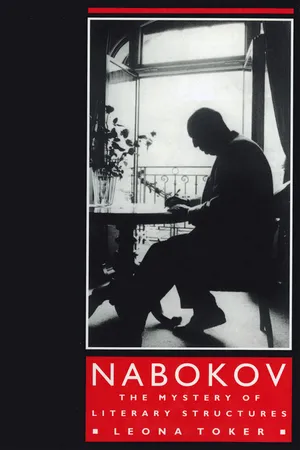
Vladimir Nabokov described the literature course he taught at Cornell as "a kind of detective investigation of the mystery of literary structures." Leona Toker here pursues a similar investigation of the enigmatic structures of Nabokov's own fiction. According to Toker, most previous critics stressed either Nabokov's concern with form or the humanistic side of his works, but rarely if ever the two together. In sensitive and revealing readings of ten novels, Toker demonstrates that the need to reconcile the human element with aesthetic or metaphysical pursuits is a constant theme of Nabokov's and that the tension between technique and content is itself a key to his fiction. Written with verve and precision, Toker's book begins with Pnin and follows the circular pattern that is one of her subject's own favored devices.
- 262 pages
- English
- ePUB (mobile friendly)
- Available on iOS & Android
eBook - ePub
About this book
Information
1
Introduction
Another thing we are not supposed to do is to explain the inexplicable.
Vladimir Nabokov, Transparent Things
I
Vladimir Nabokov belongs among those writers who are continually exposed to distrust during their lives, whose first steps encounter inauspicious predictions, who must struggle against the prejudices of the audience yet have admirers as ardent as the general public is unjust. When such writers die, there often follows a reversal: their works almost instantly become part of the classical canon.
The recognition of V. Sirin (Nabokov’s prewar pseudonym) by the Russian émigré readers of the twenties and thirties was slow and frequently reluctant. In the forties, having moved to the United States and adopted English as the language of his prose (and partly of his poetry), he found himself in relative obscurity once again. With the publication of Lolita in 1955, Nabokov became one of the rich and famous and then had to spend a considerable amount of energy fighting such side effects of glory as irresponsible misrepresentations of both his art and his life. The sexual thematics of Lolita, combined with its best-seller/cover-story popularity, placed him in a sort of literary demimonde, among the beautiful and damned. To this day some readers are surprised to learn about the serenely old-fashioned happiness of his monogamous private life.
The need to vindicate Nabokov, however, no longer exists. The quantity of literature about him published in recent years testifies to the growing recognition of his stature.1 An increasing number of scholars believe that he is our century’s foremost writer of fiction, that his works demand and reward multiple readings, and that his art is an aesthetic puzzle requiring a great deal of solving. His novels, with their countless discoveries on the way toward constantly receding bottom lines, with their moments of mirth and those other moments—of what can only be called “aesthetic bliss” (L, 316)—give one the feeling of basking in an intelligence vastly superior to one’s own. Yet the appeal of these novels is not purely cerebral: they also contain a deeply touching human reality—not a demonstrative human interest but a “personal truth” (ND, 14) protected from wear and tear by layers of exquisite wrapping made up of lexical and acoustic games (“contextual shades of color” and “nuances of noise”: LATH, 118), complex allusions, triplefold reticences and circumlocutions, defamiliarizing reversals, and subtly subversive wit.
Because at least part of this wrapping must be lifted before one can approach the real thing, some of the most valuable Nabokov criticism includes a strong element of extended annotation. The work of Donald Barton Johnson, for instance, reveals astonishing subtleties of the texture and structure of Nabokov’s narrative and then cautiously (“handle with care”) relates them to themes; Dabney Stuart shows the connection between the texture and the generic features of the novels; and Brian Boyd demonstrates the links of narrative details to the central features of both the novel in which they appear and of Nabokov’s work in general.2 Much of the earlier criticism annotated just for the fun of the game; it was often uneasy about this self-indulgence and presented Nabokov as a cold virtuoso aesthetician whose artistic feats would, or would not, allow a grudging forgiveness of what seemed to be his doubtful ethos. Page Stegner’s Escape into Aesthetics3 is destined to be considered a prime example of this trend, even though its bias is largely redeemed by its numerous insights.
Nabokov remained undaunted. “I believe that one day a reappraiser will come,” he remarked in a 1971 interview, “and declare that, far from having been a frivolous firebird, I was a rigid moralist kicking sin, cuffing stupidity, ridiculing the vulgar and cruel—and assigning sovereign power to tenderness, talent, and pride” (SO, 193). That day dawned earlier than Nabokov had expected. It was already heralded by the work of Andrew Field4 and Alfred Appel,5 whose analysis of Nabokov’s themes and intricate texture proceeded from the assumption that the author’s heart was, so to say, always in the right place; however, their personal ties to Nabokov partly discredited their positions in the eyes of the their (somewhat envious) colleagues. Of greater persuasiveness, therefore, were the articles of, for instance, Robert Alter and Stanley Edgar Hyman,6 who revealed the seriousness of Nabokov’s moral and political concerns in Invitation to a Beheading and Bend Sinister; and the books of Donald Morton, Julian Moynahan, and Ellen Pifer,7 who emphasized the humanistic, ideological contents of Nabokov’s fiction. Pifer’s book, in particular, successfully accomplishes its avowed aim of redressing the injustice that Nabokov’s literary reputation suffered as a result of criticism’s earlier preoccupation with the form of his novels at the expense of their content.
The purpose of this book is not only to reinforce the camp of the readers who believe in the humanistic value of Nabokov’s work but also to reconcile the two camps by demonstrating the close connection between its moral attitudes and virtuoso techniques, the mutual adjustment of the major thematic concerns and the structure of his novels.
Nabokov characterized his college lectures on literature as, among other things, “a kind of detective investigation of the mystery of literary structures” (LL, epigraph). The word “mystery” here is polysemous. Each great work has a structure of its own, to be investigated by a minute Sherlock-Holmesian attention to detail until its mystery—that is, its specific relation to specific dreams, desires, and limitations of human life—begins to emerge. Yet the mystery of a literary structure can be approximated rather than solved. It lies in the quaint appropriateness of the structure to an attitude; the “aesthetic bliss” produced by this harmony retains mysteriousness even after the approaches to it have been mapped. An attempt to unravel the enigmas of Nabokov’s structure ultimately confronts one with a Mystery: “a fictional technique,” if Jean-Paul Sartre is to be believed, “always relates back to the novelist’s metaphysics.”8
But what was Nabokov’s metaphysics? “Total rejection of all religions ever dreamt up by man and total composure in the face of total death,” writes a dying fictional writer in Transparent Things. “If I could explain this triple totality in one big book, that book would become no doubt a new bible and its author the founder of a new creed. fortunately for my self-esteem that book will not be written … because [it] would never express in one flash what can only be understood immediately”(TT, 84). The uncertainty of the latter idea is, of course, matched by the uncertainty with which the character’s position can be ascribed to the author. Nabokov’s own voice is more mild and modest: “I know more than I can express in words, and the little I can express would not have been expressed, had I not known more” (SO, 45). Elusive as this statement may be, it leaves no doubt of the tinge of mysticism in Nabokov’s view of the world. His mysticism was a matter of feeling, of relationship with the world, rather than of definable hypostasis: Nabokov “knew” what he could not express the way one “knows” love, or hope, or suffering. Only a few aspects of his world view can be formulated as beliefs.
II
Nabokov seems to have “liked” these beliefs rather than to have really “held” them: in his life he would have had the courage to face their crumbling, yet in his fiction he was free to create a universe controlled by the cosmogony of his choice. His favorite brand of mysticism seems to have been the gnostical belief in a transcendent reality that can occasionally be glimpsed through the chinks in our material existence and which is fully attained at death.9 Among the precious times when one feels contact with what he would call the “Beyond” are not only mystical moments (the peak experience of the protagonists of Invitation to a Beheading and The Gift) but also moments of genuine emotion, of madness, and of a disinterested aesthetic contemplation that silences suffering and desire. The value attached to these moments of “aesthetic bliss” is an overlap between Nabokov’s views and the philosophy of Arthur Schopenhauer, who is respectfully mentioned in chapter 4 of The Gift: under Schopenhauer’s “critical fingernail” the pragmatic Chernyshevski’s “saltatory thinking would not have survived for a second” (G, 258).
I single out Schopenhauer from all the philosophers referred to in The Gift because he is somewhat erroneously considered to have preached that “escape into aesthetics” of which Nabokov was often accused. The egoistic connotation of the slogan is largely a misreading of both Schopenhauer’s and Nabokov’s hostility to the pragmatic view of art. Schopenhauer did not really advocate an artist’s selfish retreat to an ivory tower; in his system, it is for the audience rather than for the artist that the beautiful provides a temporary haven. Aesthetic experience is not sensuous gratification; it does not satisfy desires but silences them and thereby suspends the ominous will that they manifest. The pleasure derived from the beautiful is “the momentary silencing of all willing, which comes about whenever as pure will-less subject of knowing, the correlative of the Idea, we are devoted to aesthetic contemplation.”10 These are the moments when the individual gains freedom from the bondage of will; they are steps toward the selfsuppression through which he or she breaks away from the grim chain of apparent causality and gains knowledge at the expense of the fulfillment of desires (another way to the same goal is the via negativa of ascetic self-discipline). The ultimate goal that Schopenhauer sets for mankind is the achievement of a state in which the cosmic will comes to know itself and is completely abolished—the state that man imagines as complete nothingness, the opposite of Being. Yet according to Schopenhauer, the negation of the world is not what we imagine as void or darkness. It is a vantage point for an opposite vision: “To those in whom the will has turned and denied itself, this very real world of ours with all its suns and galaxies, is—nothing.”11
This coda of The World as Will and Representation can be read as a commentary on the ending of Nabokov’s Invitation to a Beheading, in which the world of the “converted” protagonist is destroyed in the brief course of what looks like a filming-site disaster (all the world is a filming site). However, though unichtozhenie (the Russian for “destruction”) is dramatized in the last paragraph of Invitation, the word itself is avoided; Nabokov would not have failed to hear in it the ominous ghost word nichto, the Russian for Schopenhauer’s “nothing.” The Russian tide of Nabokov’s story “Tyrants Destroyed” is “Istrebleniye tiranov,” or “tyrants exterminated”—nichto is eschewed again (though the choice of istrebleniye may have been determined by the roughly trochaic pattern that it creates in combination with tiranov).
Despite Schopenhauer’s paradoxical optimism about the positive nature of ultimate nothingness, Nabokov was reluctant to imagine his “Beyond” as “nothing.” The execution of a young man in his early poem “Rasstrel” (1928) is followed by “merciless darkness” (neumolimaya t’ma: S, 209), but this poem is kept out (as unsafe?) from the later collection Poems and Problems. The protagonist of his last novel wonders whether “the brook and the boughs and the beauty of the Beyond all [begin] with the initial of Being” (LATH, 16). The Mystery is sometimes imagined in the metaphorical shape of a “formula” that connects the Being and the Beyond. In Nabokov’s story “Ultima Thule,” the mad mathematician Falter, whose name is German for “butterfly,” an emblem of the soul (Psyche, the “myth behind the moth”: A, 437), claims to have discovered that eschatological formula but will not impart it to others because the knowledge would lead to madness or death.12 In Nabokov’s other works the characters’ quest for the “solution of the Universe” is likewise safely sab...
Table of contents
- Preface
- Abbreviations
- 1. Introduction
- 2. Pnin: The Quest That Overrides the Goal
- 3. Mary: “Without Any Passport”
- 4. King, Queen, Knave, or Lust under the Linden
- 5. The Defense: Secret Asymmetries
- 6. Glory: “Good Example of How Metaphysics Can Fool You”
- 7. Laughter in the Dark: Guinea Pigs and Galley Slaves
- 8. Invitation to a Beheading: “Nameless Existence, Intangible Substance”
- 9. The Gift: Models of Infinity
- 10. Bend Sinister: The “Inner” Problem
- 11. “Reader! Bruder!”: Broodings on the Rhetoric of Lolita
- 12. Conclusion
- Bibliography of Works Cited
- Index
Trusted by 375,005 students
Access to over 1.5 million titles for a fair monthly price.
Study more efficiently using our study tools.
Frequently asked questions
Yes, you can cancel anytime from the Subscription tab in your account settings on the Perlego website. Your subscription will stay active until the end of your current billing period. Learn how to cancel your subscription
No, books cannot be downloaded as external files, such as PDFs, for use outside of Perlego. However, you can download books within the Perlego app for offline reading on mobile or tablet. Learn how to download books offline
Perlego offers two plans: Essential and Complete
- Essential is ideal for learners and professionals who enjoy exploring a wide range of subjects. Access the Essential Library with 800,000+ trusted titles and best-sellers across business, personal growth, and the humanities. Includes unlimited reading time and Standard Read Aloud voice.
- Complete: Perfect for advanced learners and researchers needing full, unrestricted access. Unlock 1.5M+ books across hundreds of subjects, including academic and specialized titles. The Complete Plan also includes advanced features like Premium Read Aloud and Research Assistant.
We are an online textbook subscription service, where you can get access to an entire online library for less than the price of a single book per month. With over 1.5 million books across 990+ topics, we’ve got you covered! Learn about our mission
Look out for the read-aloud symbol on your next book to see if you can listen to it. The read-aloud tool reads text aloud for you, highlighting the text as it is being read. You can pause it, speed it up and slow it down. Learn more about Read Aloud
Yes! You can use the Perlego app on both iOS and Android devices to read anytime, anywhere — even offline. Perfect for commutes or when you’re on the go.
Please note we cannot support devices running on iOS 13 and Android 7 or earlier. Learn more about using the app
Please note we cannot support devices running on iOS 13 and Android 7 or earlier. Learn more about using the app
Yes, you can access Nabokov by Leona Toker in PDF and/or ePUB format, as well as other popular books in Literature & Literary Biographies. We have over 1.5 million books available in our catalogue for you to explore.