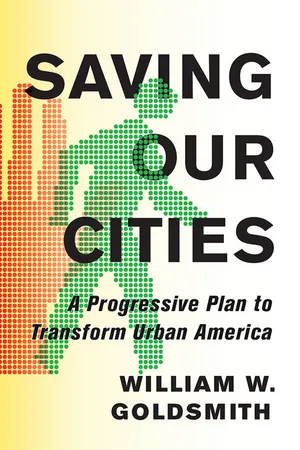
In Saving Our Cities, William W. Goldsmith shows how cities can be places of opportunity rather than places with problems. With strongly revived cities and suburbs, working as places that serve all their residents, metropolitan areas will thrive, thus making the national economy more productive, the environment better protected, the citizenry better educated, and the society more reflective, sensitive, and humane.
Goldsmith argues that America has been in the habit of abusing its cities and their poorest suburbs, which are always the first to be blamed for society's ills and the last to be helped. As federal and state budgets, regulations, and programs line up with the interests of giant corporations and privileged citizens, they impose austerity on cities, shortchange public schools, make it hard to get nutritious food, and inflict the drug war on unlucky neighborhoods.Frustration with inequality is spreading. Parents and teachers call persistently for improvements in public schooling, and education experiments abound. Nutrition indicators have begun to improve, as rising health costs and epidemic obesity have led to widespread attention to food. The futility of the drug war and the high costs of unwarranted, unprecedented prison growth have become clear. Goldsmith documents a positive development: progressive politicians in many cities and some states are proposing far-reaching improvements, supported by advocacy groups that form powerful voting blocs, ensuring that Congress takes notice. When more cities forcefully demand enlightened federal and state action on these four interrelated problems—inequality, schools, food, and the drug war—positive movement will occur in traditional urban planning as well, so as to meet the needs of most residents for improved housing, better transportation, and enhanced public spaces.
- 296 pages
- English
- ePUB (mobile friendly)
- Available on iOS & Android
eBook - ePub
About this book
Information
Topic
Scienze sociali1
Cities as Political Targets
Late in 2013 a monitor appointed by Michigan’s conservative governor pushed the City of Detroit into the largest municipal bankruptcy in U.S. history. Detroit, once the nation’s fourth-largest city, still lies at the center of the nation’s eighth-largest metropolitan area, with nearly 5.5 million inhabitants. Many less prominent cities are unable to meet their payment obligations, although few attempt formal bankruptcy—either because of the stigma attached, or because half the states restrict or prohibit bankruptcy. From 2008 through 2013, thirteen municipalities did file for bankruptcy, as did about three times that number of local authorities, such as water districts. States sometimes impose monitors, as in Detroit, forcing elected city officials to surrender their authority.1
Austerity causes significant urban damage, directly and indirectly, as evidence I present in this and the following chapter shows. Austerians—especially those who make key decisions in banks, corporations, the federal administration, Congress, and the courts—sometimes have cities in mind as they make policy, but usually not. If they do make the connection, they may aim to punish cities. They surely do not regard fiscal and economic policy as part of “urban policy.” Yet austerity policies do constitute “upstream” flows that can flood cities and swamp their options. Austerity thus needs to be incorporated into discussions and actions on “urban policy.”
Thirty-eight years before the Detroit debacle, the focus was on New York. When, in October 1975, President Gerald Ford refused federal assistance, the city hovered on the brink of bankruptcy. The president did not actually say “drop dead,” despite the headline in the New York Daily News, and that December the federal government did lend money.2 Nevertheless, the headline framed what would become a powerful trend, as the government began to cut support for cities. Starting in the late 1970s, support began to fall, and it has fallen persistently since. Following the Great Recession of 2008, city finances dipped to truly ruinous levels. Four decades of decline takes a toll—by the summer of 2012, cities, counties, and authorities were bankrupt or nearly so in at least nine states—Alabama, Illinois, Michigan, New Jersey, New Hampshire, New York, Pennsylvania, Rhode Island, and especially California.3
Cities and Austerity
Two words—city and urban—that elsewhere carry positive meaning often express negative ideas in the United States. Elsewhere, city centers are celebrated as productive powerhouses and also for their pleasurable urbanity. City leadership serves as a stepping-stone to the office of president or prime minister, but not in the United States. The planner for the Bologna region in Italy, Alessandro Delpiano, told graduate students in the United States that they seemed not to grasp the context for one of his lectures. “I am European,” he said, “and for Europeans urban is part of our DNA.” Not so for Americans. The ugly term urbanicity, invented by American sociologists, carries a negative meaning. Urban used in a pejorative sense originally meant poor, despised, and immigrant. Now it means poor, despised, and African American or Latino. American city sentiments have long been dampened by rural skepticism, a Jeffersonian suspicion. The anthology by Morton and Lucia White, first published in 1962, is titled The Intellectual versus the City.4
A signal moment in twentieth-century urban austerity came with President Ford’s refusal to New York. What can it mean when the headline says to drop dead? After all, metropolises with more than a quarter-million inhabitants account for well over 80 percent of the national population. The president did not intend to demean all these people. What we understood was, central cities drop dead. In the 1970s, city residents, disproportionately people of color, were regarded with special scorn, a negative counterweight to the celebrated white residents of suburbs, who had become the nation’s prime electoral force, of particular importance for President Ford’s Republican Party. Presumably the party did not feel threatened by the prospect of dead cities. Places with a high index of “urbanicity” were to be ignored.
Moving ahead forty years, to the second decade of the twenty-first century, one finds some central cities to have revived, and many “urban” problems to have spread to the suburbs. More than half of the poor people in the average American metropolis today live not in the city, but in surrounding suburbs. Some city centers have become so high-class and expensive as to be unlivable for middle-class households. Revivals in San Francisco, Seattle, Portland, and Boston, and in the boroughs of Manhattan and Brooklyn, for example, appear to have turned things completely around. Edward Glaeser sees New York City “rising as a financial phoenix,” leading to a resurgence for its entire metropolis.5 Is the United States transforming its city geography to become more like Europe, where highly valued central zones serve well-off people but push poorer people, including immigrants of color, to the periphery? Does the American city therefore escape the negative sense of “urban”?
The data say not. Despite a few powerful center-city revivals, most U.S. cities and many of their residents remain in deep trouble. Even the most revived cities live with profound difficulties. Philadelphia provides a good example. The fifth-largest city in the country, with a population just over 1.5 million, Philadelphia from 2000 to 2010 grew over the decade for the first time since 1950, with new investment and rising tax revenues. As the Center City Development Corporation reports: “The revival of Center City in the last 16 years demonstrates what is possible when business and civic leaders share a vision of a competitive and animated downtown while government provides the support and incentives that make success possible. We have moved from dirty and dangerous to clean and safe, from 40% office vacancy…to a thriving mixed-use Avenue…from 4.5 million square feet of vacant, obsolete…space to 11,000 new housing units…from no outdoor cafes to 187.”6 Downtown is one thing, but all Philadelphia, quite another. Center City’s CEO boasts that Philadelphia’s job loss after 2008 was less severe than job loss in its region or in the nation, and “it went into recession later[,] fell less far and has rebounded faster.”7 He finds Philadelphia as a whole doing better than places like Phoenix and South Florida, or Detroit and Cleveland. Yet the economic downturn makes it doubly difficult to hide the fact that Philadelphia overall is not doing well. In November 2008, just a year and a half after publication of the celebratory Center City report, Mayor Michael Nutter acknowledged a $1 billion budgetary shortfall. The giant fiscal shortfall was new, but not the sharp contrasts between the exciting developments at the center and the despair in many neighborhoods. As one study reported in 2009: “At 25 percent [Philadelphia’s] poverty rate is the highest among the ten largest U.S. cities, and its level of unemployment exceeds the national average. The city’s education system is a shambles: 80 percent of its public elementary schools and 50 percent of its middle and high schools do not have a functioning library. The high-school dropout rate is the second highest among large U.S. cities.”8
Philadelphia’s situation may be among the worst, but its conditions are mirrored in many metropolitan centers, some of them worse off. Still, aside from the rare formal bankruptcy filing, cities’ fiscal problems hardly register in the national consciousness. President Ford’s purpose, four decades ago, was to reduce the net cost of public funding, above all to lessen the cost of support for the racialized urban poor. With surprisingly few exceptions, major neighborhoods in cities with more than one hundred thousand inhabitants, albeit now together with their poorest suburbs, still constitute a racialized, impoverished urban population. Across the nation, in the case of cities from Fresno to Denver, Tulsa to Minneapolis, Birmingham to Syracuse, most surrounding suburbs are getting by, but the central cities are not. Their worst problems show up dramatically, as I will show in later chapters, in sky-high rates of school failures, extensive nutritional deficiencies, and the violence of the drug war.
Austerity, defined as “enforced or extreme economy,” was the 2010 Word of the Year for the Merriam-Webster dictionary. Recent attention suggests that austerity is new—in 2012, for example, the political commentator Thomas Edsall published The Age of Austerity, and in 2013 the Keynesian, Nobel Prize–winning economist Paul Krugman referred to advocates as austerians. But the austerity push has long been building, with cities serving as key targets, and the word austerity was used in relation to cities as early as 1980.9 Without using the word, James O’Connor wrote about austerity in the 1970s, noting that “although the state has socialized more and more capital costs, the social surplus (including profits) continues to be appropriated privately.” When the public pays the costs but private firms get the profits, he made clear, this “creates a fiscal crisis, or ‘structural gap,’ between state expenditures and state revenues.”10
Then, as now, points out political scientist Geoff Kennedy, austerity was imposed not to resolve the fiscal crisis, nor to aid financial institutions to recover their losses, nor to earmark funds for building social capital or offering services. To resolve the fiscal crisis, after all, we need new banking controls and small taxes on speculative transactions, as proposed long ago by Nobel Prize–winning economist James Tobin. Banks recovered their losses with the bailouts. But strong conservative opposition nixed increased funding for social capital. “Austerity is about opening up new areas of investment to enable finance capital to continue its expansion.”11 In Krugman’s words, austerity is “about using deficit panic as an excuse to dismantle social programs.”12 As in the 1970s, the price is paid in unemployment, stagnant wages, cut services, and declining neighborhoods. This “incipient fiscal crisis” affects local governments nationwide, but it distinctively affects cities. As urban geographer Jamie Peck has written, we suffer an urban crisis because “cities have been hit especially hard by the housing slump and…mortgage foreclosures.” He notes that “cities are disproportionately reliant on public services,” and “they are ‘home’ to many of the preferred political targets of austerity programs—the ‘undeserving’ poor, minorities and marginalized populations, public-sector unions and ‘bureaucratized’ infrastructures.”13
Seventy Years of Debates over Cities
Much twentieth-century U.S. city planning was antiurban in the sense that it mainly served establishment rather than majority needs, privileged rather than typical neighborhoods, and suburbs rather than city centers. But for a time, some programs for cities were relatively progressive. Conflict and contradiction clutter the history.
Urban Liberalism
From the 1930s until the mid-1960s, and in some ways through the city-troubled 1970s, city planning, often backed by federal programs, provided support to central cities and many needy residents, even as suburbs won more. In boom years after World War II, economic growth provided the wherewithal for job expansion and federal aid to cities, enabling even residents close to the bottom of the urban ladder to climb up at least a rung or two. Many achievements of that era still stood in 2008 not only as higher family incomes for a very broad middle class or as extensive metropolitan highway and transit systems, but also as better housing, improved health, better nutrition, and augmented, enriched services. Over many of those years, improvements benefited city budgets, urban images, and many residents. City creativity worked along with national policy to diminish rather than increase inequalities and, haltingly, to reduce racial gaps.14 Federal urban outlays increased phenomenally, from $3.3 billion in 1967 to $27.4 billion in 1979 (adjusted for inflation), from 2.1 percent of total federal outlays to 10.6 percent.15 A redistributive example from the tail end of this period comes from Boston, when Ray Flynn was mayor, from 1984 to 1993. Faced with great demand for large projects, the city held off the issuance of permits, then announced in a public meeting with nearly a dozen large developers that they would be required to furnish “linkages.” After a great deal of political objection, the developers (and the banks) yielded to the populist demands, creating substantial funds for the construction of affordable housing and other broadly beneficial investments.16 From the New Deal until Jimmy Carter’s presidential term, and on occasion, as in Boston, even later, federal policies often worked well in support of city agendas, reducing poverty and providing help for those who remained poor. Politics and policies worked along with econo...
Table of contents
- Acknowledgments
- Looking Upstream
- 1. Cities as Political Targets
- 2. Cities as Budget-Cutting Targets
- 3. Troubled City Schools
- 4. Options for City Schools
- 5. The Paradox of Plenty
- 6. Drugs, Prisons, and Neighborhoods
- 7. Drug-War Politics
- Democracy, Inequality, Urban Policy
- Notes
- References
- Index
Trusted by 375,005 students
Access to over 1.5 million titles for a fair monthly price.
Study more efficiently using our study tools.
Frequently asked questions
Yes, you can cancel anytime from the Subscription tab in your account settings on the Perlego website. Your subscription will stay active until the end of your current billing period. Learn how to cancel your subscription
No, books cannot be downloaded as external files, such as PDFs, for use outside of Perlego. However, you can download books within the Perlego app for offline reading on mobile or tablet. Learn how to download books offline
Perlego offers two plans: Essential and Complete
- Essential is ideal for learners and professionals who enjoy exploring a wide range of subjects. Access the Essential Library with 800,000+ trusted titles and best-sellers across business, personal growth, and the humanities. Includes unlimited reading time and Standard Read Aloud voice.
- Complete: Perfect for advanced learners and researchers needing full, unrestricted access. Unlock 1.5M+ books across hundreds of subjects, including academic and specialized titles. The Complete Plan also includes advanced features like Premium Read Aloud and Research Assistant.
We are an online textbook subscription service, where you can get access to an entire online library for less than the price of a single book per month. With over 1.5 million books across 990+ topics, we’ve got you covered! Learn about our mission
Look out for the read-aloud symbol on your next book to see if you can listen to it. The read-aloud tool reads text aloud for you, highlighting the text as it is being read. You can pause it, speed it up and slow it down. Learn more about Read Aloud
Yes! You can use the Perlego app on both iOS and Android devices to read anytime, anywhere — even offline. Perfect for commutes or when you’re on the go.
Please note we cannot support devices running on iOS 13 and Android 7 or earlier. Learn more about using the app
Please note we cannot support devices running on iOS 13 and Android 7 or earlier. Learn more about using the app
Yes, you can access Saving Our Cities by William W. Goldsmith in PDF and/or ePUB format, as well as other popular books in Scienze sociali & Pianificazione urbana e paesaggistica. We have over 1.5 million books available in our catalogue for you to explore.