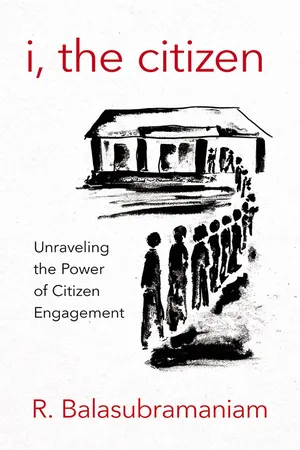
I, the Citizen is an attempt to understand citizen development and engagement. R. Balasubramaniam takes the reader through interpretations of development initiatives at the grassroots and what good governance means to ordinary people. He unravels the power of citizen engagement through his experiences of leading civil society campaigns against corruption and towards strengthening democratic participation of people. I, the Citizen also deals with the philosophical underpinnings of public policies, drawing from his on-the-ground experience as well as engagement with those in the higher echelons of policymaking and implementation. The last section of the book provides glimpses into milestones of a development movement, which Balu founded and led, milestones that are responsible for a continued faith in citizen engagement despite the hindering forces.
- 284 pages
- English
- ePUB (mobile friendly)
- Available on iOS & Android
eBook - ePub
About this book
Information
“THE ONLY TYRANT I ACCEPT IN THIS
WORLD IS THE ‘STILL SMALL VOICE’
WITHIN ME. AND EVEN THOUGH I
HAVE TO FACE THE PROSPECT OF
BEING A MINORITY OF ONE, I HUMBLY
BELIEVE I HAVE THE COURAGE TO BE
IN SUCH A HOPELESS MINORITY.”
WORLD IS THE ‘STILL SMALL VOICE’
WITHIN ME. AND EVEN THOUGH I
HAVE TO FACE THE PROSPECT OF
BEING A MINORITY OF ONE, I HUMBLY
BELIEVE I HAVE THE COURAGE TO BE
IN SUCH A HOPELESS MINORITY.”
MAHATMA GANDHI
Voices from the grassroots level
In the discourse on development, it is the powerful and the elite who often hold sway. This is a matter of concern. Even more worrying is their simplistic view of issues faced by rural, tribal or socio-economically weaker communities, and their instant assessment of the problem as well as its solution. I am no stranger to this phenomenon myself as I had held similar thoughts in my initial years of living and working among the tribal communities. Experience taught me, sometimes the hard way, that understanding grassroots perspectives takes more than a few conversations with people. It involves listening deeply and with humility as well as an ability to learn and appreciate the other’s views; patience to reflect, and perseverance to interpret things carefully.
I have been fortunate through my life and career to have the opportunity to listen to people in varied settings, understand issues from their perspective and reflect upon what ‘development’ means to them. I have the conviction to say that without listening to the voices emanating from the grassroots, no meaningful development can ever happen. In this section, I have tried to capture those voices, the wisdom contained in them, lessons for us, and more importantly questions whose simplicity belies the complexity of finding answers to them. The task for policy makers and policy advocates is to incorporate these voices in the development initiatives they conceive and implement.
An identity for Akkamma
Akkamma sounded agitated on the phone. She wanted to know why she had to go through the process of being identified and declared as ‘Akkamma’ at a place remote from her village and by someone who didn’t know her at all. She had evidently never faced a situation where she had to prove who she was. It took a while for Poshini, who had received her call, to calm her down and understand the problem.
Akkamma belongs to the Jenukuruba7 community from Bavikere tribal colony and has been an active member of the women’s self-help group, the initiation of which was facilitated by SVYM. She, and the fellow members of her group had been made aware of the government’s programs towards ensuring food security, especially the Public Distribution System (PDS) and its provisions. She knew that she belonged to a category of beneficiaries under the PDS, who were eligible to get an Antyodaya card8, which entitled her family to receive twenty nine kilograms of highly subsidized food grains each month from the local Fair Price Shop.
However, knowing what she was eligible for wasn’t enough to claim her entitlements. It wasn’t even enough if the persons operating the local Fair Price Shop knew her and what she was eligible for, without the necessary documentation. Akkamma spent more than sixty rupees to go to Heggadadevanakote, the Taluk headquarters, where the documents were to be processed. On meeting the concerned officials, she was told that she had to produce an affidavit establishing her identity as Akkamma from Bavikere village. The request felt quite strange to her. She neither understood what this meant nor how someone in this town more than thirty kilometers from her village could confirm her identity. She was further told that a notary could certify and give an affidavit to this effect.
Akkamma was thoroughly confused. In her own simplistic way, she had called up Poshini wanting to know why someone from her village or nearby was not entitled to do this and how could someone not known to her at all prove and establish her identity. Akkamma’s question was indeed profound. All that she wanted to know was how the government could trust an ‘affidavit’ purchased for a hundred rupees or so and not take her word that she was indeed the person she claimed to be. She wanted to know how her identity was not based on who she was but on the word of someone who was paid to tell who she was.
Akkamma’s query would surely find resonance in thousands of poor, illiterate, but profoundly intelligent indigenous women like her. It is an innocent query that hides many deeper questions beneath it. Can one’s identity be established at a price? Is there a price for citizenship? What does ‘entitlement’ truly mean? And where does the sense of identity flow from? Our own sense of ‘self’ or from what the government through its agents and processes determine us to be?
These questions mean a lot to the majority of India’s population, which lives below some line or the other: of poverty, social hierarchy, educational levels, health and nutritional status, and consequently deprived of the ‘fruits of development’. Though numerous programs and schemes are floated by the government with the noble intention of uplifting the population socially and economically, they fall short of their desired goal by not reaching the intended beneficiaries. Looking at the kind of budgets allocated for flagship programs such as the health mission, universal education, public distribution of subsidized food grains or the rural employment guarantee scheme, it is natural to desire accuracy in identifying beneficiaries. In a country whose population exceeds a billion, the process is indeed challenging, but when a truly inclusive approach is adopted, I wonder if identifying the deserving poor is really as complex as it is made out to be.
The government, on the other hand, seems to have a ready-made answer to the problem of identification in the form of Aadhaar, an initiative to provide citizens with a unique 12-digit identification number combined with the capture of biometric information of the individual. The notion that schemes will be better implemented because of Aadhaar is at best illusory since it is based on an incorrect premise that pilferage, exclusion and misappropriation of resources under various government schemes is attributed to poor identification. It is collusion and fraud at the middle and higher levels of the system that largely incapacitate the delivery mechanisms of programs and not the people living in underserved areas.
Yet, people like Akkamma have to go through convoluted procedures of identification evolved by the state before it provides services to its citizenry. The state fails to understand that her identity is centered on her transactions with her community and interdependence on people who matter in her life and livelihood, which includes the local service providers. It is also based on trust and an intimate knowledge of her social and economic status among the people around her. No centrally controlled mechanism can establish a more accurate identity for Akkamma than what can be done locally. The onus of guaranteeing inclusion also lies as much on the local community and governance structure as the government. The real question is whether the government trusts Akkamma and millions like her, and their identities. Isn’t the ‘trust’ that the government ought to have in people like Akkamma also an ‘entitlement’? Is there an answer in collective citizen action that can find answers to Akkamma’s questions? Can we help find an identity for Akkamma, the citizen?
7 Jenukurubas are one of the Particularly Vulnerable Tribal Groups (PVTG) who reside in the southern districts of Karnataka whose traditional occupation is honey-gathering from the forests.
8 Cards issued by the Department of Food, Civil Supplies and Consumer Affairs to extremely poor families that entitles them to receive maximum benefits from the Public Distribution System.
Leadership lessons from Kempaiah
Leadership is indeed a much used and abused term. In a workshop on leadership that I was conducting, I recollect asking participants how many of them wanted to be a leader and how many wanted to be managers. Every one of them, without an exception wanted to be a leader. Each one of us have our own interpretation of leadership and there are thousands of books on leadership written and published around the world every year.
I have always believed that leadership is innate to every individual and one only needs to manifest it appropriately. One has to call upon one’s inner resources and respond to each situation adaptively to function as a leader. In my view, leadership is not a decoration or even a position, but an ability to summon and mobilize resources both within and around us to achieve a common constructive goal together amidst enormous uncertainty. Having lived amongst the indigenous tribal communities for more than two decades, I have witnessed the manifestation of some of the finest leadership qualities among tribal chieftains. Called Yajamana within their communities, they command respect and loyalty from their folk, but their ability to face tumultuous times and hardships are often hidden.
This is the story of Kempaiah, a Yajamana of the Kadukuruba tribe. He and his people were forcibly relocated in 1972 by the forest department from the Bandipur forests as a result of the introduction of the Forest Conservation Act, which considered human activity in the forests to be detrimental to the conservation process. Having lost their home and hearth, they settled themselves on the fringes of their beloved forests and their hamlet was named as ‘Kempanahadi’ (the hamlet of Kempaiah). When I first met him in 1987, Kempaiah was around sixty five years of age and had his long gray hair tied into a bun. He carried a small bag around his neck containing betel-nuts and one always found him chewing on them incessantly. Kempaiah loved to talk and would come to meet me every other day.
Our discussions many a time turned to the lives of the tribal people in the forest. There were stories of how the communities lived, their dependence on whatever the forest offered them and the fact that they never felt deprived. There were conversations about how life was different before the communities were asked to relocate from what was a home to them for generations. On one such occasion, the conversation centered on the emotional pain that relocation left. It would have been no surprise if there was anguish and disappointment in Kempaiah’s narrative. Instead, he narrated the incident of his community being forcibly moved out of the forest in a very matter-of-fact manner. He neither had any anger nor hatred towards the department that had caused such deep anguish for him and his people. Their lives and lifestyles of thousands of years had changed permanently, yet there was no bitterness in his voice.
I found his attitude strange and inferred that it was born out of helplessness and asked him how he could stay unmoved by all that had happened. Kempaiah’s explanations left me speechless. He told me that though emotions had their own role in leading his people, he had to take care that he did not get carried away by them. He had to ensure that emotions did not cloud his judgment and he had to accept what came his way. As the Yajamana or the leader of his people, he felt that it was his duty to stay grounded, maintain poise and not lose focus. Getting emotional would not only cloud his judgment, but would also possibly prevent him from arriving at the right decisions.
He explained to me that life in the forests had taught him to live in the present and not really worry about the future. The entire tribal culture and lifestyle revolved around living in the present and he lamented that moving out of the forest would have consequences deeper than what one could imagine. He added that his greater concern was that his people would lose their way and move away from living in the present to worrying about their future and romantically dream about how they lived in the past. He considered losing the tribal interpretation of life, which contains a certain sense of equanimity, as a bigger danger than the loss of their forests and land. He had to make sure that his people saw that and had to guard his people against losing what was of greater value.
Looking back now, I can see the extraordinary visionary that Kempaiah was. I can now explain his serene look and infectious humor. I have now begun to understand that it is not the events themselves, but our own reactions and interpretations of these events that shape our leadership abilities. Kempaiah was not one who had become a Yajamana just by an accident of tradition. He was a true leader, who in his own way had understood what self-awareness was and how critical it was in leading people under such difficult circumstances.
Kempaiah is no more and I miss his loud laughter and paan9-spewing conversations. More than anything, the world will miss his brand of enlightened leadership that it needs so badly today. Kempaiah’s lessons were not limited to leadership alone. The value of selfless work, trusting each other and the wisdom to live in the present were lessons that not only Kempaiah, but many other indigenous friends constantly continue to illustrate in the way they live and approach the world. In comparison, there is much ground that modern civilization has to cover in terms of learning to live.
9 Betel leaf rolled or folded over a filling of areca nut and other ingredients including tobacco at times and chewed
Learning from first generation school-goers
The school, located in Hosahalli that today educates more than four hundred forest-based tribal children every year had its beginnings in a makeshift arrangement in a cowshed in a hamlet named Brahmagiri in 1988. The first batch of the ‘school’ had twenty eight children and the experience of running a school and interacting with the children and their communities had more lessons than any textbook could provide. None of us who started the school had any notable semblance of a background or experience in the education sector. We started a center for learning nevertheless, on the back of unbridled enthusiasm and goodwill of the communities.
Back then, we had to make our own arrangements for the mid-day meal amidst the ‘classes’ or academic sessions. Cooking and having lunch at the school was great fun with responsibilities being shared between children and adults alike. A few of us would decide on the menu, which unfailingly was ragi (finger-millet) balls and sambar10 every day. A few more would collect the firewood required to light up our hearth of three stones, while some others would cut the few vegetables that we could lay our hands on. A few children would then mold cooked ragi flour into small balls called mudde. Some others would take on the responsibility of serving their friends and a couple of them had to clean up after the whole thing was done. All this took more time than the academic work, but that was what the fun was all about.
One day, it was the turn of seven-year old Manju to make the ragi balls. That day he had brought along with him, his kid sister Sunanda to school. The first thought that crossed my mind on seeing her was, “Oh my God! Another mouth to feed today!” I expected Manju to roll an extra ball for her and was quite surprised when I saw him make only twenty eight. This aroused my curiosity and I started watching him keenly. All twenty eight plates were laid out and I saw him seat his sister next to him. Surely but slowly, he broke his ragi ball into two and shared it with his sister. I could not contain my curiosity and took Manju aside after the meal and asked him the question that I ...
Table of contents
- Acknowledgments
- Foreword
- Preface
- Understanding development
- Voices from the grassroots level
- Governance, democracy and citizenship
- Information indeed is power – people and their right to information
- Citizen engagement and the fight against corruption
- Citizen engagement towards making democracy work
- Perspectives on policy
- An unending movement
- Epilogue: Citizen Engagement – Exemplars and Realities
- Glossary
Trusted by 375,005 students
Access to over 1.5 million titles for a fair monthly price.
Study more efficiently using our study tools.
Frequently asked questions
Yes, you can cancel anytime from the Subscription tab in your account settings on the Perlego website. Your subscription will stay active until the end of your current billing period. Learn how to cancel your subscription
No, books cannot be downloaded as external files, such as PDFs, for use outside of Perlego. However, you can download books within the Perlego app for offline reading on mobile or tablet. Learn how to download books offline
Perlego offers two plans: Essential and Complete
- Essential is ideal for learners and professionals who enjoy exploring a wide range of subjects. Access the Essential Library with 800,000+ trusted titles and best-sellers across business, personal growth, and the humanities. Includes unlimited reading time and Standard Read Aloud voice.
- Complete: Perfect for advanced learners and researchers needing full, unrestricted access. Unlock 1.5M+ books across hundreds of subjects, including academic and specialized titles. The Complete Plan also includes advanced features like Premium Read Aloud and Research Assistant.
We are an online textbook subscription service, where you can get access to an entire online library for less than the price of a single book per month. With over 1.5 million books across 990+ topics, we’ve got you covered! Learn about our mission
Look out for the read-aloud symbol on your next book to see if you can listen to it. The read-aloud tool reads text aloud for you, highlighting the text as it is being read. You can pause it, speed it up and slow it down. Learn more about Read Aloud
Yes! You can use the Perlego app on both iOS and Android devices to read anytime, anywhere — even offline. Perfect for commutes or when you’re on the go.
Please note we cannot support devices running on iOS 13 and Android 7 or earlier. Learn more about using the app
Please note we cannot support devices running on iOS 13 and Android 7 or earlier. Learn more about using the app
Yes, you can access I, the Citizen by Ramaswami Balasubramaniam in PDF and/or ePUB format, as well as other popular books in Politics & International Relations & Civics & Citizenship. We have over 1.5 million books available in our catalogue for you to explore.