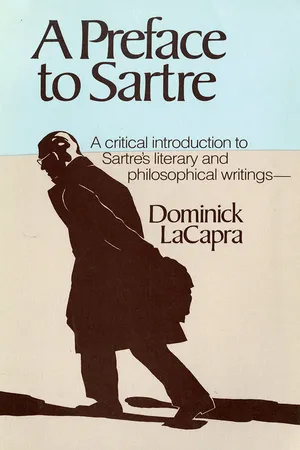
Perhaps the leading Western intellectual of his time, Jean-Paul Sartre has written highly influential works in an awesomely diverse number of subject areas: philosophy, literature, biography, autobiography, and the theory of history. This concise and lucidly written book discusses Sartre's contributions in all of these fields. Making imaginative use of the insights of some of the most important contemporary French thinkers (notably Jacques Derrida), Dominick LaCapra seeks to bring about an active confrontation between Sartre and his critics in terms that transcend the opposition, so often discussed, between existentialism and structuralism. Referring wherever appropriate to important events in Sartre's life, he illuminates such difficult works as Being and Nothingness and the Critique of Dialectical Reason, and places Sartre in relation to the traditions that he has explicitly rejected. Professor LaCapra also offers close and sensitive interpretations of Nausea, of the autobiography, The Words, and of Sartre's biographical studies of Baudelaire, Genet, and Flaubert. "I envision intellectual history," writes LaCapra, "as a critical, informed, and stimulating conversation with the past through the medium of the texts of major thinkers. Who else in our recent past is a more fascinating interlocutor than Sartre?" A Preface to Sartre will be welcomed by philosophers, literary critics, and historians of modern Western culture. It is also an ideal book for the informed reader who seeks an understanding of Sartre's works and the issues they raise.
- English
- ePUB (mobile friendly)
- Available on iOS & Android
eBook - ePub
A Preface to Sartre
About this book
Information
Subtopic
French Literary CriticismIndex
Literature1
Early Theoretical Studies:
Art Is an Unreality
Imagination. Always “lively.” Be on guard against it. When lacking it oneself, attack it in others. To write a novel, all you need is imagination.
Flaubert, Dictionary of Received Ideas
The extreme beauty of a woman kills the desire for her. Indeed we cannot place ourselves simultaneously on the aesthetic level—where there appears this unreal “herself” that we admire—and on the realizing level of physical possession. In order to desire her, one must forget that she is beautiful, because desire is a plunge into the heart of existence—into what existence has of the most contingent and the most absurd.
Sartre, L’Imaginaire
Regarding all aesthetic values I now avail myself of this main distinction: I ask in every instance, “Is it hunger or superabundance that has here become creative?”
Nietzsche, The Gay Science
The work of art in Mallarmé is “just,” but its justice is not that of existence; it is still an accusatory justice which denies life and presupposes failure and impotence. When Nietzsche speaks of the “aesthetic justification of existence,” on the contrary, it is a question of art as “stimulant of life”; art affirms life, life affirms itself in art.
Gilles Deleuze, Nietzsche et la philosophie
Sartre’s early series of theoretical studies are rarely read today: The Transcendence of the Ego (1936–1937), The Imagination (1936), Sketch for a Theory of the Emotions (1939), and L’Imaginaire (1940). In preparation for the examination of Sartre’s more famous and influential works, a brief and highly selective analysis of the early ones, explicitly addressed to the issue of continuity and discontinuity in Sartre’s thought, is pertinent.
The analysis of imagination and emotion as structures or activities of consciousness is especially interesting in these early works. It fills gaps in the dominant line of argument of Being and Nothingness (1943), although more submerged but still forceful tendencies in the later work go beyond its limits. The early theoretical notions—especially in the case of L’Imaginaire—are situated and indirectly contested in Nausea (1938). And they are more directly challenged in Sartre’s views on language, literature, and art in What Is Literature? (1947) and “A Plea for Intellectuals” (1965). But, in certain respects, Sartre returns repeatedly—as, for example, in the existential biographies—to notions or modes of conceptualization developed in the early studies, notably in the very important L’Imaginaire.
Sartre’s early theoretical studies are organized around the phenomenological conception of consciousness. Consciousness is intentional, that is, it is always consciousness of something. The thing is the object of consciousness, but not its content. To see consciousness as itself a thing or as having contents is to fall into the naturalistic “illusion of immanence.” Consciousness is a structure or an activity, which for Sartre is appropriately understood through the metaphor of an empty spontaneity. Indeed, in an important sense, which Sartre never takes as problematic, a series of metaphors structures the proper usage of “consciousness” as a concept. (Consciousness is masculine, pure, limpid, clean, hard, active, mineral-like, erect yet devoid of content; its adventure is a flight from “feminine” passivity, maternal immanence, viscosity, “a stinking brine of the spirit,” “moist gastric” intimacy, self-love, formlessness, mud, and indecision.) Consciousness as an activity that transcends the thing or object is, moreover, closely connected with human freedom. Sartre never makes theoretically explicit the precise nature of the relationship between freedom and consciousness: he often uses the two terms interchangeably. And these two terms are linked to a third: nihilation, or the ontological basis for processes of negation—a linkage explicated at length in Being and Nothingness, yet already crucial in L’Imaginaire.
Two relatively clear aspects of Sartre’s early studies impugn common interpretations of his early thought. First, Sartre’s early thought does, in one of its movements, directly relate freedom or consciousness to action and projects in the “real” world. The “mind” is not seen simply as active less. Second, consciousness is not originally specified in terms of the individual. It is initially treated as impersonal, or at least as nonpersonal. It is individuated but in a sense initially contrasted, not with the social, but with the universal or generic. And it is always “mine” but in a sense specified in The Transcendence of the Ego as nonpossessive and purely designative. One explicit criticism of Husserl in this work is of his view of ego as the center and subject of consciousness, thereby giving consciousness a content. The ego for Sartre is not the subject or center of consciousness: it is the intentional object of consciousness in the world. Indeed, the early works of Sartre explode the notion of identity and individuality in the ordinary sense. As Sartre later put it in Being and Nothingness, the for-itself is what it is not and is not what it is. Sartre, in one important movement of his thought, does conceive consciousness as initially isolated in the world, but this isolation is not at first identified with that of the lonely or uncommitted individual.
One central equivocation in the early Sartre, however, continues throughout his works and allows, if it does not invite, systematic misreadings. There is a dominant tendency in his thought that presents freedom (or consciousness) as initially pure and total within itself and radically transcendent in relation to the world. In this sense, freedom—split off from the world—is initially isolated. A submerged tendency in Sartre’s thought indicates that freedom is always already implicated in the world in a sense that undercuts and may give rise to the opposition between transcendence and immanence.
In his early theoretical works, Sartre’s dominant tendency is especially powerful. In terms of it, freedom is conceived as having two basic “options.” On the one hand, it can choose to direct itself toward perception, reality, action, desire, truth, and morality. On the other hand, it can attempt to escape this series of involvements in the “real” world and, in its negative purity, transcend them toward imagination, emotion, unreality, contemplation, artifice, error, evil, and art. The first series might be termed that of proper reactions to the world or proper uses of freedom and intentional consciousness. The second series is an object of suspicion and anxiety but also, paradoxically, a possible source of salvation (through art). At the most basic level, Sartre explicitly resists any ambiguous overlap or undecidable interplay between the two series of free choices or activities of consciousness even at the margin of borderline cases. But his texts do at times indicate the submerged and unspeakable intercourse or interplay of the two series in a manner that is not “raised to consciousness” as an object of theoretical reflection. In his early theoretical works, moreover, Sartre not only explicitly resists supplementary relationships; he also fails to discuss the possibility of complementary relationships through dialectical mediation and possible synthesis. Instead, he “relates” the two series through the nonrelation of segregation or a taboo on contact and relies on an extreme form of analysis to mark the divide. An analytic logic of identity and difference presents the only relationship between the two series as mutual avoidance or, upon contact and the impairment of purity, mutual annihilation. Sartre himself attempts to play the good shepherd of theoretical concepts that clearly separate the two series and prevent the encroachment of the one upon the other.
Sartre explicitly relates his enterprise in his early thought to Husserl and Descartes and in a sense repeats Husserl’s own recapitulation of the Cartesian heritage—but in a form more uncompromising and outré than the endeavors of his predecessors, for Sartre makes no explicit allowance for exceptions or areas of permeability in his clear and distinct ideas. Subversive and misguided inclinations in Husserl and Descartes are duly observed and excoriated. Sartre will not wink where his predecessors nodded. His short but powerful essay “A Fundamental Idea of the Phenomenology of Husserl” begins with words calculated to produce a shock effect in the reader:
“He ate her with his eyes.” This sentence and many other signs mark the illusion common to realism and idealism, according to which to know is to eat. French philosophy, after a hundred years of academicism, is still at this point. We have all read Brunschvicg, Lalande, and Meyerson; we have all believed that the Spirit-Spider [l’Esprit-Araigneé] attracted things into its web, covered them with white spittle, and slowly swallowed them, reducing them to its own substance. [S. I, p. 29]
The rejection of what Sartre terms an alimentary philosophy, which presents consciousness as digesting contents, prefaces his own association of phenomenology with what might be called, by an extension of the metaphor, an emetic philosophy, which evacuates consciousness and throws it explosively into the world. For alimentary philosophy, consciousness is itself immanent in reality: it is sucked down by an alien “other,” which makes it flesh of its flesh. For Sartre, consciousness is radically transcendent but in a sense that immediately presents it to the world. It has no contents or attachments to serve as barrier between its pure, empty spontaneity and the world. It is altogether disponible. The concluding words of this brief essay are as insistent as its opening lines:
If we love a woman, it is because she is lovable. Thus we are delivered from Proust. Delivered at the same time from “interior life”: in vain do we seek like Amiel, like a child that kisses its own shoulder, the caresses and pamperings of our intimacy, since at last everything is outside, even ourselves: outside, in the world, among others. It is not in I know not what retreat that we discover ourselves: it is on the road, in the city, in the midst of the crowd, thing among things, man among men. [S. I, p. 32]
Sartre takes his distance from Husserl in criticizing the tendencies that betray the phenomenological project of liberation by either filling in consciousness or diverting it from an orientation toward reality. In The Transcendence of the Ego, the transcendental ego as subject was rejected by Sartre precisely because it blocked the empty spontaneity of a wind-swept consciousness. And Sartre accepts the epochè or phenomenological reduction only in so far as it does not simply bracket reality or put it out of play but rather seeks to transform everyday life. In Being and Nothingness, Sartre accuses Husserl of taking a turn toward subjective idealism in seeking an intuition of ideal essences. In The Transcendence of the Ego, Sartre concludes by insisting that for centuries philosophy has not experienced so realistic a current as phenomenology and so intense a concern with plunging man back into the world. A political, historical concern with “real problems” is directly indicated: “It has always seemed to me that a working hypothesis as fruitful as historical materialism never needed for a foundation the absurdity that is metaphysical materialism” (TE, p. 86). (This is, of course, the theme that was later developed in the 1946 essay “Materialism and Revolution.”)
Yet the critique of Husserl is not without attendant difficulties in Sartre’s early thought. Sartre’s rejection of the transcendental ego and his purge of the “I” from consciousness still enable him to assert that consciousness is “quite simply a first condition and an absolute source of existence” (TE, p. 87). And the desire to affirm a primary orientation toward reality fosters Sartre’s extreme analytic tendencies, for he sometimes takes ideal types (or eidetic essences) and projects them onto “reality” as inclusive and exhaustive definitions of things in terms of categorial opposites or antinomies. This tendency marks his early analyses of emotion, imagination, and perception (as well as his later analysis of prose and poetry).
Before turning to these analyses, one may note Sartre’s attested affinity with Descartes. As Sartre expressed himself in an interview of 1944: “In our country [chez nous], only one person has profoundly affected my mind: Descartes. I place myself in his lineage and proclaim my relationship to this old tradition that has been conserved in France.”1 But the criticisms of Husserl in The Transcendence of the Ego were implicit criticisms of Descartes, and Sartre—in expelling the ego from consciousness—was engaged in displacing the final “o” from the cogito. Sartre attempts to explicate his relation to Descartes in an essay of 1945, “La Liberté cartésienne.” Cartesian freedom and Husserlian intentionality are intimately linked in Sartre’s mind, for the freedom of Descartes applies to consciousness in the world.
As Sartre sees it, freedom in Descartes is total but not absolute, for in Descartes, as in the Stoics, a crucial distinction is made between freedom and power. The purity and totality of freedom depend upon its clear distinction from power in the world. “To be free is not at all to be able to do what one wants [pouvoir faire ce qu’on veut] but it is to be able to will what one can do [vouloir ce qu’on peut]” (S. I, p. 294). Action, however restricted its field, is free to the extent that it is informed by the project of intentional consciousness. Freedom is total, but power is limited by the situation. One may note that this conception, which Sartre holds on a possibly dominant level of his thought, depends upon an identity between freedom and intentional consciousness and a dichotomy between freedom and the situation. The conception is placed in question to the extent that these associations are challenged. On this conception, moreover, freedom is related to power through an activist leap made in the interest of man’s mastery of the situation. Sartre finds in Descartes “a magnificent humanist affirmation of creative liberty,” which constrains us to take up “this fearful task, our task par excellence: to make truth exist in the world, to make the world be true . . .” (S. I, p. 296). Sartre, of course, objects to the Cartesian role of divinity as fail-safe. But—in a turn of thought that seems to confuse Heidegger with Feuerbach—he insists that the reliance upon traditional religious ideas does not detract from Descartes’s ringing affirmation of man and freedom:
Little does it matter to us that he was constrained by his epoch, as by his point of departure, to reduce human free will to only a negative power to refuse itself to the point of finally giving in and abandoning himself to divine solicitude; little does it matter to us that he hypostatized in God this original and constituting freedom whose infinite existence he seized by the cogito itself: it remains that a formidable power of divine and human affirmation runs through and supports his universe. Two centuries of crisis will be necessary—crisis of Faith, crisis of Science—for man to recuperate this creative freedom that Descartes placed in God and for one to suspect finally this truth, the essential basis of humanism: man is the being whose appearance makes a world exist. But we do not reproach Descartes for having given to God what is our proper due [ce qui nous reuient en propre]; instead we admire him for having, in an authoritarian epoch, laid the bases of democracy, having followed the requirements of the idea of autonomy to the end, and having understood, well before Heidegger in Vom Wesen des Grundes, that the unique foundation of being is freedom. [S. I, p. 308]
Thus, the task of human freedom is to repossess what was formerly “hypostatized” in divinity. In his early theoretical writings, Sartre explores the adventures of freedom through an analytic framework that is probably more demanding than Cartesianism in its insistence upon clear and distinct ideas. Analysis in the early Sartre functions as an extreme ritual of purification. Where Descartes, for example, allows for a possible confusion between the real and the imaginary, Sartre insists upon their radical discontinuity.2 Perception for Sartre is informed by a logic of identity and difference, and it is geared to reality through a linkage with instrumental action that tests the real. Perception has no points of contact with imagination. Perception, imagination, and emotion are total, or totalitarian, structures of consciousness that can be experienced only alternately, not simultaneously. Their relation is purely diachronic, not synchronic. But all three are structures and activities of consciousness, which cannot be seen on the analogy of the thing or through the naturalistic “illusion of immanence” which would fill them with contents and implicate them in causal series. Sartre presents perception as central and guiding in its logical, adult relation to freedom and action in reality. By contrast, emotion and imagination are “perceived” in structurally analogous ways as escapes from reality and freedom—emotion as an evasion “from below” and imagination as one “from above.” Both emotion and imagination are compared to magic, “prelogical” thinking, or childlike behavior. Both are what orthodox Freudians would call forms of substitute gratification and what Sartre later discusses in terms of the game ...
Table of contents
- Preface
- Abbreviations for Sartre's Works
- Introduction
- 1. Early Theoretical Studies: Art Is an Unreality
- 2. Literature, Language, and Politics: Ellipses of What?
- 3. Nausea: “Une Autre Espèce de Livre”
- 4. From Being and Nothingness to the Critique: Breaking Bones in One's Head
- 5. Autobiography and Biography: Self and Other
- 6. In Lieu of a Conclusion
- Notes
Trusted by 375,005 students
Access to over 1.5 million titles for a fair monthly price.
Study more efficiently using our study tools.
Frequently asked questions
Yes, you can cancel anytime from the Subscription tab in your account settings on the Perlego website. Your subscription will stay active until the end of your current billing period. Learn how to cancel your subscription
No, books cannot be downloaded as external files, such as PDFs, for use outside of Perlego. However, you can download books within the Perlego app for offline reading on mobile or tablet. Learn how to download books offline
Perlego offers two plans: Essential and Complete
- Essential is ideal for learners and professionals who enjoy exploring a wide range of subjects. Access the Essential Library with 800,000+ trusted titles and best-sellers across business, personal growth, and the humanities. Includes unlimited reading time and Standard Read Aloud voice.
- Complete: Perfect for advanced learners and researchers needing full, unrestricted access. Unlock 1.5M+ books across hundreds of subjects, including academic and specialized titles. The Complete Plan also includes advanced features like Premium Read Aloud and Research Assistant.
We are an online textbook subscription service, where you can get access to an entire online library for less than the price of a single book per month. With over 1.5 million books across 990+ topics, we’ve got you covered! Learn about our mission
Look out for the read-aloud symbol on your next book to see if you can listen to it. The read-aloud tool reads text aloud for you, highlighting the text as it is being read. You can pause it, speed it up and slow it down. Learn more about Read Aloud
Yes! You can use the Perlego app on both iOS and Android devices to read anytime, anywhere — even offline. Perfect for commutes or when you’re on the go.
Please note we cannot support devices running on iOS 13 and Android 7 or earlier. Learn more about using the app
Please note we cannot support devices running on iOS 13 and Android 7 or earlier. Learn more about using the app
Yes, you can access A Preface to Sartre by Dominick LaCapra in PDF and/or ePUB format, as well as other popular books in Literature & French Literary Criticism. We have over 1.5 million books available in our catalogue for you to explore.