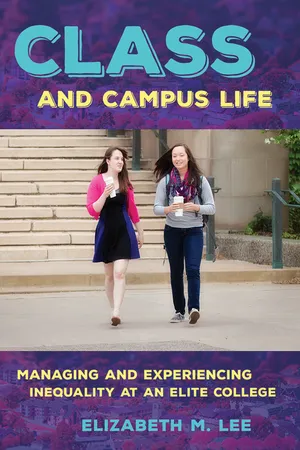
In 2015, the New York Times reported, "The bright children of janitors and nail salon workers, bus drivers and fast-food cooks may not have grown up with the edifying vacations, museum excursions, daily doses of NPR and prep schools that groom Ivy applicants, but they are coveted candidates for elite campuses." What happens to academically talented but economically challenged "first-gen" students when they arrive on campus? Class markers aren't always visible from a distance, but socioeconomic differences permeate campus life—and the inner experiences of students—in real and sometimes unexpected ways. In Class and Campus Life, Elizabeth M. Lee shows how class differences are enacted and negotiated by students, faculty, and administrators at an elite liberal arts college for women located in the Northeast.Using material from two years of fieldwork and more than 140 interviews with students, faculty, administrators, and alumnae at the pseudonymous Linden College, Lee adds depth to our understanding of inequality in higher education. An essential part of her analysis is to illuminate the ways in which the students' and the college's practices interact, rather than evaluating them separately, as seemingly unrelated spheres. She also analyzes underlying moral judgments brought to light through cultural connotations of merit, hard work by individuals, and making it on your own that permeate American higher education. Using students' own descriptions and understandings of their experiences to illustrate the complexity of these issues, Lee shows how the lived experience of socioeconomic difference is often defined in moral, as well as economic, terms, and that tensions, often unspoken, undermine students' senses of belonging.
eBook - ePub
Class and Campus Life
Managing and Experiencing Inequality at an Elite College
- 272 pages
- English
- ePUB (mobile friendly)
- Available on iOS & Android
eBook - ePub
About this book
Information
Topic
EducationSubtopic
Higher Education1
College Dreams, College Plans
When I asked Genesis how old she was when she first started thinking about college, she scrunched up her face as she thought back. She had been thinking about and planning for college through high school, but before that as well: “I think middle school, like eighth grade I started thinking about college. I remember working really hard in high school, and my main motivation working so hard was to get into a good college.” College loomed large for Genesis in high school as a motivating factor and central concern, linked to other goals for adulthood such as career choice.
Genesis’s account of college preparation sounds like that of many young American college students: years of planning, months of worrying over applications, anxiety while waiting for acceptance or rejection, joy at admission to a hoped-for school. However, Genesis, Violet, and other students from socioeconomically marginalized backgrounds who attend selective and highly selective colleges are by definition exceptional. The rates of low-income, first-generation, and working-class students attending four-year colleges immediately after high school are far lower than those of middle and upper socioeconomic status students. It is not an exaggeration to say that their representation at the top 146 most selective colleges and universities is tiny: according to one estimate, only 3 percent of students at these campuses come from the bottom income quartile, and only 10 percent from the bottom half.1 I therefore begin this book by examining how these particular respondents began their lives at Linden by zeroing in on their decision to go to college, how they chose Linden, and their recollections of arriving on campus.
In examining this precollege process, I also highlight some of the ways in which moral questions related to class inequality were already coming into play as respondents and their families thought about college and the meanings of class mobility. In particular, I pay attention to respondents’ motivations for attending college and for selecting Linden. Respondents indicated generally that they were seeking greater economic stability than they grew up with, and this positioned college as a path “out,” as Genesis put it later in our conversation, but also a path away from the lives their parents and home-community friends typically led. I discuss parents both as sources of support and as what I call “conflicted role models.” In this light, college aspirations often become tinged with moral associations, making the route toward enrollment and the thinking about what type of college to select more complicated. I close by discussing respondents’ first impressions of Linden formed during visits or arrival on campus, the first face-to-face interactions between students and the new community they are about to join.
Parents: Sources of Support and Conflicted Role Models
In most cases, as we saw in Genesis’s recollections, respondents had been thinking seriously about college since junior high or earlier. When asked how long they had known they wanted to go to college, some told me that they had always known; one respondent held out her hands about two feet off the ground to show the height of a young child and said, “Since I was this tall.” Evelyn, for example, told me, she had “always” planned to go to college:
Always. And my parents, I have to say, they were so good about saying, “We didn’t go to college, and we want you to go to college and use your brain.” Which is weird. They were so good with positive affirmation about my brain…. Doing whatever I wanted to set my mind to do as far as going to college and becoming something. Especially my mom. Not so much my dad, but especially my mom. She was always, “Go to college. Go to college.” So I just have always thought, “Well, I guess I’m going to go to college.” And I wanted to as well.
The language that Evelyn attributes to her parents is evocative: going to college and “us[ing] your brain” means “becoming something.” Evelyn portrays her parents as supportive of these goals, as we see through their long-term encouragement about using her abilities. Indeed, Evelyn seems to position her mother’s push toward college as foundational and her own desire as almost secondary when she states, “I guess I’m going to college. And I wanted to as well.” Many respondents shared this narrative of parental support and emphasis on higher education as an important goal.
We can also see a second kind of parental influence in Evelyn’s description, positioning college as a way to avoid following their own pathways. Going to college not only means “becoming something” but also highlights an implied contrast to her parents’ achievements. Evelyn’s parents are equally clear about this as they are about their encouragement: they tell Evelyn, “We didn’t go to college, and we want you to…use your brain.” In Evelyn’s and other students’ narratives, this comparison positioned parents or other family as a kind of reverse role models in ways that could be uncomfortable for respondents. Parents play a key role in this chapter and in the broader sociological literature about educational outcomes. Sociologists have long been interested in the ways that parents’ aspirations and expectations influence children’s grades, progression through school, and indeed students’ own goals for educational attainment.2 Sociologists such as Annette Lareau, however, caution that we must also pay attention to the resources that parents have available at their disposal to support those aspirations.3 While Lareau’s interest is especially in cultural capital, other scholars have directed our attention to the role of information or “college knowledge”: parents who themselves attended college not only understand the process of applying for admission more clearly than parents who have not but are also more likely to be immersed in communities that provide additional sources of information for their children, which increases the available sources of information exponentially. We might think of cultural capital and information as crucial for a shift from college dreams to college plans. Although most respondents reported the positive support of their parents, many also described this more complex undertone. I focus on this aspect because it tells us more about the complicated moral issues associated with college and has been less widely documented in the literature on parents’ aspirations for their children’s educations.4
Victoria’s story is emblematic of this duality. When I asked Victoria about how she first began thinking about college, she was definite about how college had become a priority for her.
| Liz: | Did you always know when you were in high school that you wanted to go to college? Was it always clear to you? |
| Victoria: | Yes. I think I started looking at colleges when I was in seventh grade. |
| Liz: | Wow. How come? Was there some place specific that prompted that, and did your folks tell you that you needed to go to college or… |
| Victoria: | No. |
| Liz: | Cousins or anything? |
| Victoria: | No, no one told me. I think it was just—this sounds really bad. I think it was that I didn’t want to end up living—this sounds terrible—because I love my mother and I admire my mother so, so much. And I’m so proud of her and everything that she’s done for my sister and I. I think that I didn’t want to end up repeating the cycle. I think in my day-to-day life I’m very, very conscious all the time, maybe overly so—I’m always very afraid of making a choice that’s gonna repeat the cycle that my mother did…. It kind of, it scares me to think that if I don’t go to school, if I don’t educate myself, if I don’t really learn how to support myself that I’ll end up in some kind of bad relationship. And a situation where I’m stuck and I can’t get out. |
Victoria’s emotional conflict comes through in her description of the role college plays in her thinking—namely, something that will hopefully ensure that she does not “repeat” her mother’s life, not only in terms of work but in even more personal ways, like “end[ing] up in a bad relationship.” Again, this positioning is a difficult one, seeming to show Victoria wanting something more or better than her family, which “sounds terrible” to Victoria as she compares her own life’s path favorably to her mother’s. She worries that she may be implicitly positioning herself as better than her mother, an impression she rushes to correct by mentioning how much she loves and respects her. We begin to see here the ways in which college plans, even when shared and honored by parents, can evoke fraught moral worries.
Violet, whom we met in the introduction, described how her mother had always encouraged her to go to college in similar terms, also highlighting the way that college was a way of avoiding the economic instability in which she had grown up: “My mom said you have to go to college. She didn’t know what that meant or what [that might] look like, but this is what you do if you want to not clean houses. I didn’t know anything about college at all.” Thus, the idea of college was significant for making sure Violet did not end up repeating her mother’s work history, even though neither of them knew exactly how to make the actual process happen.
For many respondents, then, college represented a “way out,” a phrase that Genesis used—a way out of both specific childhood circumstances and a prospective undesired future: “I guess maybe I always knew I always wanted to get out, and I didn’t like my childhood and teenager years so much. I wanted to…get out. Everything I did, doing it to get out, I knew college was like one way out, if I wanted a good job, a better life.”
We see here strong links to what Richard Sennett and Jonathan Cobb referred to as the “hidden injuries” of class.5 In thinking about college, respondents were often confronting difficult questions about what kind of life they and their parents envisioned for themselves and whether that life would be different, “better” than that of their upbringing. College was thus a source of desired mobility into a more stable economic position but also a path away from family and community. As we see in Victoria’s response, this presented emotional conflicts for many respondents.
Immigration History as College Context
Respondents whose families had immigrated to the United States did not share this duality. These respondents did not report the same kinds of internal conflict about surpassing parents’ educational or occupational attainments; rather, their families had come to the United States for this purpose, though this did not prevent later struggles with these same issues. First- and second-generation immigrants are more likely to attend college than those young adults whose families have been in the United States over multiple generations. This link between parents’ immigration histories and students’ college framing could be seen in my interviews with several respondents. Genesis, Alyssa, Georgina, Alexandra, Fiona, and Isabel were all children of parents who had immigrated to the United States. Alyssa told me that college was a priority in her family because her parents’ “whole purpose…for coming to this country is so we could have the opportunity, that opportunity and so, they wouldn’t want us to fall back…they only want to see us to go forward. So that was a big deal for them.” Alyssa’s sister was six years older, and Alyssa said that in her memories of childhood, “all I know is that she [her sister] was [applying to college], that college is a must in my family. It’s either you go to school or you have to split the bills in the house. So it was: you do what you got to do, and so that’s how that works.” Alyssa’s parents were also clear about what they saw as the benefits of a college degree: “It was definitely like, ‘You’re going to college. It’s either you go to college or don’t think you’re going to come sit down [at home]…. You’re going to be…either you’re going to grow up really fast and have to split the cost of the bills or you can go to school and sit behind your own desk and do what you like.’” A college degree would bring the kind of extended transition into adulthood and independence as a worker that Alyssa’s parents wished for their children—“sit[ting] behind your own desk and do[ing] what you like” rather than “grow[ing] up really fast.”
Similarly, Georgina’s parents, who had emigrated from China before she was born, recalled that her parents “didn’t know [about Linden]. They said, ‘You’re going to college.’ Okay, my family, my parents are first-generation immigrants. [In] Asian American families, in general it’s a big [thing].” Like most students whose parents came to the United States, college was “a big thing” in Georgina’s family, inextricable from family reasons for immigrating. Georgina’s noting that her parents weren’t aware of Linden as a college highlights an issue that a number of respondents described, that of needing to convince their parents and families about the importance of going to a college like Linden. For many families, simply going to college would have been sufficient, and staying close to home or going to a school with a lower sticker price might have been preferable. The ability to distinguish between types of colleges is yet another kind of “college knowledge.”6
Exceptions: Unconvincing Role Models
The vast majority of respondents described family members as being strongly and explicitly supportive of their plans to attend college generally, even if not Linden College specifically. For most respondents, this consistent support was an important factor in their college stories. In some cases, however, respondents described their parents’ efforts at convincing them to go to college as unconvincing. Harmony, for example, knew that her parents believed college to be important, but she did not see them as credible role models. She recalled: “My parents would stress education, but my father went to school and he dropped out, and my mom went to school after she had all of her kids, so it wasn’t like [trails off]. And both went in the area…so I didn’t really have an idea of all the schools that were out there.” For Harmony, neither the full range of college possibilities nor higher education as something to be accomplished in her young adult life were represented in her parents’ experiences.
Becca found that her parents also were not fully credible college advocates. She told me, “My parents would always be extremely kind of big proponents of college, but they also had jobs that you don’t need a college degree [for].” Their support for college as a priority shifted over time. During her teenage years, when maintaining a college track in school seemed to represent a safe alternative to risky adolescent behaviors, Becca’s parents stressed college: “They pushed college until I was older because it’s a lot easier to explain to a sixteen to seventeen year old, who, if they didn’t go to college would develop drinking problems or hang out on college campuses, get wasted then go to work—it was a lot easier to say no, you really nee...
Table of contents
- Acknowledgments
- Introduction
- 1. College Dreams, College Plans
- 2. “Scholarship Girls”: Creating Community and Diversity on Campus
- 3. “Are you my friend, or are you classist?”: Confronting and Avoiding Inequality among Peers
- 4. Activism and Representation: Organizing Class
- 5. Silence vs. Empowerment: Class Inequality in Formal Settings
- 6. After College: Class and Mobility
- Conclusion
- Appendix: Methods
- Notes
- Bibliography
- Index
Trusted by 375,005 students
Access to over 1.5 million titles for a fair monthly price.
Study more efficiently using our study tools.
Frequently asked questions
Yes, you can cancel anytime from the Subscription tab in your account settings on the Perlego website. Your subscription will stay active until the end of your current billing period. Learn how to cancel your subscription
No, books cannot be downloaded as external files, such as PDFs, for use outside of Perlego. However, you can download books within the Perlego app for offline reading on mobile or tablet. Learn how to download books offline
Perlego offers two plans: Essential and Complete
- Essential is ideal for learners and professionals who enjoy exploring a wide range of subjects. Access the Essential Library with 800,000+ trusted titles and best-sellers across business, personal growth, and the humanities. Includes unlimited reading time and Standard Read Aloud voice.
- Complete: Perfect for advanced learners and researchers needing full, unrestricted access. Unlock 1.5M+ books across hundreds of subjects, including academic and specialized titles. The Complete Plan also includes advanced features like Premium Read Aloud and Research Assistant.
We are an online textbook subscription service, where you can get access to an entire online library for less than the price of a single book per month. With over 1.5 million books across 990+ topics, we’ve got you covered! Learn about our mission
Look out for the read-aloud symbol on your next book to see if you can listen to it. The read-aloud tool reads text aloud for you, highlighting the text as it is being read. You can pause it, speed it up and slow it down. Learn more about Read Aloud
Yes! You can use the Perlego app on both iOS and Android devices to read anytime, anywhere — even offline. Perfect for commutes or when you’re on the go.
Please note we cannot support devices running on iOS 13 and Android 7 or earlier. Learn more about using the app
Please note we cannot support devices running on iOS 13 and Android 7 or earlier. Learn more about using the app
Yes, you can access Class and Campus Life by Elizabeth M. Lee in PDF and/or ePUB format, as well as other popular books in Education & Higher Education. We have over 1.5 million books available in our catalogue for you to explore.