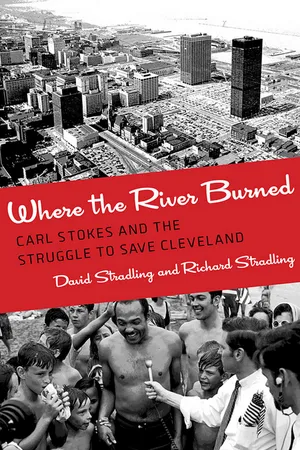
In the 1960s, Cleveland suffered through racial violence, spiking crime rates, and a shrinking tax base, as the city lost jobs and population. Rats infested an expanding and decaying ghetto, Lake Erie appeared to be dying, and dangerous air pollution hung over the city. Such was the urban crisis in the "Mistake on the Lake." When the Cuyahoga River caught fire in the summer of 1969, the city was at its nadir, polluted and impoverished, struggling to set a new course. The burning river became the emblem of all that was wrong with the urban environment in Cleveland and in all of industrial America.Carl Stokes, the first African American mayor of a major U.S. city, had come into office in Cleveland a year earlier with energy and ideas. He surrounded himself with a talented staff, and his administration set new policies to combat pollution, improve housing, provide recreational opportunities, and spark downtown development. In Where the River Burned, David Stradling and Richard Stradling describe Cleveland's nascent transition from polluted industrial city to viable service city during the Stokes administration.The story culminates with the first Earth Day in 1970, when broad citizen engagement marked a new commitment to the creation of a cleaner, more healthful and appealing city. Although concerned primarily with addressing poverty and inequality, Stokes understood that the transition from industrial city to service city required massive investments in the urban landscape. Stokes adopted ecological thinking that emphasized the connectedness of social and environmental problems and the need for regional solutions. He served two terms as mayor, but during his four years in office Cleveland's progress fell well short of his administration's goals. Although he was acutely aware of the persistent racial and political boundaries that held back his city, Stokes was in many ways ahead of his time in his vision for Cleveland and a more livable urban America.
eBook - ePub
Where the River Burned
Carl Stokes and the Struggle to Save Cleveland
- 264 pages
- English
- ePUB (mobile friendly)
- Available on iOS & Android
eBook - ePub
Where the River Burned
Carl Stokes and the Struggle to Save Cleveland
About this book
Information
Subtopic
Political BiographiesIndex
HistoryTable of contents
- Preface
- Introduction
- 1 What Will Become of Cleveland?
- 2 Hough and the Urban Crisis
- 3 Downtown and the Limits of Urban Renewal
- 4 Policy and the Polluted City
- 5 The Burning River
- 6 From Earth Day to EcoCity
- Epilogue
- Notes
- Bibliographic Essay
- Index
Trusted by 375,005 students
Access to over 1.5 million titles for a fair monthly price.
Study more efficiently using our study tools.
Frequently asked questions
Yes, you can cancel anytime from the Subscription tab in your account settings on the Perlego website. Your subscription will stay active until the end of your current billing period. Learn how to cancel your subscription
No, books cannot be downloaded as external files, such as PDFs, for use outside of Perlego. However, you can download books within the Perlego app for offline reading on mobile or tablet. Learn how to download books offline
Perlego offers two plans: Essential and Complete
- Essential is ideal for learners and professionals who enjoy exploring a wide range of subjects. Access the Essential Library with 800,000+ trusted titles and best-sellers across business, personal growth, and the humanities. Includes unlimited reading time and Standard Read Aloud voice.
- Complete: Perfect for advanced learners and researchers needing full, unrestricted access. Unlock 1.5M+ books across hundreds of subjects, including academic and specialized titles. The Complete Plan also includes advanced features like Premium Read Aloud and Research Assistant.
We are an online textbook subscription service, where you can get access to an entire online library for less than the price of a single book per month. With over 1.5 million books across 990+ topics, we’ve got you covered! Learn about our mission
Look out for the read-aloud symbol on your next book to see if you can listen to it. The read-aloud tool reads text aloud for you, highlighting the text as it is being read. You can pause it, speed it up and slow it down. Learn more about Read Aloud
Yes! You can use the Perlego app on both iOS and Android devices to read anytime, anywhere — even offline. Perfect for commutes or when you’re on the go.
Please note we cannot support devices running on iOS 13 and Android 7 or earlier. Learn more about using the app
Please note we cannot support devices running on iOS 13 and Android 7 or earlier. Learn more about using the app
Yes, you can access Where the River Burned by David Stradling,Richard Stradling in PDF and/or ePUB format, as well as other popular books in History & Political Biographies. We have over 1.5 million books available in our catalogue for you to explore.