1
YOUTH IN THE STALIN REVOLUTION
Revolutions overthrow not only political regimes but also generational hierarchies. They demand organizers, supporters, and soldiers, giving young people opportunities beyond traditional age-based social orders. After the October Revolution, the enormous needs of the Soviet state meant that young activists gained an unusual amount of authority as they were funneled into the army and administration of the new regime.1 The Bolshevik Revolution not only invested youth with influence, it inspired them with revolutionary ideals about the construction of a socialist workers’ state. The first decade and a half of Soviet power unleashed young people’s enthusiasm, and their empowerment brought them into conflict with their elders inside and outside the regime.
In the 1920s, the spirit of the 1917 revolutions and the sense that the new regime was not fulfilling its promises made many into radicals during a time of relative moderation. In 1921, with the economy in shambles after seven years of war, Lenin instituted the New Economic Policy, a period of “economic breathing space” that allowed limited autonomy in the peasant economy and in industry following the nationalization of many sectors and use of coercion during War Communism.2 Not all young people became radicals even in the Komsomol, but a fervent base of young organizers grew disillusioned with the relative moderation of NEP. They were mostly male, urban factory workers, the emblematic constituency of the youth league.3 The Bolsheviks had promised a paradise for proletarians after the overthrow of prerevolutionary elites. Instead, young workers found themselves suffering from high levels of unemployment in the cities while cultural and educational institutions were still dominated by non-Bolshevik elites.4 These factors and the relative autonomy local youth organizations enjoyed during NEP fostered an internal “cultural revolution”—a process of radicalization among activists that occurred throughout the 1920s.5 As much as young radicals directed their anger against workers’ supposed class enemies, they also targeted their elders broadly, claiming the mantle of revolution for youth.
When Stalin’s regime abandoned NEP for a radical solution to lackluster industrial growth at the end of the decade, it encouraged young people to protest openly against voices of moderation.6 Although they empowered young radicals, Stalin and his inner circle did not share their iconoclastic outlook. Instead, the country’s leadership enabled young zealots to turn their cultural revolution outward as a cudgel against common enemies in various spheres of the country’s political, cultural, and economic life.7 Although some activists volunteered, the regime pressed millions of other young people into service through the Komsomol, mobilizing them toward the transformation of the country.
A core component of Stalin’s revolution was the collectivization of agriculture and its exploitation to pay for industrialization. Stalin had become convinced that rich peasants (so-called kulaks) were impeding food supplies to the cities. He responded to grain crises by sending outside activists, including large numbers of youth organizers, to the countryside to extract grain by force. When Stalin initiated the collectivization of the entire countryside in late 1929, the violence of the campaign and the license the regime gave its agents led to inescapable abuses of power—“excesses,” in the language of Stalinism. The perpetrators of these excesses were not only young, just as opponents of collectivization were not always old. When young people spoke out, though, their actions often bore the signs of youthful maximalism and generational conflict.
Stalin’s revolution succeeded in remaking the Soviet economy, but its effects were also devastating. By 1932, the large majority of households in grain-growing regions had joined collective farms.8 In spite of agriculture’s increased pliancy to grain extraction, though, there was a severe shortfall in requisitions in 1932–33. When state representatives fulfilled party leaders’ demands to take supposed excess grain from the peasantry, the result was a famine that killed millions. In the midst of famine, Stalinist leaders assumed that many activists had been disloyal to the regime and had shown their true colors as kulak saboteurs. The Komsomol, like the party, undertook a membership purge following collectivization that expelled a large proportion of its membership for supposed opposition to collectivization. The purge punctuated the end of a tumultuous period for Soviet youth. The relative independence of youth culture in the 1920s had given young radicals the space to form as a group and gave license to generational conflict. During the turmoil of the revolution from above, though, pro-Soviet youth culture came entirely under the control of Stalin’s regime.
From Radical Activists to State Radicalism
The tenth anniversary of the October Revolution in 1927 was a time for celebration, reflection, and dissent. Amid parades and films commemorating the Bolshevik victory, discord about the future path of the Soviet Union lurked.9 Soon after the celebrations, the party’s Central Committee expelled a number of Stalin’s opponents, including prominent figures like Lev Trotsky, Lev Kamenev, and Grigorii Zinov′ev. Although Kamenev and Zinov′ev were one-time allies of Stalin, they had joined Trotsky in the so-called United Opposition, hoping to overturn the semicapitalist NEP economy and Stalin’s creeping domination of the country. Beaten by Stalin, the leadership of the opposition went into exile or recanted. Even as the organized opposition dissolved, though, the radical challenge from below continued, often led by youth. High urban unemployment—20 percent in January 1925, and nearly 50 percent among young adults in 1928—contributed to popular dissatisfaction with the NEP system among young people.10 It seemed to many that the new regime was failing to improve conditions for workers.
Although they lived in the supposed dictatorship of the proletariat, many youth felt that Soviet officials were helping everyone but young proletarians. At the end of the civil war, Lenin and other Soviet leaders had concluded that there were not enough party-loyal technical specialists to support the economy. The new state needed the nonparty technical intelligentsia to rebuild the country’s industrial sector. For this reason, until the late 1920s regime leaders defended technical professionals from “specialist baiting” (spetseedstvo), verbal and even physical attacks by radicals.11 Activists also targeted segments of the population that appeared to be prospering from the semicapitalist economy. At a factory Komsomol meeting in Sokolniki district (Moscow) organized to celebrate the tenth anniversary of the October Revolution, one young man said, “The pride of the party C[entral] C[ommittee] is that it has fostered kulaks in the countryside, and in the city it continues to help the Nepmen [private entrepreneurs] get rich.”12 Peasants’ alleged wealth was another source of hostility for young workers, but so were rural migrants to the cities. Worker activists feared that peasant migrants would overwhelm their factories and youth cells.13
Activists also criticized the new regime for its failure to overturn hierarchies in higher education. Like specialists in industry, Soviet leaders gave the academy considerable autonomy, and much as they had before the revolution, universities admitted relatively few workers or peasants as students. In the 103 traditional institutions of higher education in Russia, students classified as proletarians made up only 21.8 percent of enrollment in 1925.14 Responding to the persistence of the traditional academy, communist academics founded a parallel system of party-loyal higher education institutions that the Bolsheviks hoped would train a new generation of pro-Soviet intellectuals.
Despite the presence of this alternative academy, young radicals remained dissatisfied with workers’ access to higher education. One clandestine group of young people from a village in Cheliabinsk territory, uncovered by United State Political Administration (OGPU) agents in November 1927, printed a wall newspaper containing a characteristic critique, “Educational institutions are full of the brats of the bourgeois and former bureaucrats.”15
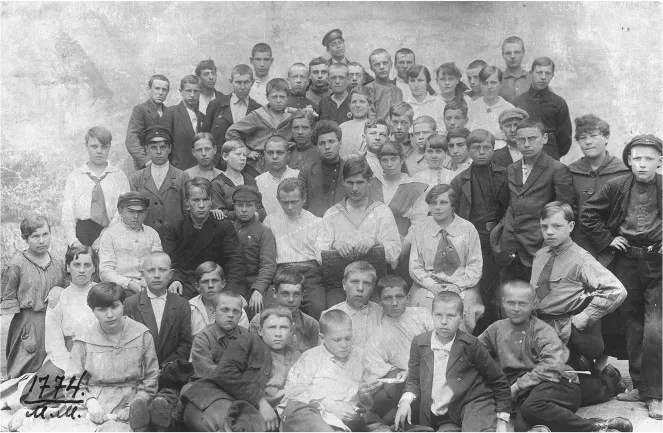
FIGURE 1.1. Young Communists at the Komsomol’s Petrograd Political School in 1920. The future Komsomol leader Aleksandr Kosarev (age sixteen) is in the third row with his hand on the shoulder of a comrade. Rossiiskii Gosudarstvennyi Arkhiv Sotsial′no-Politicheskoi Istorii (RGASPI), f. 1m, op. 18, d. 2472, l. 26.
In addition to class-based criticisms, generational differences sparked dissent among young activists in the 1920s. As the historian Diane Koenker has noted of the printing industry, Soviet protections for young workers like adolescents’ six-hour maximum workday made employers reluctant to hire them. Moreover, the prerevolutionary system of apprenticeship persisted, causing dissatisfaction among apprentices who felt stifled by their masters.16 Shock work—conducting extraordinarily difficult labor or finding ways to increase production (e.g., through minimizing absenteeism)—became a means for youth to subvert the power structure of the factories and gain experience and authority.17 At the Krasnyi Proletariat machine tool factory on the outskirts of Moscow, the head of a Komsomol workshop cell named Anikiev initiated a shock brigade after reading about a similar effort in a Pravda article in 1924. Around the same time and probably related to the brigade, league members began unsanctioned efforts to monitor the factory’s administration. An activist later recalled that young people scrutinized “the condition of the factory, [if] the factory was making a profit, [and] the status of orders.” Anikiev commented that some youth, particularly those from the countryside, opposed the cell’s activities. Voluntary increases in labor norms and inspections of workshops were especially unpopular. Krasnyi Proletariat’s administration, too, resisted youth activists’ interference in the factory’s management. As one organizer said, “The party cell didn’t approve of Komsomol members’ activities.” Understandably, leaders at the factory probably viewed the youth cell’s actions as meddling.18
Revolutionary iconoclasm also manifested itself in young communists’ attacks on religion. In a large-scale campaign in the winter of 1922–23, the Komsomol Central Committee sanctioned an alternative to traditional religious festivals, Komsomol Christmas. Thousands of young people in hundreds of towns m...