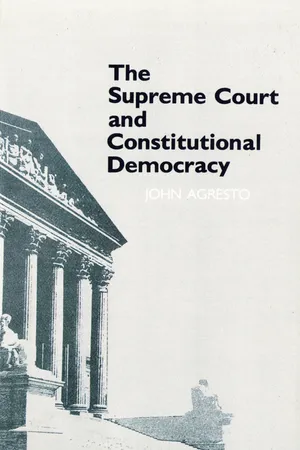
In The Supreme Court and Constitutional Democracy John Agresto traces the development of American judicial power, paying close attention to what he views as the very real threat of judicial supremacy. Agresto examines the role of the judiciary in a democratic society and discusses the proper place of congressional power in constitutional issues. Agresto argues that while the separation of congressional and judicial functions is a fundamental tenet of American government, the present system is not effective in maintaining an appropriate balance of power. He shows that continued judicial expansion, especially into the realm of public policy, might have severe consequences for America's national life and direction, and offers practical recommendations for safeguarding against an increasingly powerful Supreme Court. John Agresto's controversial argument, set in the context of a historical and theoretical inquiry, will be of great interest to scholars and students in political science and law, especially American constitutional law and political theory.
- 184 pages
- English
- ePUB (mobile friendly)
- Available on iOS & Android
eBook - ePub
The Supreme Court and Constitutional Democracy
About this book
Information
Subtopic
Public LawIndex
Law1 The Limits of Judicial Power
In the arguments in favor of a declaration of rights, you omit one which has great weight with me, the legal check which it puts into the hands of the judiciary. This is a body, which if rendered independent, and kept strictly to their own department, merits great confidence for their learning and integrity.
—Thomas Jefferson
We have seen, too, that contrary to all correct example, they are in the habit of going out of the question before them, to throw an anchor ahead, and grapple further hold for future advances of power. They are then in fact, the corps of sappers and miners….
—Thomas Jefferson
A peculiar mystery surrounds the Supreme Court. I mean here not the secrecy of its deliberations or the awesome nature of its trappings—its robes, its grand temple, or any of the vestiges of antique veneration still connected to American magistracy and law. The curious, the mysterious fact about the United States Supreme Court is that its function, its appropriate role—its very justification—is often indistinct or confused in our minds. Not that we fail to understand what the Court does; we know, for instance, that it helps to govern and direct the polity through the interpretation and application of the law, including the law of the Constitution. Our difficulty stems not from confusion over what the Court does but from conflicting notions, or no notions at all, as to why it does it. We should begin, then, by putting the question bluntly: Why is it that the Court has judicial review?
The first and often predominant answer to that question is the legal-historical response: the Founders intended the Court to have this power. American constitutional scholarship has always concerned itself with the debate over the intentions of the Founders and the true origins of judicial power. The concern is surely a valid one, for within the Founders’ intentions are viewpoints that must be seen and arguments that must be understood. And intent, when discovered, binds us in law. But, as we all know, America has thought it fitting, again through law, to modify or abandon the Founders’ intent on any number of serious issues, from the reeligibility of the president and the election of senators to the status of slavery and the requirements for citizenship. As a philosophic argument the intent of the Founders need not be compelling—it can carry weight only insofar as the intent is reasonable and persuasive. If the Founders intended judicial review, we should know why; if not, why not. They would have wanted it no other way.
Thus, although the power of judicial review may be traceable to the framers’ original intent, it will gain its justification only from deliberative argument. At this point in our search for reasons for the Court’s power we are often confronted not by silence but by an impressive chorus of strong voices. Yet the voices often sing not only different but discordant lines.
Judicial Power and Constitutional Government
On one side there is the venerable argument that looks on the Court as the Founders’ protective barrier against unconstitutional acts, our security against political usurpation. The justices, in this account, stand as defensores fidei, as the watchmen in the constitutional edifice. The argument is venerable because it has its roots in the first ages of judicial review. No less a figure than Alexander Hamilton observed that “the courts of justice are to be considered as the bulwarks of a limited constitution,” as an “excellent barrier to…encroachments and oppressions.”1 Like Peter at the gates, the Court, in this account, holds the keys to the Constitution, letting through those laws and acts that pass the test, rejecting those found wanting.
There are, of course, more and less subtle varieties of this understanding. In its coarser forms come visions of varying degrees of “mechanical jurisprudence”—the putting of the questionable law next to the Constitution to see if it “squares.” The best-known judicial statement of this position is Justice Owen Roberts’: “When an act of Congress is appropriately challenged in the courts as not conforming to the constitutional mandate the judicial branch of the government has only one duty,—to lay the article of the Constitution which is invoked beside the statute which is challenged and to decide whether the latter squares with the former.”2a On that level judges become the defenders of the Constitution because they are honest officials of goodwill who can read well. At this extreme it is their judicial dispassion that makes us rest easy in their guardianship.
John Marshall began, more convincingly, from a contrary perspective: it was in fact the very passion of the judicial branch, its passion for the rule of law, that made the Court the proper guardian of the Constitution. “It is emphatically the province and duty of the judicial department to say what the law is.” Moreover—as the partisans of this position affirm—although all officers of the government swear an oath to uphold the Constitution, the oath “certainly applies in an especial manner to [judges’] conduct in their official capacity.”3 Other political officials, since they are not jurists, may often overstep their constitutional bounds simply in the pursuit of what seem to them to be wholesome and desirable public policies. “The members of the legislature,” Hamilton argues, “will rarely be chosen with a view to those qualifications which fit men for the stations of judges.”4 But those whose oath applies in an “especial” manner because they are jurists, professionals of the law rather than of policy, are appropriately thoughtful guardians of our constitutional will. When this perspective is coupled with the fact that justices are carefully selected by the executive and confirmed by the Senate, then given safe tenure and secure salaries, the task of justifying judicial review seems at an end. Our Court (this position affirms) is select, expert, and independent, bound only by our will as we have expressed it constitutionally. On this basis alone Hamilton seems justified in referring to the justices as “faithful guardians of the Constitution.”5
Still, as by now we know, this carefully drawn argument is hardly a persuasive justification. It raises, to give only one obvious objection, a difficult question of fact: Is the Court, or has it been, this proper guardian of our Constitution? Objections on this score could be multiplied with ease, even by a researcher whose only material included what Courts have remarked about the fidelity of their predecessors to the constitutional text. Opinions, of course, will differ. But there precisely is the crux of the issue. The judgments of the Court—the “opinions” of the justices, as the word is properly used even by them—necessarily bear the marks of individual assessment, of individual perspectives, insights, understandings, and even individually formulated goals. This admixture of judicial insight is, to be sure, involved in the very essence of proper constitutional development—the organic law partly gains its life from the vitality of judicial insight. But it is always at first their insight, their judgment. And even if the separation of judgment from will were as clear as Hamilton described it,b we would still need the assurance that cannot always be given—that the judgment of justices is the judgment of the Constitution.c
Finally, if we put aside questions of fact as to the faithful guardianship of the Court over the constitutional text, other questions still emerge: Is the Court the only defender? Is it the last defender? And in what areas, if any, can we rest most confidently in its judgments?
Judicial Review and the Protection of Individual Rights
When we consider whether there are any areas in which the constitutional judgment of the Court is especially trustworthy, the evidence seems at first to be particularly clear. Regarding “adherence to the rights…of individuals,” the Court would necessarily be “inflexible and uniform.” “The general liberty of the people,” Hamilton remarked, “can never be endangered from that quarter.”6 Here begins the most prevalent of the modern defenses of the judicial power; here today’s defenders of judicial review have marshaled their arguments and collected their evidence: the Court is especially necessary to protect from subversion or erosion the constitutional rights of all individuals.7
Although Jefferson would later oppose expansive judicial power, he originally connected judicial review to the preservation of civil liberties. As we noted at the start of this chapter, Jefferson wrote Madison that a declaration of rights would help buttress the judiciary’s legal check on legislative power. If judicial powers were both independent and well defined, the judges’ “learning and integrity” would effectively prevent the erosion of public liberty.8 Madison, never one to forget a valuable argument, repeated and developed much the same sentiment in the congressional debate over the ratification of the Bill of Rights. Against the objection that a declaration of right would be an ineffectual “paper barrier” to illiberal usurpation, Madison replied with the best general view of the libertarian function of an active court: “If they [that is, statements of reserved rights] are incorporated into the Constitution, independent tribunals of justice will consider themselves in a peculiar manner the guardians of those rights; they will be an impenetrable bulwark against every assumption of power in the Legislative or Executive; they will be naturally led to resist every encroachment upon rights expressly stipulated for in the Constitution by the declaration of rights.”9
It is exactly this notion of the Court as the ultimate and effective partisan of constitutional and individual rights that Chief Justice Marshall seized upon in defense of judicial power in Marbury v. Madison. The only examples Marshall gives of judicial review in action are hypothetical instances of legislative attacks on fundamental liberties: illegal taxation, bills of attainder, ex post facto laws, and attempts to weaken a citizen’s security against being declared a traitor.10 So, when Eugene Rostow wrote that “the Court sits as the ultimate guardian of the liberties on which the democratic effectiveness of political action depends,” he not only summarized the ground on which the most prevalent modern defense of judicial review rests but repeated a view seemingly hallowed in its American antiquity.11 A select and independent Court—free from the legislator’s necessary attachment to various economic, religious, and narrow political interests—has every incentive to be a partisan not only of the constitutional text itself but especially of “the general liberty of the people.”12
Although current statements describing the Court as the champion of individual liberties could be easily collected and multiplied, the remarkable fact is that in the formative period of judicial review, such arguments were uncommon, even rare. The major statements have already been alluded to, including parts of Marshall’s formulation in Marbury. Yet it is hardly the case that the Founders were unconcerned about the necessary requirements for establishing a liberal nation. While critics may take issue with their understanding of liberty within their vision of the just society, or dispute their means of achieving it, the fact remains that the writers and supporters of the Constitution discussed the idea of liberty with a thoroughness and a devotion that verged on singlemindedness. Daily the Federal Convention debated, for example, whether liberty was more secure under greater or lesser centralization, with more or less democratic power, through simple or more complex mechanisms, in small countries or in large republics. These concerns were repeated and developed in The Federalist, in the debates in the state ratifying conventions, in the public press, and in the precedent-setting first Congresses. Still, the topic of judicial review arose only sporadically.
Reasons for this situation are hardly obscure. Simply put, the Court was not widely regarded as our foremost guardian of liberty. Such a faith would have seemed to the Founders to be overly simplistic and potentially quite dangerous. It was rather the totality of the interactive constitutional mechanisms that would finally be the surest protection of human liberties in a just society, and not any single organ of that government. As Madison pointed out, the primary protection against political oppression destructive of individual rights and interests would initially be set in the diversity and scope of the nation itself: “In the extended republic of the United States, and among the great variety of interests, parties and sects which it embraces, a coalition of a majority of the whole society could seldom take place on any other principles than those of justice and the general good.”13 To this major social defense against despotic government the Founders added other, more political precautions. There, listed among these varied political checks on precipitous as well as tyrannic power, was included the power of judicial review. These “auxiliary precautions” (as The Federalist labels them) encompassed bicameralism, diverse modes and times of election, separation of powers with a modified check in each branch, and, at base, the direct or indirect connection of all branches to the will of the electorate.14 “It is rema...
Table of contents
- Preface
- 1 The Limits of Judicial Power
- 2 Judicial Review and the Rise of Constitutional Government
- 3 The Growth of Judicial Power
- 4 From Judicial Review to Judicial Supremacy
- 5 “From This Court There Is No Appeal”
- 6 The Promise and Perils of an Active Court
- Notes
Trusted by 375,005 students
Access to over 1.5 million titles for a fair monthly price.
Study more efficiently using our study tools.
Frequently asked questions
Yes, you can cancel anytime from the Subscription tab in your account settings on the Perlego website. Your subscription will stay active until the end of your current billing period. Learn how to cancel your subscription
No, books cannot be downloaded as external files, such as PDFs, for use outside of Perlego. However, you can download books within the Perlego app for offline reading on mobile or tablet. Learn how to download books offline
Perlego offers two plans: Essential and Complete
- Essential is ideal for learners and professionals who enjoy exploring a wide range of subjects. Access the Essential Library with 800,000+ trusted titles and best-sellers across business, personal growth, and the humanities. Includes unlimited reading time and Standard Read Aloud voice.
- Complete: Perfect for advanced learners and researchers needing full, unrestricted access. Unlock 1.5M+ books across hundreds of subjects, including academic and specialized titles. The Complete Plan also includes advanced features like Premium Read Aloud and Research Assistant.
We are an online textbook subscription service, where you can get access to an entire online library for less than the price of a single book per month. With over 1.5 million books across 990+ topics, we’ve got you covered! Learn about our mission
Look out for the read-aloud symbol on your next book to see if you can listen to it. The read-aloud tool reads text aloud for you, highlighting the text as it is being read. You can pause it, speed it up and slow it down. Learn more about Read Aloud
Yes! You can use the Perlego app on both iOS and Android devices to read anytime, anywhere — even offline. Perfect for commutes or when you’re on the go.
Please note we cannot support devices running on iOS 13 and Android 7 or earlier. Learn more about using the app
Please note we cannot support devices running on iOS 13 and Android 7 or earlier. Learn more about using the app
Yes, you can access The Supreme Court and Constitutional Democracy by John Agresto in PDF and/or ePUB format, as well as other popular books in Law & Public Law. We have over 1.5 million books available in our catalogue for you to explore.