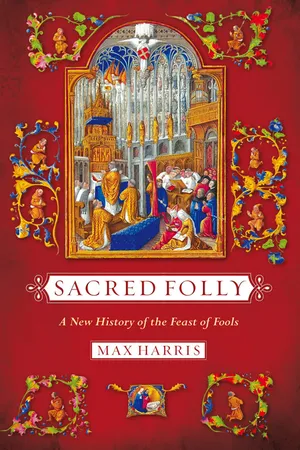
For centuries, the Feast of Fools has been condemned and occasionally celebrated as a disorderly, even transgressive Christian festival, in which reveling clergy elected a burlesque Lord of Misrule, presided over the divine office wearing animal masks or women's clothes, sang obscene songs, swung censers that gave off foul-smelling smoke, played dice at the altar, and otherwise parodied the liturgy of the church. Afterward, they would take to the streets, howling, issuing mock indulgences, hurling manure at bystanders, and staging scurrilous plays. The problem with this popular account—intriguing as it may be— is that it is wrong.In Sacred Folly, Max Harris rewrites the history of the Feast of Fools, showing that it developed in the late twelfth and early thirteenth centuries as an elaborate and orderly liturgy for the day of the Circumcision (1 January)—serving as a dignified alternative to rowdy secular New Year festivities. The intent of the feast was not mockery but thanksgiving for the incarnation of Christ. Prescribed role reversals, in which the lower clergy presided over divine office, recalled Mary's joyous affirmation that God "has put down the mighty from their seat and exalted the humble." The "fools" represented those chosen by God for their lowly status.The feast, never widespread, was largely confined to cathedrals and collegiate churches in northern France. In the fifteenth century, high-ranking clergy who relied on rumor rather than firsthand knowledge attacked and eventually suppressed the feast. Eighteenth- and nineteenth-century historians repeatedly misread records of the feast; their erroneous accounts formed a shaky foundation for subsequent understanding of the medieval ritual. By returning to the primary documents, Harris reconstructs a Feast of Fools that is all the more remarkable for being sanctified rather than sacrilegious.
- 336 pages
- English
- ePUB (mobile friendly)
- Available on iOS & Android
eBook - ePub
About this book
Information

Before the Feast of Fools
The Kalends of January
The fifteenth-century Parisian theologians were right in one regard: the history of the Feast of Fools begins with the Kalends of January.
In ancient Rome, the first day of each month was known as the kalendae (Kalends). After 153 BCE, when the date on which new consuls took office was fixed at 1 January, the Kalends of January ushered in not merely a new month but a new political and calendar year.1 Civic rituals included a solemn procession of the two new consuls to the Senate, where each sacrificed a bull to Jupiter and where, too, under the empire, the senators swore an oath of allegiance to the emperor. Domestic rituals included New Year’s Eve visits to friends and relatives, the exchange of gifts (strenae) of real or symbolic value, the expression of good wishes for the coming year, and offerings to the domestic gods of the hearth.2
The January Kalends, unlike other classical festivals sometimes invoked as precedents for the Feast of Fools,3 not only survived into the Christian era but did so on an increasingly grand scale. Extending from New Year’s Eve until 3 January and expanding outwards to “all the towns of the Roman world,” the festival of the Kalends grew, according to its most careful historian, Michel Meslin, into “a gigantic popular kermess, . . . a fiesta spilling over the whole Christian empire.” It was arguably “the largest popular festival in all the empire.”4
Libanius (314–ca. 393), a distinguished Greek writer and teacher of rhetoric in Antioch and an unabashed member of the pagan Greek upper class, wrote two appreciative essays describing the Kalends of his day. One is a general encomium in praise of the festival;5 the other sets out the main events of the festival in chronological order.6 Celebration of the festival, Libanius wrote in the first essay, is coterminous with Roman rule. It flourishes in the plains and in the hills, on the lakes and on the rivers, even—weather permitting—on board ships at sea. Everywhere there are banquets and outbursts of laughter. So many gifts are exchanged that the roads are full of packages in transit. Family members are moved to reconciliation. Slaves are treated liberally. Even in the jails, he has been told, prisoners crack a smile. In the second essay he notes that the Kalends are the only feast “common to all those who live under the Roman empire.”7 On the last day of the old year, gifts to fill the table for the evening’s banquet are sent from house to house. Few sleep that night. Most people pass the time with “songs, leaping dances [p¯edēmata], and jests.”8 Some bang on the doors of shopkeepers to keep them awake. In the morning, people decorate their doors with laurel branches. Breeders lead their horses to the temple to petition the gods for victory in the chariot races. Attendants scatter money into the crowd. Those who have drunk too much the night before spend the day asleep, but “those . . . who are sharper in their wits” occupy themselves with the business of gift giving.9 On 2 January people stay home. Rules are relaxed. Masters and slaves play dice together. If a slave proves lazy or tipsy, the festival excuses him, and he is not reproached. Even the poor do their best to eat well. On 3 January crowds fill the hippodrome to watch the chariot races, after which they again eat, play dice, and get very little sleep.
By Libanius’s time, the more overtly pagan elements of the official ceremonies—the temple sacrifices and the related civic rituals—were on their way out.10 But other features of the Kalends celebrations still roused the ire of Christian preachers. Augustine of Hippo (354–430), as the fifteenth-century Parisian theologians were so keen to recall, railed against “the din of silly and disgraceful songs” and the “disgraceful junketing and dances” that characterized “this false feast day.” He challenged his congregation not to take part: “Are you going to join in the celebrations of good luck presents [strenae] like a pagan, going to play at dice—and get yourself drunk?” To do so, he told them, would be to associate with demons, for “demons take pleasure . . . in idle songs, they take pleasure in the trifling spectacle, in the manifold indecencies of the theaters, in the mad frenzy of the chariot races.”11 Everything associated with the traditional feast of Kalends was condemned as “pagan” by the preachers: no moral distinction was drawn between the “indecencies of the theaters,” on the one hand, and the exchange of gifts, on the other hand.
Surprisingly, however, no historical evidence of Kalends revelers wearing masks, cross-dressing, disguising themselves as animals, mocking the powerful, making house-to-house visits, or otherwise behaving like stereotypical medieval clerical fools survives from the pagan Roman Empire. Rather, the first signs of such practices appear shortly before 400, some eighty years after Christianity had first gained privileged status under Constantine I and at about the time that it became the official state religion under Theodosius I. Indeed, Meg Twycross and Sarah Carpenter have insisted that the Kalends masquerades of the early Christian empire are the first evidence of seasonal folk play involving masks anywhere in Europe.12 Character masks were used in the formal theater of both Greece and Rome, and wax death masks of ancestors were worn in state funeral processions by costumed actors hired for the purpose; but neither of these traditions appears to have spilled over into pre-Christian seasonal folk play.13 Even the Germanic tribes of northern Europe left no written evidence of masking activity other than for military purposes. What visual and material evidence has survived is sparse and inconclusive; it, too, may well pertain to the arts of war.14 By contrast, the January Kalends of the Christianized Roman Empire provide a proliferation of evidence for the popular use of masks in seasonal festivities.
It is possible, therefore, that generations of Christian preachers, up to and including those in fifteenth-century Paris, were mistaken in their insistence that the New Year masquerading traditions of their day had pagan roots. Seasonal masquerades may have existed in southern Europe before the late fourth century and entered the written record only when Christian preachers took objection to them, but the lack of prior evidence is striking. Even the emperor Theodosius I’s detailed and repressive edicts against paganism, issued in 391 and 392, make no mention of Kalends masquerades.15 A few years earlier, in 389, he had simply ordered “the Kalends of January” to be “set aside . . . as a customary rest day.”16 As far as we can tell from the available records, Kalends masquerades arose in a Christian context.
John Chrysostom (ca. 344/54–407), at one time a student of Libanius in Antioch and later bishop of Constantinople, was among the first to complain of New Year masqueraders. Preaching in Antioch sometime between 386 and 398, he denounced the “demons marching in procession [pompeusantōn] in the marketplace, . . . the all-night devilish celebrations . . . , the tauntings, the invectives, the nightlong dances, this ridiculous comedy,” and the drunkenness of the revelers.17 Chrysostom was a hostile witness, not an unbiased observer. Rudolph Arbesmann suggests that the marching “demons” were festive participants “wearing masks of gods.”18 As far as one can tell from similar accounts elsewhere, the masqueraders were engaged in carnivalesque mocker...
Table of contents
- Acknowledgments
- Prologue
- Part I. Before the Feast of Fools
- Part II. Shaping the Feast of Fools
- Part III. Supporting the Feast of Fools
- Part IV. Suppressing the Feast of Fools
- Part V. Beyond the Feast of Fools
- Epilogue
- Bibliography
Trusted by 375,005 students
Access to over 1.5 million titles for a fair monthly price.
Study more efficiently using our study tools.
Frequently asked questions
Yes, you can cancel anytime from the Subscription tab in your account settings on the Perlego website. Your subscription will stay active until the end of your current billing period. Learn how to cancel your subscription
No, books cannot be downloaded as external files, such as PDFs, for use outside of Perlego. However, you can download books within the Perlego app for offline reading on mobile or tablet. Learn how to download books offline
Perlego offers two plans: Essential and Complete
- Essential is ideal for learners and professionals who enjoy exploring a wide range of subjects. Access the Essential Library with 800,000+ trusted titles and best-sellers across business, personal growth, and the humanities. Includes unlimited reading time and Standard Read Aloud voice.
- Complete: Perfect for advanced learners and researchers needing full, unrestricted access. Unlock 1.5M+ books across hundreds of subjects, including academic and specialized titles. The Complete Plan also includes advanced features like Premium Read Aloud and Research Assistant.
We are an online textbook subscription service, where you can get access to an entire online library for less than the price of a single book per month. With over 1.5 million books across 990+ topics, we’ve got you covered! Learn about our mission
Look out for the read-aloud symbol on your next book to see if you can listen to it. The read-aloud tool reads text aloud for you, highlighting the text as it is being read. You can pause it, speed it up and slow it down. Learn more about Read Aloud
Yes! You can use the Perlego app on both iOS and Android devices to read anytime, anywhere — even offline. Perfect for commutes or when you’re on the go.
Please note we cannot support devices running on iOS 13 and Android 7 or earlier. Learn more about using the app
Please note we cannot support devices running on iOS 13 and Android 7 or earlier. Learn more about using the app
Yes, you can access Sacred Folly by Max R. Harris in PDF and/or ePUB format, as well as other popular books in History & European Medieval History. We have over 1.5 million books available in our catalogue for you to explore.