How did the soldiers in the trenches of the Great War understand and explain battlefield experience, and themselves through that experience? Situated at the intersection of military history and cultural history, The Embattled Self draws on the testimony of French combatants to explore how combatants came to terms with the war. In order to do so, they used a variety of narrative tools at hand—rites of passage, mastery, a character of the soldier as a consenting citizen of the Republic. None of the resulting versions of the story provided a completely consistent narrative, and all raised more questions about the "truth" of experience than they answered. Eventually, a story revolving around tragedy and the soldier as victim came to dominate—even to silence—other types of accounts. In thematic chapters, Leonard V. Smith explains why the novel structured by a specific notion of trauma prevailed by the 1930s. Smith canvasses the vast literature of nonfictional and fictional testimony from French soldiers to understand how and why the "embattled self" changed over time. In the process, he undermines the conventional understanding of the war as tragedy and its soldiers as victims, a view that has dominated both scholarly and popular opinion since the interwar period. The book is important reading not only for traditional historians of warfare but also for scholars in a variety of fields who think critically about trauma and the use of personal testimony in literary and historical studies.
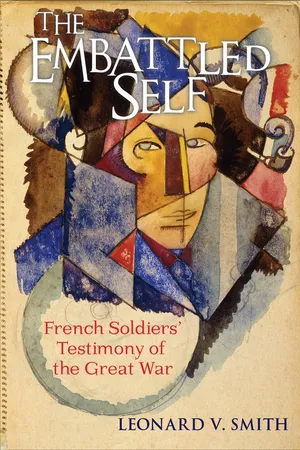
- 232 pages
- English
- ePUB (mobile friendly)
- Available on iOS & Android
eBook - ePub
About this book
Information
Topic
HistoriaSubtopic
Historia francesa1

Rites of Passage and the Initiation to Combat

In his first major statement on the Great War, Sigmund Freud lamented how the experience of less than one year of war had overwhelmed the existing means of understanding experience itself:
Swept as we are into the vortex of this war-time, our information one-sided, ourselves too near to focus on the mighty transformations which have already taken place or are beginning to take place, and without a glimmering of the inchoate future, we are incapable of apprehending the significance of the thronging impressions, and know not what value to attach to the judgments we form.1
Time had gone out of joint, or at least narrative time, which could connect in a linear form past, present, and future. Freud sought to articulate a passage from one world to another. At the heart of his anxiety lay profound uncertainty about that next world and the rules, if any, according to which it would be governed. Perhaps more appropriately than he knew, Freud did not distinguish between civilians and soldiers. But certainly the brutality of the transition from peace to war would be most pronounced among those initiated into fighting it. The chaos of warfare created precisely the situation Freud described—fragmented information, alongside immense physical and emotional peril. I have previously noted that experience “as it happens,” in the sense of a succession of nows is intrinsically incompatible with narrative. The initiation to combat would seem to prove this incompatibility obvious.
Yet because experience abhors a vacuum, the succession of nows requires the imposition of some sort of linear, narrative order. Anthropologists have long maintained that societies invoke rites to structure specific pivotal personal and collective experiences. A rite imposes a kind of performed narrative on a major transition. “We undergo passages,” wrote Ronald L. Grimes, “but we enact rites.”2 René Girard observed that rites often revolve around violence. Rites both make violence comprehensible and regulate it within ceremonial boundaries.3 They mark and act out a predictable transformation if carried out correctly, whether the rite involves violence or not. A boy becomes a man, two people become married, a person is prepared to die, a common person becomes a warrior—all through rites of passage. The initiate may not fully understand the transformation being performed during the rite. But societies around initiates do, which explains the social functions of rites.
Rites of passage are commonly thought of in terms of a three-stage narrative structure, as outlined in 1908 by Arnold van Gennep.4 Preliminal rites separate the initiate from the societies of which they had been a part, and from their previous identities. Liminal rites are both the most important, as well as the most uncertain and unstable. In a sense, they are the transition between the old identity and the new, as the initiate encounters the sacred in some direct and often brutal way. Clearly, liminality provides a way to read Freud’s sense of the present in 1915. But rites of passage, by definition, must have closure. Postliminal rites occur for just this reason, to certify the new identities of the initiates and to reincorporate them into the societies whence they came.
Soldiers in 1914 who survived their initiation to combat looked for a structure through which to understand it. They found a set of narratological tools for doing so through rites of passage. There was nothing especially new in 1914 about this. The term baptême de feu had become as common in French as the English “baptism of fire.” Moreover, rites of passage offered an immediate way to explain experience in 1914 according to the most basic narrative structure of beginning, middle, and end (or situation, crisis, and resolution). This is not where the significance of adopting rites of passage as a guide to narration ends, however, but where it begins.
“Ritual, like art, is a child of imagination,” wrote Grimes, “but the ritual imagination requires an invention, a constantly renewed structure, on the basis of which a bodily and communal enactment is possible.”5 He, like most contemporary anthropologists, is skeptical of considering the three-part division of rites of passage as timeless and transcultural.6 But as Grimes would agree, the importance of such rites goes beyond taxonomy. I will argue that rites of passage provided a toolbox for understanding experience. Soldiers in 1914 used the rites of passage to put together experience in a seemingly endless variety of ways. What interests me is both the prevalence (stated or unstated) of rites of passage and the insufficiency of that structure. However testimonies invoked rites of passage, they failed to produce a stable narrative or narrator. Thought of as an organizing principle of narrative, a fully enacted rite of passage has to produce closure. Stories of the initiation to combat in 1914 did not do so. In his pioneering book on combat experience in the Great War, Eric Leed argued that testimony become forever “stuck” in the middle or liminal stage.7 While I use rites of passage in a different way and come to some different conclusions, it is certainly clear that structuring experience in 1914 according to rites of passage raised more questions than it answered. Indeed, doing so set the stage for issues that would bedevil telling the story of experience in the Great War for decades to come.
Rites of Separation: The Mobilization
In the first phase of the classic rite of passage, initiates are ritually separated from the collectivity. Generally, anthropologists have conceived this separation as some form of symbolic death. The former identity is killed or eradicated, in preparation for the liminal stage creating the new one. For example, Victor Turner described in great detail circumcision rites among the Ndembu people of Africa.8 The novices, typically eight to ten years old, are kept separate from the rest of the tribe for a certain time and allowed to eat only specific, ritually prepared foods. Through an elaborate series of ceremonies, which play out any number of power relationships within the village and within families, the novices are “killed” as children and prepared for rebirth as very young men. They are forever set apart, not just from women, but from other males deemed unworthy of circumcision. The key aspects of rites of separation here are the tearing asunder of the former identities and the establishment of absolute commensurability among the initiates.
It does not take a great leap of imagination to consider European military rituals of conscription and mobilization as rites of separation. It is easy to forget in the highly demilitarized Europe of today how prominently military identity figured in the public sphere before 1914. In republican France, citizenship and military service were much more closely linked than in Britain or the United States. To be a soldier, as Richard Challener put it, was to carry “both the badge and the moral consequence of citizenship.”9 Nothing did more than conscription to make democracy in France a conspicuously male enterprise. Likewise, citizenship in France made rituals of conscription and mobilization ipso facto rites of male passage.
Departure, whether for the barracks or the front, articulated the citizen-soldier’s relationship to the political community and his civic equality with his fellow conscripts. With equality went commensurability, each conscript becoming politically identical to every other. Indeed, at some level the soldier in uniform would surrender his individuality, notably his individual agency, to the collectivity of his comrades. The armies of the Republic became a representation of the sovereign people. Each individual would thus become subsumed into an incarnation of Jean-Jacques Rousseau’s General Will, in which the whole would be much greater than the sum of its parts. Rites of separation thus had profound political significance. As we will see, they provided the ideological infrastructure for wartime consent.
Down to the definitive abolition of conscription in 2001, few drafted into the French army in peace or war ever admitted to enjoying it. But a carnivalesque spirit often infused rituals marking the departure of young conscripts, particularly in the provinces. For decades before and after the Great War, le départ was a major spectacle in hundreds of towns and villages throughout France. Young recruits would parade noisily down the main street, often accompanied by music and cheered on by their civilian compatriots. These pre-soldiers would wave tricolor flags and wear distinctive hats, often decorated with tricolor ribbons. But the initiates still wore civilian clothes and marched in disorganized groups, both celebrating and marking the end of their lives as preadult, “passive” citizens. The initiation to the world of Mars also meant initiation to the world of Venus. The draft-board determination of Bon pour le service (fit for service) became the cliché Bon pour les jeunes filles (fit for young girls). A conscripts’ song popular around 1900 sought to channel the sorrow families felt at the departure of their young men:
It is not for us that you must weep
Fathers and mothers of families
It is not for us that you must weep
It is for the love of your daughters.10
Of course, conscription rituals were also rehearsals for mobilization, the massive gathering of active and reserve citizen-soldiers in the event of war. The young man had to know his cues well, should he be asked to make the transition from soldier to warrior.
Thanks to the work of Jean-Jacques Becker and others, we now understand that Europeans in August 1914 did not embrace war in a unanimous spasm of atavistic fury.11 Beyond media and literary circles, grave apprehension and cold resolution were far more prevalent than nationalist euphoria. It was this apprehension that gave written testimony of the mobilization an inherent incertitude. In the separation rites of August 1914, the French, like the other peoples of Europe, relied heavily on tradition. Some aspects of the general mobilization looked like the departure of conscripts. In larger cities cavalry and dragoons, still the most socially prestigious branches of the service, accompanied large parades in sartorial splendor. Hundreds and sometimes thousands of soldiers marched off to patriotic music, cheered by disproportionately female crowds. Infantrymen wore bright red pants similar to those worn by their fathers and grandfathers in 1870. Often derided by military historians for making French soldiers such fine targets, such attire spoke to the end of an era in which soldiers had to be rendered beautiful in distinct and separate ways in order to make war.
By definition, a rite of passage is supposed to produce a predictable outcome in the transformed initiate. Of course, such certainty was not possible in the mobilization of August 1914. There had been no general European war since the defeat of Napoleon in 1815, and no major war involving France since 1871. Few in France or elsewhere really understood the long-term implications of industrialized warfare. No rite could speak with much certainty as to w...
Table of contents
- Preface
- Introduction: Experience, Narrative, and Narrator in the Great War
- 1 Rites of Passage and the Initiation to Combat
- 2 The Mastery of Survival: Death, Mutilation, and Killing
- 3 The Genre of Consent
- 4 The Novel and the Search for Closure
- Conclusion
- Bibliography
Trusted by 375,005 students
Access to over 1.5 million titles for a fair monthly price.
Study more efficiently using our study tools.
Frequently asked questions
Yes, you can cancel anytime from the Subscription tab in your account settings on the Perlego website. Your subscription will stay active until the end of your current billing period. Learn how to cancel your subscription
No, books cannot be downloaded as external files, such as PDFs, for use outside of Perlego. However, you can download books within the Perlego app for offline reading on mobile or tablet. Learn how to download books offline
Perlego offers two plans: Essential and Complete
- Essential is ideal for learners and professionals who enjoy exploring a wide range of subjects. Access the Essential Library with 800,000+ trusted titles and best-sellers across business, personal growth, and the humanities. Includes unlimited reading time and Standard Read Aloud voice.
- Complete: Perfect for advanced learners and researchers needing full, unrestricted access. Unlock 1.5M+ books across hundreds of subjects, including academic and specialized titles. The Complete Plan also includes advanced features like Premium Read Aloud and Research Assistant.
We are an online textbook subscription service, where you can get access to an entire online library for less than the price of a single book per month. With over 1.5 million books across 990+ topics, we’ve got you covered! Learn about our mission
Look out for the read-aloud symbol on your next book to see if you can listen to it. The read-aloud tool reads text aloud for you, highlighting the text as it is being read. You can pause it, speed it up and slow it down. Learn more about Read Aloud
Yes! You can use the Perlego app on both iOS and Android devices to read anytime, anywhere — even offline. Perfect for commutes or when you’re on the go.
Please note we cannot support devices running on iOS 13 and Android 7 or earlier. Learn more about using the app
Please note we cannot support devices running on iOS 13 and Android 7 or earlier. Learn more about using the app
Yes, you can access The Embattled Self by Leonard V. Smith in PDF and/or ePUB format, as well as other popular books in Historia & Historia francesa. We have over 1.5 million books available in our catalogue for you to explore.