Conventional Deterrence is a book about the origins of war. Why do nations faced with the prospect of large-scale conventional war opt for or against an offensive strategy? John J. Mearsheimer examines a number of crises that led to major conventional wars to explain why deterrence failed. He focuses first on Allied and German decision making in the years 1939–1940, analyzing why the Allies did not strike first against Germany after declaring war and, conversely, why the Germans did attack the West. Turning to the Middle East, he examines the differences in Israeli and Egyptian strategic doctrines prior to the start of the major conventional conflicts in that region. Mearsheimer then critically assays the relative strengths and weaknesses of NATO and the Warsaw Pact to determine the prospects for conventional deterrence in any future crisis. He is also concerned with examining such relatively technical issues as the impact of precision-guided munitions (PGM) on conventional deterrence and the debate over maneuver versus attrition warfare.
Mearsheimer pays considerable attention to questions of military strategy and tactics. Challenging the claim that conventional detrrence is largely a function of the numerical balance of forces, he also takes issue with the school of thought that ascribes deterrence failures to the dominance of "offensive" weaponry. In addition to examining the military consideration underlying deterrence, he also analyzes the interaction between those military factors and the broader political considerations that move a nation to war.
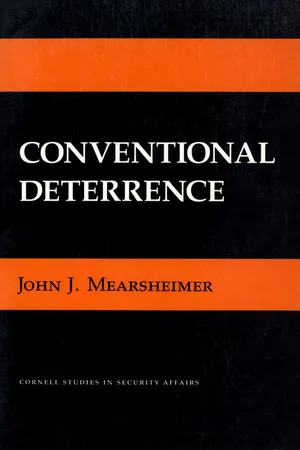
- 296 pages
- English
- ePUB (mobile friendly)
- Available on iOS & Android
eBook - ePub
Conventional Deterrence
About this book
Information
[1]
Introduction
Since the early 1960s the United States has increasingly relied on its conventional forces to deter Soviet aggression.1 American policy makers have frequently stressed the need to keep the nuclear threshold as high as possible. Their concern has influenced the North Atlantic Treaty Organization (NATO), which is now giving serious consideration to fighting only conventional battles not unlike those of the Second World War. There is also evidence that since the early 1970s the Soviets have been preparing for possible nonnuclear conflict in Europe.2
Nuclear weapons of course continue to play a role in deterring war in Europe and will do so as long as they remain available. Nevertheless, growing acceptance of the disutility of nuclear weapons for purposes of defense has brought greater interest in the conventional balance in recent years. The subject of conventional deterrence therefore seems to warrant greater scholarly attention. Specifically, we must address a very important question: When two large armies face each other in a crisis, as Warsaw Pact and NATO forces do in Europe, what factors determine whether or not a potential aggressor opts for war? What military considerations might lead the Soviets to launch a conventional attack against NATO?
A rich history of deterrence failures and ensuing conventional wars could be tapped to answer such questions. Little effort has been made to use it, although there are certainly some individual case studies. In addition, as we shall see, two existing theories of conventional deterrence are discernible, neither of which has been tested against particular crises. Still, no published study develops general propositions based on close examination of a number of past cases involving conventional deterrence. No one has attempted, for example, to compare the German decision to strike against the Allies in 1940 with the 1967 Israeli decision to attack in the Sinai. Such a comparison would indicate whether lessons from these important incidents might be applied to the NATO–Warsaw Pact balance. A sound theory of conventional deterrence would, of course, do more than shed light on present policy issues. It would also provide a key for understanding the outbreak of war in a number of important historical cases.
DEFINING THE TARGET
Deterrence, in its broadest sense, means persuading an opponent not to initiate a specific action because the perceived benefits do not justify the estimated costs and risks. Because the decision to fight is predicated on more than military considerations—on more than the calculation that a nation’s forces are capable of achieving their objectives on the battlefield3—other, nonmilitary factors also affect deterrence. If we assume that there is a broadly defined political benefit to be gained from successful military action, we must recognize that a host of factors act upon decision makers.4 More specifically, leaders must consider risks and costs of a nonmilitary nature. Decision makers might well assess the probable reaction of allies and adversaries, aspects of international law and possible reaction in a forum such as the United Nations, and the likely effect upon the economy. In short, deterrence broadly defined is ultimately a function of the relationship between the perceived political benefits resulting from military action and a number of nonmilitary as well as military costs and risks.
Given the difficulty, if not impossibility, of developing a theory that takes all of these elements into account, I must limit my study.5 I have chosen to focus first on the military considerations that underlie deterrence and second on the relationship between them and the perceived political benefits, omitting risks and costs that are nonmilitary in nature. I try to answer two questions. First, how are decision makers who are contemplating military action affected by the projected outcome on the battlefield? Second, what are the dynamics between these military considerations and the broader political forces that are propelling a nation toward war? I should emphasize that I make no attempt to analyze these political forces in detail.
There is a well-known distinction between deterrence based on punishment, which involves threatening to destroy large portions of an opponent’s civilian population and industry, and deterrence based on denial, which requires convincing an opponent that he will not attain his goals on the battlefield.6 Dean Acheson expressed this distinction aptly: “We mean that the only deterrent to the imposition of Russian will in Western Europe is the belief that from the outset of any such attempt American power would be employed in stopping it, and if necessary, would inflict on the Soviet Union injury which the Moscow regime would not wish to suffer” (emphasis added).7
Deterrence based on punishment is associated usually with nuclear weapons but sometimes with conventional weapons.8 Conversely, battlefield denial is usually linked with conventional forces, although one school of thought argues that nuclear weapons can and should be used on the battlefield.9 Conventional deterrence, as defined in this study, is a function of the capability of denying an aggressor his battlefield objectives with conventional forces. Thus I focus on the question: When two large armies face each other in a crisis, what military considerations are likely to lead one side to conclude that it can launch a successful military operation?
Conventional deterrence is directly linked to battlefield outcomes, and the term battlefield has a broad connotation. This study examines deterrence failures related to a specific type of conventional battlefield, one on which two large armies directly face each other and, if war breaks out, directly engage each other in a relatively large amount of space. My theory therefore does not apply to guerrilla conflict, such as the Vietnam War, or to episodes dominated by naval and air warfare, such as Pearl Harbor.
Further delimitation is necessary, however. Although conventional wars of the sort I just defined can be found throughout the course of history, my theory applies only to the modern—that is, armor-dominated—battlefield. I do not purport to explain the failure of deterrence before the Franco-Prussian War or World War I. My reasons for so restricting my scope are the following. The decision to go or not to go to war is based in part on specific considerations regarding the conduct of war. Now, the passage of time has brought some fundamental changes in this area. The battlefield at Jena (1806), where Napoleon’s forces soundly defeated the Prussian army, greatly differed from the battlefield at Sedan (1870), where the Prussians turned the tables and inflicted a decisive defeat on the French.10 At Jena, railroads were nonexistent, general staff systems were in their infancy, and the muzzle-loading flintlock musket with bayonet was the principal infantry weapon. By 1870, railroads and general staff systems figured importantly in warfare, and the breech-loading rifle, a revolutionary development at the time, had become the standard infantry weapon. Significant improvements had also been made in artillery. Strategy and tactics, as well as weaponry, had been greatly affected by the advances. In short, the conduct of war underwent a transformation in the sixty-four years between Jena and Sedan.
Such developments very much affect the detailed military calculations on which deterrence is based; the variables in the deterrence equation change with time. A policy maker considering war in 1939 faced problems very different from those confronting his counterparts in 1800. The point has been perhaps best articulated by Clausewitz, who wrote: “Every age had its own kind of war, its own limiting conditions, and its own peculiar preconceptions. Each period, therefore, would have held to its own theory of war, even if the urge had always and universally existed to work things out on scientific principles. It follows that the events of every age must be judged in the light of its own peculiarities.”11 This statement makes plain the difficulty of framing meaningful generalizations about conventional deterrence that apply to all periods of history. It is therefore necessary to determine what military calculations led to deterrence failures in a given era.12
I have chosen to concentrate on the period that extends from the end of World War I to the present. At the start of World War I, the tank did not exist, and none of the armies relied on motorized (wheeled) transport. European armies basically comprised foot-borne infantry and horse-drawn artillery. By the end of the conflict, both sides were deploying sizable numbers of mechanized (tracked) and motorized vehicles with their forces. That the introduction of new weapons, especially the tank, had fundamentally altered the conduct of war became clear only in the early stages of World War II, when the Germans over ran France in six weeks. The tank’s effect on the conventional battlefield will occupy us further in the next chapter.
Since World War II the nature of conventional war has remained essentially unchanged. Armaments (for example, tanks, artillery, attack aircraft), although more sophisticated today, remain basically the same; and today’s armies are organized along the same lines as those of World War II. Furthermore, theoreticians debate the same doctrines today that they did before and during the Second World War (for example, the importance of the tank relative to infantry and artillery; the relationship between close air support and ground forces). In short, the lessons of the recent past have broad application to the present.
The relevance of World War II for contemporary problems is not widely appreciated in the United States, partly because most civilian defense analysts know very little about military history.13 It is widely believed that nuclear weapons have disarmed the past for present purposes, removing the incentive to study it.14 In addition, the American military has not been strongly disposed to draw on its experience in earlier times.15 Such has not been the case, however, in other nations concerned with the prospect of fighting a conventional war. For example, the Israeli military places great stress on studying the campaigns of World War II,16 and the Soviets constantly emphasize the lessons of the Great Patriotic War.17 Strong threads bind the recent past with the present. This continuity permits us to generate propositions that are as relevant to the breakdown of deterrence in 1939 as they are to its failure in 1973 in the Middle East.
I am, of course, concerned not merely with the military considerations that underpin deterrence but also with the broader relationship between them and the perceived political gains. Generalizations about this relationship prove meaningful when applied to different periods of military history, making it worthwhile to examine the interaction between war and politics in connection with deterrence failures unrelated to the modern battlefield. Many of the problems associated with this more general level of warfare are not time bound, as are those that deal with the conduct of war.18 Clausewitz’s On War,which was written in the early 1800s, illustrates the point. The sections that deal with actual battlefield strategy and tactics are largely irrelevant today; On War offers few clues regarding battlefield denial. On the other hand, Clausewitz’s words on the basic nature of war and on the relationship between war and politics remain insightful and account for his book’s enduring greatness.
IMPLICATIONS FOR THEORY AND POLICY
Despite my self-imposed limitations, it will be evident to the reader that my scope encompasses a large number of very important historical cases: all the principal large-scale conventional wars of the past fifty years and a number of less important conflicts.
It may well be asked whether there is likely to be a fundamental shift in the nature of conventional war in the near future. We have no reason to expect one. This fact, coupled with the growing number of armies equipped with tanks and other mechanized vehicles, means that my theory of conventional deterrence will be relevant to future conflicts. It is also noteworthy that my theory can be used to evaluate present policy issues of two important sorts: the prospects for deterrence in regions where there is a possibility of a large-scale conventional war, and technical issues relating to military strategy and weaponry that affect deterrence. In short, my theory has broad application indeed.
THE DETERRENCE LITERATURE
Two subjects have received the lion’s share of scholarly attention in the literature. The first is nuclear deterrence between the superpowers,19 in particular that associated with specific targeting strategies. Analysts speak of concepts such as counterforce-damage limiting and mutual assured destruction. The nuclear deterrence literature, however, sheds little light on conventional deterrence.20 The second topic is the matter of the credibility of a promised response, which I term the credibility-of-commitment issue.21 The main reason for the great interest in this subject is that in the years since World War II the United States has sought to use its vast military power—both nuclear weapons and conventional forces—to deter conflicts in areas beyond its borders.22 Regardless of the character of the promised threat, the United States has frequently ...
Table of contents
- Preface
- 1. Introduction
- 2. Conventional Deterrence
- 3. The Allied Decision Not to Attack Germany, March 1939–May 1940
- 4. The German Decision to Attack in the West, 1939–1940
- 5. Conventional Deterrence and the Arab-Israeli Conflict
- 6. The Prospects for Conventional Deterrence in Central Europe
- 7. Precision-Guided Munitions and Conventional Deterrence
- 8. Conclusion
- Notes
- Select Bibliography
Trusted by 375,005 students
Access to over 1.5 million titles for a fair monthly price.
Study more efficiently using our study tools.
Frequently asked questions
Yes, you can cancel anytime from the Subscription tab in your account settings on the Perlego website. Your subscription will stay active until the end of your current billing period. Learn how to cancel your subscription
No, books cannot be downloaded as external files, such as PDFs, for use outside of Perlego. However, you can download books within the Perlego app for offline reading on mobile or tablet. Learn how to download books offline
Perlego offers two plans: Essential and Complete
- Essential is ideal for learners and professionals who enjoy exploring a wide range of subjects. Access the Essential Library with 800,000+ trusted titles and best-sellers across business, personal growth, and the humanities. Includes unlimited reading time and Standard Read Aloud voice.
- Complete: Perfect for advanced learners and researchers needing full, unrestricted access. Unlock 1.5M+ books across hundreds of subjects, including academic and specialized titles. The Complete Plan also includes advanced features like Premium Read Aloud and Research Assistant.
We are an online textbook subscription service, where you can get access to an entire online library for less than the price of a single book per month. With over 1.5 million books across 990+ topics, we’ve got you covered! Learn about our mission
Look out for the read-aloud symbol on your next book to see if you can listen to it. The read-aloud tool reads text aloud for you, highlighting the text as it is being read. You can pause it, speed it up and slow it down. Learn more about Read Aloud
Yes! You can use the Perlego app on both iOS and Android devices to read anytime, anywhere — even offline. Perfect for commutes or when you’re on the go.
Please note we cannot support devices running on iOS 13 and Android 7 or earlier. Learn more about using the app
Please note we cannot support devices running on iOS 13 and Android 7 or earlier. Learn more about using the app
Yes, you can access Conventional Deterrence by John J. Mearsheimer in PDF and/or ePUB format, as well as other popular books in Politics & International Relations & Military & Maritime History. We have over 1.5 million books available in our catalogue for you to explore.