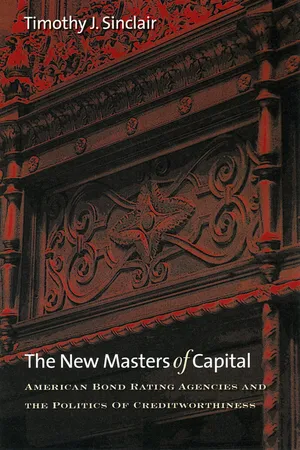
In The New Masters of Capital, Timothy J. Sinclair examines a key aspect of the global economy—the rating agencies. In the global economy, trust is formalized in the daily operations of such firms as Moody's and Standard & Poor's, which continuously monitor the financial health of bond-issuers ranging from private corporations to local and national governments. Their judgments affect unimaginably large sums, approximately $30 trillion in outstanding debt issues, according to a recent Moody's estimate. The difference between an AA and a BB rating may cost millions of dollars in interest payments or determine if a corporation or government can even issue bonds.Without bond rating agencies, there would be no standard means to compare risks in the global economy, and international investment would be problematic. Most observers assume that the agencies are neutral and scientific, and that they interpret their role in narrowly economic terms. But these agencies, by their nature, wield extraordinary power and exert massive influence over public policy. Sinclair offers a highly accessible account of these institutions, their origins, and the rating processes they use to judge creditworthiness. Illustrated with a wide range of cases, this book offers a fresh assessment of the role of an often-overlooked institution in the dynamics of modern global capitalism.
eBook - ePub
The New Masters of Capital
American Bond Rating Agencies and the Politics of Creditworthiness
- English
- ePUB (mobile friendly)
- Available on iOS & Android
eBook - ePub
The New Masters of Capital
American Bond Rating Agencies and the Politics of Creditworthiness
About this book
Information
CHAPTER ONE
Introduction
We live again in a two-superpower world. There is the U.S. and there is Moody’s. The U.S. can destroy a country by levelling it with bombs: Moody’s can destroy a country by downgrading its bonds.THOMAS L. FRIEDMAN, New York Times, 1995
Contemporary American power is obvious to the casual observer. If you want concrete evidence of U.S. superpower status, take a trip to southern Arizona. Outside the city of Tucson is AMARC, the USAF “boneyard,” the greatest collection of mothballed warplanes on Earth.1 If an airplane was a part of the American war machine during the past thirty years you will probably find it here, patiently awaiting its fate in the blazing Sonoran desert sun, together with some three thousand others. In this place, B-52 Stratofortresses, like those that dropped bombs on Vietnam, Afghanistan, and Iraq, and which were held in readiness for nuclear retaliation during the Cold War, are broken up, their shattered fuselages and wings displayed for the benefit of Russian spy satellites documenting the fulfillment of Strategic Arms Reduction Treaty (START) obligations. A-10 Thunderbolt IIs, the venerable “Warthog” tank-busters of Gulf Wars I and II, now expected to be in the USAF inventory until 2028, stand row upon row in the searing desert heat, quietly awaiting redeployment. Other “hogs,” based at nearby Davis-Monthan Air Force Base, fly low overhead, silently circling the University of Arizona campus. In this arsenal, the embodiment of a Tom Clancy or Don DeLillo novel, the basis of America’s superpower status could not be clearer.
But things are different when it comes to the “second superpowers,” the major bond rating agencies—Moody’s Investors Service (Moody’s), its competitor, Standard & Poor’s (S&P), the smaller and less important Fitch Ratings (Fitch), and the multitude of minor domestic rating agencies around the globe. They operate in a very different world. Their arsenal is an occult one, largely invisible to all but a few most of the time.2 Financial stress expands the size of the group aware of the agencies: in 2002, Europe had its highest-ever level of defaults, up to $15 billion from $4 billion in 2001. To the people directly concerned with matters of financial health—chief financial officers, budget directors, Treasury officials, and increasingly even politicians—rating agencies are well known.3 In this book the world of these second superpowers is explored: the basis of their power, the nature of their authority in financial markets, and implications of their judgments for corporations, municipal governments, and sovereign states.
In examining this world, I argue that rating agency activities reflect not the “correctness” or otherwise of rating analyses but instead the store of expertise and intellectual authority the agencies possess. Market and government actors take account of rating agencies not because the agencies are right but because they are thought to be an authoritative source of judgments, thereby making the agencies key organizations controlling access to capital markets. It is the esteem enjoyed by rating agencies—a characteristic distributed unevenly in modern capitalism—that this book explores, rather than whether agency ratings are actually valid.
A further claim made here is that this consequential speech has semantic content or meaning. That content, developed within the framework of rating orthodoxy delineated in chapter 3, is not purely technical but is linked to social and political interests. Although it is tempting to suggest that those interests are not related to location, the American origins of the rating agencies are relevant.
Changes on Wall Street and in other global financial centers increased the significance of Moody’s and S&P during the 1990s. The destruction of the World Trade Center in 2001 did not reverse this trend.4 Since the terrorist attacks, international trade and financial transactions have increased.5 The broad context for the increased role of rating is the process of financial globalization that began in the 1970s.
Financial globalization encompasses worldwide change in how financial markets are organized, increases in financial transaction volume, and alterations in government regulation. As discussed here, the concept is more comprehensive than Armijo’s specification of financial globalization as “the international integration of previously segmented national credit and capital markets.”6 In financial globalization, markets are increasingly organized in an “arms length” way. Institutions that once dominated finance and were politically consequential, as a result, now have other roles.
Cross-border transactions have, of course, massively increased since capital controls were liberalized in most rich countries during the late 1970s and 1980s. The regulation of financial markets has also changed form since then. Though increasingly detailed, regulation is typically implemented by market actors. Government agencies create and adjust the self-regulatory framework as circumstances merit. In this environment, new financial products and strategies emerge frequently. Market volatility is associated with these developments, as is a sense that governments themselves are increasingly subject to the judgments of speculators and investors.
The changes in market organization have been significant. Commercial banks used to be the institutions that corporations, municipalities, and national governments sought out in order to borrow money. Today, in a process known as disintermediation, bonds and notes sold on capital markets are displacing traditional bank loans as the primary means of borrowing money. In a related process, securitization, mortgages, credit card receivables, and even bank loans are being transformed into tradeable securities that can be bought and sold in capital markets. This does not mean banks are of little importance in global financial markets. It means that judgments about who receives credit and who does not are no longer centralized in banks, as was the case in the past.
Over the past decade, the liberalization of financial markets has made rating increasingly important as a form of private regulation.7 States have had to take account of private sector judgments much more than in the heavily controlled post-war era.8 Liberalization of the financial markets have also increased exposure to risk and therefore the importance of information, investigation, and analysis mechanisms. Outside the rich countries, liberalization has been pursued by developing-country governments in Asia and Latin America that have sought to create local capital markets to finance investment in new infrastructure and industrial production. The importance of these new markets is that their operatives want information about the creditworthiness of the corporations and governments that seek to borrow their money. As things stand, market operatives get some of this information, in the form of bond ratings, from Moody’s and S&P.
The two major U.S. rating agencies pass judgment on around $30 trillion worth of securities each year.9 Of this $30 trillion, around $107 billion worth of debt issued by 196 bond issuers was in default in 2001—a figure up sharply from 2000, when 117 issuers defaulted on $42 billion.10 Ratings, which vary from the best (AAA or “triple A”) to the worst (D, for default), affect the interest rate or cost of borrowing for businesses, municipalities, national governments, and, ultimately, individual citizens and consumers. The higher the rating, the less risk of default on repayment to the lender and, therefore, other things being equal, the lower the cost to the borrower. Rating scales are described in more detail in chapter 2.
The phenomenon investigated here is usually thought of as a technical matter. But this is largely a nontechnical book. An accurate, meaningful understanding of bond rating requires a broader view than the technical, just as an understanding of war cannot be limited to the analysis of military maneuvers or logistics. Hence, this book considers not just how ratings are done but also the purposes attributable to the rating process, the power and authority of the agencies, the implications of rating judgments, and the problems that may bring change to the world of ratings.
Widespread misunderstandings exist about the way capital markets and their institutions work and shape the world. These markets are complex and seemingly arcane. The amount of money involved is titanic and likely awesome to all but the richest inhabitants of the planet. Many think these markets shape economic and political choices in an objective way, much as the laws of physics shape the universe.11 But the unqualified influence of markets and market institutions in recent years has not always been evident. For a time, during the New Deal era of the 1930s and the years of postwar prosperity in the West, a greater degree of public control tempered these global forces. U.S. and other Western governments developed welfare programs and policy measures to insulate their populaces from the vagaries of capital markets. But the constraints, so the story goes, were artificial and, since the 1970s, have been challenged. Financial markets have again opposed the dictates of elected authorities and voters, to assume their “rightful place” in the scheme of things. Now, we are told by the popular and the scholarly press, there is no escaping these impersonal forces.
As an explanation of financial globalization, this sort of mechanistic view is not adequate. A technical understanding of the forces that constrain our economic and political choices is necessarily limited. This view assumes markets develop in ways beyond the influence of citizens, that people should simply allow things to take their “natural” course—financial globalization is inevitable. This is a key point. Much that is written about financial markets, even by people who recognize the political consequences of these markets, misses the fundamentally social character of what happens inside the markets and their institutions.12
The assumption in established texts is that markets reflect fundamental economic forces, which are not subject to human manipulation. But this view does not take account of the fact that people make decisions in financial markets in anticipation of and in response to the decisions of others.13 In this book, the social nature of global finance gets particular emphasis. The social view of finance suggests that in situations of increased uncertainty and risk, the institutions that work to facilitate transactions between buyers and sellers have a central role in organizing markets and, consequently, in governing the world.14 Financial markets are more social—and less spontaneous, individual, or “natural”—than we tend to believe.
The role of rating agencies is not mechanistically determined, either. Many financial markets survived and flourished in the past without them. Typically, banks assumed the credit risk in the relationship between those with money to invest and those wishing to borrow. Alongside banks, traditional capital markets relied on borrowers who were well known and trusted names in their communities. But rating has increasingly become the norm as capital markets have displaced bank lending and as the trust implicit in these older systems has broken down. Rating serves a purpose in less socially embedded capital markets, where fund managers are under pressure to demonstrate they are not basing their understanding of the creditworthiness of investment alternatives on implicit trust in names but use a recognized, accepted mechanism.
At least three other ways of doing the existing work of the rating agencies can be imagined. The first is self-regulation by debtors. Much like the professional bodies for physicians, architects, and lawyers, a debtor-based system of credit information could provide data to the markets. Although this system might not be independent, collective self-interest would mitigate the tendency to self-serving outputs, much as is the case with professional self-regulation. Second, nonprofit industry associations could undertake or coordinate creditworthiness work. Good precedents already exist in countries where non profits enforce some national laws, such as in the case of animal welfare. The non profit model offers to eliminate some conflict of interest tensions implicit in charging debtors for their ratings. Third, governments could collectively take on the job, perhaps in the form of a new international agency. The International Organization of Securities Commissions (IOSCO) is already involved in discussions about rating standards and codes of conduct.15 The World Bank, the International Monetary Fund (IMF), and regional development banks could encourage local rating agencies in emerging markets to issue ratings. Such an arrangement would be independent of particular debtors ...
Table of contents
- List of Tables and Figures
- 1. Introduction
- 2. Good, Bad, or Indifferent: The Emergence of Rating
- 3. Unconscious Power
- 4. Rating Corporations
- 5. Rating State and Local Governments
- 6. Global Growth of the Rating Business
- 7. Blown Calls: Rating Challenges and Crises
- 8. A New Constellation of Power
Trusted by 375,005 students
Access to over 1.5 million titles for a fair monthly price.
Study more efficiently using our study tools.
Frequently asked questions
Yes, you can cancel anytime from the Subscription tab in your account settings on the Perlego website. Your subscription will stay active until the end of your current billing period. Learn how to cancel your subscription
No, books cannot be downloaded as external files, such as PDFs, for use outside of Perlego. However, you can download books within the Perlego app for offline reading on mobile or tablet. Learn how to download books offline
Perlego offers two plans: Essential and Complete
- Essential is ideal for learners and professionals who enjoy exploring a wide range of subjects. Access the Essential Library with 800,000+ trusted titles and best-sellers across business, personal growth, and the humanities. Includes unlimited reading time and Standard Read Aloud voice.
- Complete: Perfect for advanced learners and researchers needing full, unrestricted access. Unlock 1.5M+ books across hundreds of subjects, including academic and specialized titles. The Complete Plan also includes advanced features like Premium Read Aloud and Research Assistant.
We are an online textbook subscription service, where you can get access to an entire online library for less than the price of a single book per month. With over 1.5 million books across 990+ topics, we’ve got you covered! Learn about our mission
Look out for the read-aloud symbol on your next book to see if you can listen to it. The read-aloud tool reads text aloud for you, highlighting the text as it is being read. You can pause it, speed it up and slow it down. Learn more about Read Aloud
Yes! You can use the Perlego app on both iOS and Android devices to read anytime, anywhere — even offline. Perfect for commutes or when you’re on the go.
Please note we cannot support devices running on iOS 13 and Android 7 or earlier. Learn more about using the app
Please note we cannot support devices running on iOS 13 and Android 7 or earlier. Learn more about using the app
Yes, you can access The New Masters of Capital by Timothy J. Sinclair in PDF and/or ePUB format, as well as other popular books in Economics & Bonds. We have over 1.5 million books available in our catalogue for you to explore.