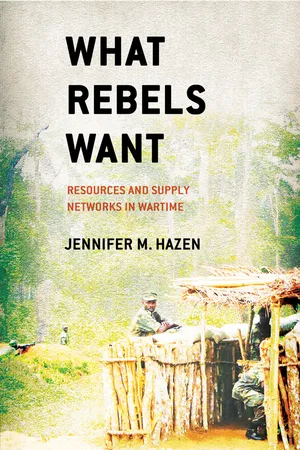
How easy is it for rebel groups to purchase weapons and ammunition in the middle of a war? How quickly can commodities such as diamonds and cocoa be converted into cash to buy war supplies? And why does answering these questions matter for understanding civil wars? In What Rebels Want, Jennifer M. Hazen challenges the commonly held view that rebel groups can get what they want, when they want it, and when they most need it. Hazen's assessments of resource availability in the wars in Sierra Leone, Liberia, and Côte d'Ivoire lead to a better understanding of rebel group capacity and options for war and war termination.Resources entail more than just cash; they include various other economic, military, and political goods, including natural resources, arms and ammunition, safe haven, and diplomatic support. However, rebel groups rarely enjoy continuous access to resources throughout a conflict. Understanding fluctuations in fortune is central to identifying the options available to rebel groups and the reasons why a rebel group chooses to pursue war or peace. The stronger the group's capacity, the more options it possesses with respect to fighting a war. The chances for successful negotiations and the implementation of a peace agreement increase as the options of the rebel group narrow. Sustainable negotiated solutions are most likely, Hazen finds, when a rebel group views negotiations not as one of the solutions for obtaining what it wants, but as the only solution.
- 216 pages
- English
- ePUB (mobile friendly)
- Available on iOS & Android
eBook - ePub
About this book
Information
Subtopic
Military & Maritime HistoryIndex
History1
NEVER-ENDING WARS
Explaining Conflict Duration
One notable characteristic of civil wars is their duration. The length of civil wars steadily increased in the post–cold war period, reaching an average of sixteen years in 1999.1 Despite the decline in the number of active civil wars since the mid-1990s, duration has not decreased. Instead, many of the ongoing conflicts in 2009 were “unusually protracted.”2 Several civil wars have lasted more than a decade. Some of these wars ended after years of fighting, most often through some form of a negotiated solution; others, such as those in Colombia and Burma, continue today with no end in sight. In most civil wars, the balance of power fluctuates between the fighting factions, with victories gained and losses suffered by all sides. Most conflicts experience some form of external intervention aimed at reaching a peace settlement and, in most cases, numerous attempts to negotiate a peace. The persistence of civil wars in the face of perceived high costs and numerous efforts at negotiation raises important questions about the intractable nature of civil wars and whether external parties can play a successful role in ending them peacefully.
There are primarily two outcomes in conflict: military and political. The former tends to involve the military victory of one party; the latter is a compromise solution negotiated between parties. The continuation of fighting is also a possibility, though not one that would normally be described as an outcome. In fact, if we assess conflicts on a yearly basis, the continuation of conflict does appear more common than the termination of conflict through either military victory or political compromise. Part of the explanation is that conflicts often get trapped between the polar ends of onset and termination. Although conflicts have often been described as passing through stages, from onset to escalation to termination to peace building, such a linear progression is rare. Instead, conflicts involve numerous attempts at negotiations, cease-fires, and signed peace agreements, as well as frequent returns to active fighting. Negotiations and peace talks took place over the years during wars in Sudan, Liberia, the Democratic Republic of Congo, Sri Lanka, Nepal, and Colombia. Sierra Leone parties agreed to three different peace agreements during the war, as well as several cease-fires. Despite these various efforts at resolution, the wars persisted.3
Explanations for the intractability of civil war abound, each pointing to particular obstacles to peace.4 There are those that emphasize group goals and balances of power, explaining war through irreconcilable preferences, indivisible goals, asymmetries of power, and security dilemmas. Other explanations focus on perceptions and motivations, focusing on greed, uncertainty, fear, misperception, and the belief that victory is possible. There is limited agreement on which of these factors is important, under which circumstances, and whether such factors should be weighted more heavily than others. Other explanations stress the role of spoilers, the contents of the peace agreement, the enforceability of a peace agreement, and so on. There is no clear, single answer in the literature why a rebel group chooses to continue fighting a war rather than seek a negotiated end. Each of these explanations finds supporting evidence in the case study literature and therefore cannot be easily dismissed, though generalizability can be questioned and utility in explaining particular cases may be limited. The following discussion highlights the most common explanations for conflict duration.
Irreconcilable Differences
The existence of incompatible goals among fighting factions can limit the options available for negotiation. Such incompatibilities are often depicted as indivisible and inherent characteristics of particular groups, such as ethnicity, religion, and identity.5 Common examples include the wars in Rwanda and Burundi between Hutu and Tutsi and the Balkan wars between Muslims, Serbs, and Croats. The characteristics of these populations are considered set identities that are neither negotiable nor easily divisible. In such situations, conflict can appear to be zero-sum in nature with any victory by one side perceived as a defeat by the other. Negotiations can threaten the survival of a particular group if they center on defining a state based on criteria that do not include the threatened group or that force the group to assimilate to the defined state culture, as is the fear, for instance, of those involved in the Muslim insurgency in southern Thailand. The threatened group is unlikely to agree to negotiations when political discussions offer no possibility of maintaining the group’s identity. Under such conditions the conflict will continue until one side wins or a solution acceptable to all sides can be found.
Despite being labeled deep-rooted or irreconcilable, identity conflicts are not immune to negotiated settlements. The notion of ancient hatreds between groups that can never be resolved suggests the only option is to let groups resolve their differences through violence. Another option is to enable the secession of a particular ethnic group. Secession is rare and not largely supported by the international community, but it has happened.6 Examples include the 2011 referendum for the independence of south Sudan, the independence of East Timor from Indonesia, and the dissolution of larger composite states into their component parts, as happened in Yugoslavia, the Soviet Union, and Czechoslovakia. Unless protections are put in place, however, secession does not guarantee an end to conflict. Secession can simply replace an internal border that keeps groups apart with an international one, without resolving the underlying grievances and thereby risking the evolution of an intrastate conflict into an interstate one, as in the cases of Ethiopia and Eritrea, and Sudan and the newly created Republic of South Sudan. Secession often leads to members of the minority group being left behind in the original state while members of the majority group are subsumed, as minorities, under the breakaway state, as was the case for Serbs living in the Krajina region of Croatia and in Kosovo. This provides constant fodder for conflict between the groups, even if an international border separates them. It may prove difficult to convince minority populations to move their lives from one area of a country to another, even if this means remaining with their group. Separating groups based on their claimed identity certainly poses logistical challenges and raises moral questions about what to do with those who do not move or who are forced to move. Another possible solution suggests that negotiated settlements can provide clear measures that explicitly protect the threatened group(s). Commonly this entails offering some form of autonomy, minority protection, and/or a minority veto to protect the minority group. In Papua New Guinea, autonomy for Bougainville contributed to ending the conflict there. In other cases, autonomy has not been explicitly granted through negotiation but through recognition of areas as autonomous by the central government as a way of reducing tensions, though not resolving the underlying crisis, as in Abkhazia in Georgia and Trans-Dniester in the Republic of Moldova.
Ruling governments are not always willing to acknowledge the rights of minority groups or fighting factions. In many cases they are portrayed as criminals, insurgents, or terrorists in an effort to discredit the group’s grievances and rule out the possibility of negotiations. Few governments publicly agree to negotiate with criminals or terrorists. The labeling of the Revolutionary Armed Forces of Colombia (FARC) as first narcotraffickers and then terrorists has created stumbling blocks to negotiations. Getting beyond the labels, which are often applied by the ruling power but not necessarily accepted by the opposition group, requires an acceptance of the legitimacy of the group’s demands, or at least the grievances claimed.7 Few governments are willing to accept such groups as legitimate political actors, refusing to negotiate at what is perceived to be the barrel of a gun. In Côte d’Ivoire the international mediators agreed that the rebels had legitimate grievances but refused to grant them political status to negotiate. This presents moral, and sometimes legal, challenges to external actors seeking negotiated solutions. Certainly the same standard is not always applied, with the international community bestowing legitimacy on some rebel groups through encouraging negotiations, while denying political status for others by continuing to support military campaigns to annihilate them. Such a comparison is readily seen in the international support for the Libyan rebel group in 2011, which entailed purchasing oil and providing military goods in contravention to UN sanctions, versus the United States’ support for the Ugandan military in its efforts to eliminate the Lord’s Resistance Army. Often the international community does not act with one voice, and member states take different stances toward the fighting factions, thereby creating a balance of power among the fighting factions or simply reducing the external pressure for resolution. Neither situation is conducive to negotiations.
Even conflicts over political power and economic wealth can seem intractable. These situations are not inherently intractable—political and economic power can be divided—but when such power is perceived in zero-sum terms, rather than as divisible goods, parties to the conflict will resist resolution unless the settlement favors their position. Solutions are possible but difficult to achieve. They require groups to agree to some model for sharing power and wealth.8 If a group is negotiating from a strong position, it is unlikely to be interested in a deal that provides only a fraction of the total, especially if the group believes victory is still possible and that winning entails access to power and wealth without compromise.
Asymmetry
A mutually hurting military stalemate—a situation in which parties to the conflict cannot afford to continue a stalemate and must seek an end to active fighting—is widely believed to be the best context for negotiations. The situation forces both sides to the bargaining table because they no longer have the option of continued fighting. Yet mutually hurting stalemates are rare. Civil wars are rarely characterized by symmetry of power between the government and the rebel group(s).9 Instead, asymmetry, reflected in differences in capacity, interests, and resources, is far more common.10
Asymmetry between a rebel group and the government can take a variety of forms: balance of power, level of commitment, scale of organization, and degree of legitimacy.11 There are commonly imbalances in information as well, contributing to misperception about the other side’s capacity. These asymmetries often result in different levels of engagement in the war by the factions. For example, governments that view rebellions as nuisances rather than threats to the state might pay less attention and contribute fewer resources to the war effort. The Sierra Leone government initially viewed the Revolutionary United Front (RUF) as a localized rebellion that would be easily put down by the military, not as a serious threat to the state. Rebel groups who see war as the only way to achieve their goals, especially ideological victory, might be far more committed to the fight than the government, despite lacking sufficient resources to wage large-scale war. The persistence of Sendero Luminoso in Peru and the Muslim insurgency in Thailand attests to the willingness of factions to continue fighting, albeit often at lower levels of intensity, despite overwhelming odds. Given the different types of asymmetry and the difficulty in measuring factors such as commitment and legitimacy, it remains unclear how to measure the advantages that asymmetries provide to any one faction. This is especially true when trying to make an assessment in real time; hindsight provides both better information and perspective. What is clear, however, is that asymmetry is common, symmetry is not, and asymmetry is widely believed to be less conducive to negotiations.
Several problems arise in attempting to pursue negotiations in asymmetric contexts. The side with the advantage may see no reason to negotiate because it has the upper hand and would prefer to seek victory than compromise. The stronger side may make demands the other side cannot or will not meet. Asymmetries can provide advantages to a faction, which reinforce the belief that victory is possible, thereby decreasing a gr...
Table of contents
- Preface
- Introduction
- 1. Never-Ending Wars: Explaining Conflict Duration
- 2. Resources, Options, and Preferences in War
- 3. Sierra Leone Rebels: The Revolutionary United Front
- 4. Liberia’s Rebels: LURD and MODEL
- 5. Côte d’Ivoire: From the MPCI to the Forces Nouvelles
- Conclusion
Trusted by 375,005 students
Access to over 1.5 million titles for a fair monthly price.
Study more efficiently using our study tools.
Frequently asked questions
Yes, you can cancel anytime from the Subscription tab in your account settings on the Perlego website. Your subscription will stay active until the end of your current billing period. Learn how to cancel your subscription
No, books cannot be downloaded as external files, such as PDFs, for use outside of Perlego. However, you can download books within the Perlego app for offline reading on mobile or tablet. Learn how to download books offline
Perlego offers two plans: Essential and Complete
- Essential is ideal for learners and professionals who enjoy exploring a wide range of subjects. Access the Essential Library with 800,000+ trusted titles and best-sellers across business, personal growth, and the humanities. Includes unlimited reading time and Standard Read Aloud voice.
- Complete: Perfect for advanced learners and researchers needing full, unrestricted access. Unlock 1.5M+ books across hundreds of subjects, including academic and specialized titles. The Complete Plan also includes advanced features like Premium Read Aloud and Research Assistant.
We are an online textbook subscription service, where you can get access to an entire online library for less than the price of a single book per month. With over 1.5 million books across 990+ topics, we’ve got you covered! Learn about our mission
Look out for the read-aloud symbol on your next book to see if you can listen to it. The read-aloud tool reads text aloud for you, highlighting the text as it is being read. You can pause it, speed it up and slow it down. Learn more about Read Aloud
Yes! You can use the Perlego app on both iOS and Android devices to read anytime, anywhere — even offline. Perfect for commutes or when you’re on the go.
Please note we cannot support devices running on iOS 13 and Android 7 or earlier. Learn more about using the app
Please note we cannot support devices running on iOS 13 and Android 7 or earlier. Learn more about using the app
Yes, you can access What Rebels Want by Jennifer M. Hazen in PDF and/or ePUB format, as well as other popular books in History & Military & Maritime History. We have over 1.5 million books available in our catalogue for you to explore.